
Ali Raza Momand
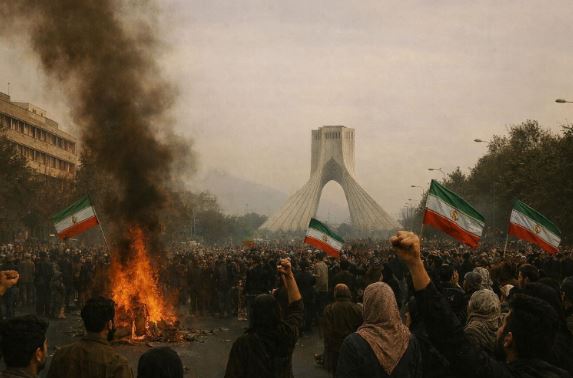
The Middle East once again finds itself at a delicate geopolitical moment, with Iran occupying the center of regional strategic calculations. For decades, tensions between Iran on one side and the United States and Israel on the other have shaped the region’s security environment. Today, analysts increasingly debate whether the pressure on Tehran is evolving from long-term containment toward a more accelerated strategy aimed at weakening or transforming the Iranian political system.
Unlike earlier approaches that relied primarily on sanctions and diplomatic isolation, contemporary strategic thinking appears to emphasize a more calibrated approach. Rather than triggering a direct large-scale war, external pressure on Iran could unfold gradually, combining internal political pressure, technological warfare, and limited military actions. The objective of such an approach would be to weaken the Iranian state while avoiding a sudden regional escalation that could draw in other global powers.
Iran’s strategic importance explains why any confrontation involving the country carries global implications. With a population of nearly 90 million and some of the world’s largest reserves of oil and natural gas, Iran remains a critical player in global energy markets and regional security.
Despite decades of sanctions, Tehran has maintained significant political influence across the Middle East through diplomatic ties and regional alliances.
Because of these realities, analysts argue that any effort aimed at destabilizing Iran would likely unfold in phases rather than through a conventional invasion. The first stage would involve intensifying internal pressure. Economic hardship, political dissatisfaction, and tensions among various ethnic communities could become focal points of instability. In such a scenario, cyber operations, covert influence campaigns, and limited strikes on strategic facilities might be used to undermine confidence in the central government without immediately triggering a full-scale conflict.
The second phase could involve intensified military pressure once internal strains begin to weaken state authority. However, modern conflict would likely remain largely aerial and technological.
Missile strikes, drone warfare, cyber attacks, and targeted sabotage of key installations would dominate the battlefield. Over the past two decades Iran has significantly expanded its missile and drone capabilities, creating a deterrent designed to discourage direct intervention by adversaries.
The ultimate objective of such pressure, according to many observers, would be political transformation in Tehran. Yet the history of regime-change efforts in the Middle East demonstrates that outcomes rarely unfold as planned. The experiences of Iraq after 2003 and Libya after 2011 illustrate how the collapse of centralized authority can lead to prolonged instability rather than immediate political reform.
From Iran’s perspective, therefore, survival itself represents strategic success. Iranian leadership is likely to respond through a combination of internal consolidation, diplomatic outreach, and military deterrence. Domestically, Tehran may attempt to maintain stability through strict security measures while simultaneously offering limited political accommodation to groups willing to operate within the system.
On the diplomatic front, Iran may seek to strengthen its narrative within the Muslim world by linking its position to the broader Palestinian issue and presenting itself as a defender of regional sovereignty against foreign intervention. At the same time, improving relations with European states and reviving negotiations over its nuclear program could help Tehran ease international isolation and reduce pressure.
Nevertheless, Iran’s strategic environment is complex. Two major conflicts already dominate its broader neighborhood: the Russia–Ukraine war and ongoing tensions in South Asia. Russia’s deep involvement in Ukraine limits its ability to openly support Tehran, while China must carefully balance its strategic partnership with Iran against its extensive economic ties with Arab states in the Gulf.
The stakes extend far beyond Iran itself. If Tehran manages to withstand sustained external pressure, it could emerge more militarized and more determined to strengthen its deterrence capabilities. Conversely, if Iran were to descend into state collapse, the consequences could be severe for the entire region. A breakdown of state authority could trigger refugee flows, economic disruption, and the resurgence of militant groups similar to those that emerged after the Iraq conflict.
For this reason, many observers argue that the international community—particularly global institutions and European diplomacy—should prioritize de-escalation. Preventing a wider conflict may ultimately serve the interests of all regional and global actors. In geopolitics, survival often defines victory. For Iran, enduring the current pressures may prove more decisive than any battlefield triumph, while for the region the real success would lie in avoiding another prolonged and destabilizing war.
Ali Raza Momand, Assistant Professor of Political Science at Higher Education Department Government of Khyber Pakhtunkhwa Pakistan.
Email: [email protected]