
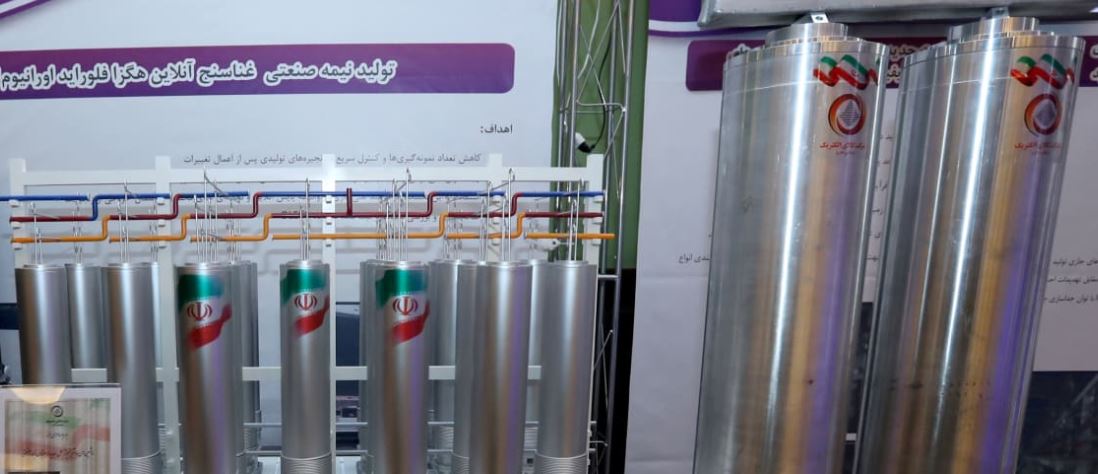
TEHRAN, MAY 26: In the ongoing US-Iran ceasefire negotiations, Iran may consider transferring its 60% enriched uranium to China. The uranium currently lies beneath the rubble of bombed nuclear facilities, but it has the potential to be quickly weaponized.
Multiple media have carried similar reports, and China has not denied them, while a response from its Foreign Ministry seems to leave the possibility open.
In response to a question at a press conference on Tuesday, the Chinese Foreign Ministry responded: “Since the outbreak of the war between the United States, Israel, and Iran, China has maintained close communication with all relevant parties, including Iran, and has been working tirelessly to stop the fighting and promote peace.”
Advertisement
“We will continue to uphold the spirit of President Xi Jinping’s four-point proposal and play a positive role in restoring peace and tranquility to the Middle East and the Gulf region as soon as possible,” the ministry continued.
Next, it stated, “Regarding the Iranian nuclear issue, we have consistently supported the peaceful resolution of the Iranian nuclear issue through dialogue and negotiation, and hope that all relevant parties can seize the opportunity to reach a solution that takes into account the legitimate concerns of all parties through negotiations.”
Chinese President Xi Jinping attends the opening session of the Chinese People’s Political Consultative Conference (CPPCC), at the Great Hall of the People in Beijing, China March 4, 2026.
Chinese President Xi Jinping attends the opening session of the Chinese People’s Political Consultative Conference (CPPCC), at the Great Hall of the People in Beijing, China March 4, 2026. (credit: REUTERS/FLORENCE LO)
Chinese Foreign Ministry agrees to play role in Iran nuclear issue
Most critically, the ministry said, “We are also willing to continue to play a constructive role in the political and diplomatic resolution of the Iranian nuclear issue, safeguard the international nuclear non-proliferation regime, and promote peace and stability in the Middle East and the world.”
It is unclear whether Iran’s latest raising of the China option as a transfer destination for its 60% enriched uranium is its true desired position in light of the overall negotiations context, or an attempt to probe and press the US on the issue.
Under the 2015 Obama nuclear deal – almost all of Iran’s medium and low enriched uranium at 20%, 5%, and 3.67%, potentially enough for around 10 nuclear weapons – was transferred to Russia.
However, since then, the level of trust between the US and Russia has dropped significantly.
US, Russia nuclear agreements lapse
In 2015, the US and Russia had a substantial series of bilateral nuclear arms agreements in place, which mandated several foreign teams being present at each other’s nuclear facilities to ensure the parties’ joint obligations were being kept.
During the first Trump administration of 2017-2021, some of these deals lapsed, and the rest lapsed after Moscow’s invasion of Ukraine, which led to the cratering of American-Russian relations.
Washington and Beijing have never had the same kind of mutual nuclear inspections of each other’s facilities, and both parties are suspicious of the other stealing technology or spying on each other as they have entered an extended period of great power competition.
Accordingly, it is unclear whether the US would accept such a transfer without guarantees from Americans or IAEA UN nuclear inspectors having ongoing and indefinite access to and supervision of the nuclear material in China.
The removal or permanent dilution of the 60% enriched uranium is one of the main goals of the current US-Iran negotiations and Tehran’s refusal or slow move to agree to resolve the issue was one of the primary reasons leading to Israel’s attacks on Iran in June 2025 (with a smaller US contribution toward the end of that war) and the US and Israel’s attacks on Iran in 2026.