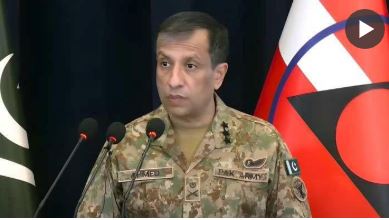
RAWALPINDI, JAN 6: Reviewing the security situation across the country, particularly over the previous year, Inter-Services Public Relations (ISPR) Director-General Lieutenant General Ahmed Sharif Chaudhry has said that Khyber Pakhtunkhwa (KP) is the worst-affected province by terrorism due to a “political-criminal-terror nexus”.
Addressing a press conference to brief the media on the current security situation and other key matters on Tuesday, Lt Gen Chaudhry said that nearly 71% of terrorist incidents occurred in Khyber Pakhtunkhwa.
“The primary reason for this is a politically conducive environment and the flourishing political-criminal-terror-nexus which is flourishing there,” he said.
In his opening remarks, the military’s spokesperson said that the purpose of the media briefing was to give a comprehensive overview of counter-terrorism measures taken in the past year.
Providing details of counterterrorism efforts in 2025, the ISPR chief said that law enforcement agencies carried out 75,175 intelligence-based operations (IBOs) across the country.
Giving a breakdown, he said 14,658 IBOs were conducted in Khyber Pakhtunkhwa, 58,778 in Balochistan, while 1,739 operations took place in the rest of the country.
Lt Gen Chaudhry said that 5,397 terrorism incidents were reported nationwide during the last year. Of these, 3,811 incidents, he said, occurred in Khyber Pakhtunkhwa, 1,557 in Balochistan, and 29 incidents were reported in other parts of the country.
He said that 2,597 terrorists were killed during counterterror operations last year.
“Afghanistan has become the centre of terrorist operations in the region,” he said while explaining the factors behind terrorism.
Reiterating the resolve to curb the menace of terrorism, he said: “We have to win the war against terrorism at all costs”.
“We have to win this war with strength.”
Addressing the hostilities with Afghanistan, the ISPR chief said that the Afghan Taliban regime had attacked Pakistani border posts, following which, “whatever was needed was done, and a hard message was given”.
“In the last three months, we have closed the borders. There are many signs here for those who see and understand.”
Noting that Islamabad targeted terrorists at the Afghan border in October 2025, and “dozens of Afghan posts were eliminated within hours”.
“We targeted the TTP, not TTA,” said Lt Gen Chaudhry.
Recalling the Doha agreement, the 2020 US-Taliban peace deal, he recalled that the Afghan Taliban had assured that terrorism would be eradicated from the Afghan soil.
However, he lamented, the neighbouring country remains a stronghold of Fitna al-Khawarij and Fitna al-Hindustan.
All terrorist organisations are based in Afghanistan, and are being nurtured there, he said.
While providing details of 10 major terror attacks across the country, he said that civilians and soft targets had been deliberately targeted, and Afghan militants were involved in all attacks.
“We have evidence of the presence of all terrorists… where they are and where they operate,” he said.
During the press briefing, video confessions of arrested terrorists were also played.
Lt Gen Chaudhry said 21 civilians were martyred in the Jaffar Express attack, adding that the incident would never fade from the memory of Pakistanis.
He further stated that a civilian bus was also targeted in Noshki, while an attack on the Frontier Corps headquarters in Quetta resulted in the martyrdom of eight civilians.
“The attack on the FC headquarters in Quetta was carried out by Afghans,” the ISPR DG said, adding that a similar attack had taken place on the FC headquarters in Peshawar in November.
Referring to an attempted attack on Cadet College Wana in November, the ISPR DG said Afghan terrorists had tried to replicate the 2014 APS Peshawar attack.
“This is a war of the nation, a war of every single child,” he said, rejecting a narrative portraying the fight against terrorism as solely the military’s responsibility.
“A narrative is built, suggesting this is the army’s war. This is not true,” Lt Gen Chaudhry added.