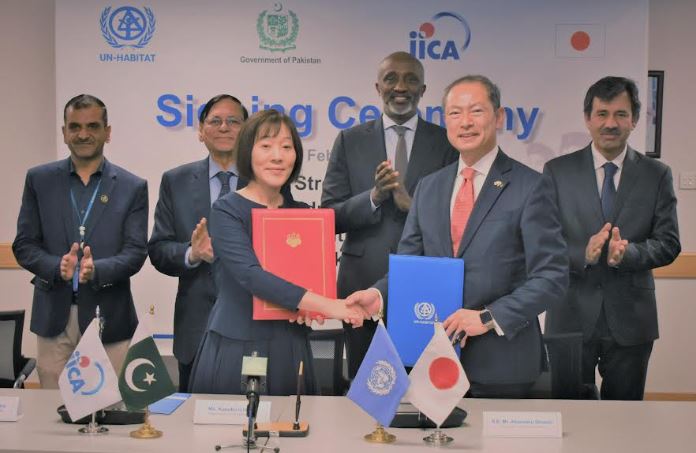
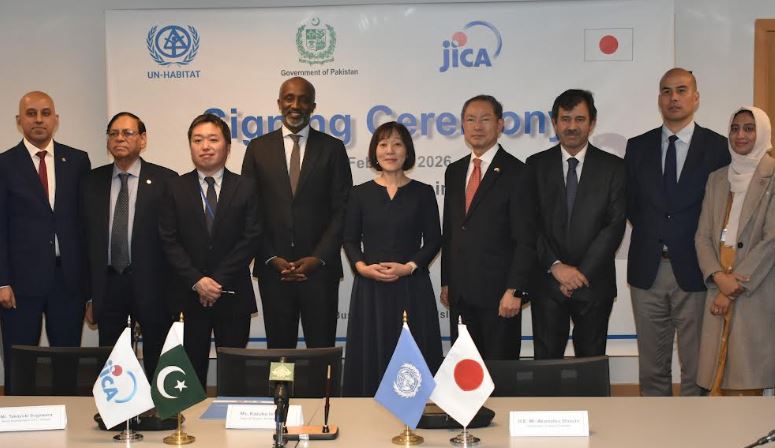
ISLAMABAD, FEB 11 /DNA/ – The Government of Japan, the United Nations Human Settlements Programme (UN-Habitat) and the Japan International Cooperation Agency (JICA) signed an Exchange of Notes and a Grant Agreement during a signing ceremony held on 11 February 2026, for the project on ’Strengthen the disaster resilience of educational infrastructure in Khyber Pakhtunkhwa Province’. The initiative is supported through a grant of JPY 427 million, equivalent to approximately USD 2.7 million, from the Government of Japan.
Due to the geographical characteristics, Khyber Pakhtunkhwa is prone to climate‑driven hazards. The 2025 cloudbursts and flash floods damaged 437 schools, severely disrupting education services especially in Swat and Buner among the hardest-hit districts. The grant will support the rehabilitation and retrofitting of schools damaged by the 2025 floods in Swat and Buner districts. The project aims to restore safe, resilient and functional learning environments by strengthening school structures and improving ventilation and lighting. It will also reinstate gender-sensitive WASH facilities, ensuring dignity, privacy and accessibility for girls and children with disabilities.
Speaking at the signing ceremony, the Ambassador of Japan to the Islamic Republic of Pakistan, H.E. Mr. Akamatsu Shuichi, appreciated the collaborative partnership and reaffirmed Japan’s continued support to Pakistan’s resilience agenda. Ambassador Akamatsu emphasized that strengthening school infrastructure is a critical investment in protecting children and ensuring continuity of education in the face of climate induced disasters.
Ms. Kazuko Ishigaki, Regional Director for Asia and the Pacific, UN-Habitat, highlighted UN-Habitat’s leadership in delivering safer learning environments. She noted that the retrofitted schools will provide structurally stable classrooms, improved ventilation, and essential WASH services, enabling children to learn with confidence, safety and dignity. By positioning schools as hubs for disaster preparedness and response, the project will extend preparedness and first-aid benefits to surrounding communities, strengthening local resilience and emergency response capacities.
Mr. Sugawara Takayuki, Senior Representative of JICA, emphasized that this project addresses the JICA’s approach to disaster risk reduction principally by“Promoting Build Back Better”.He mentioned that JICA promotes this concept to ensure that the country as a whole including the affected areas can rebuild in a way that is more resilient to future disasters. It is crucial not to repeat the same damage in a similar disaster to ensure sustainable economic and social development.
Mr. Mohamed Yahya, United Nations Resident and Humanitarian Coordinator, expressed appreciation to the Government of Japan and JICA for their partnership with Pakistan and the United Nations. He highlighted that the initiative aligns with the UN Sustainable Development Cooperation Framework and supports Pakistan’s implementation of the Sendai Framework, advancing resilience for the most vulnerable communities.
Through the construction and rehabilitation of disaster-resilient schools, along with the provision of disaster resilience training, this collaborative effort will contribute to the implementation of the Sendai Framework by reducing loss of life, the number of people affected, and economic damage caused by natural disasters, while advancing human security in flood-affected communities.