
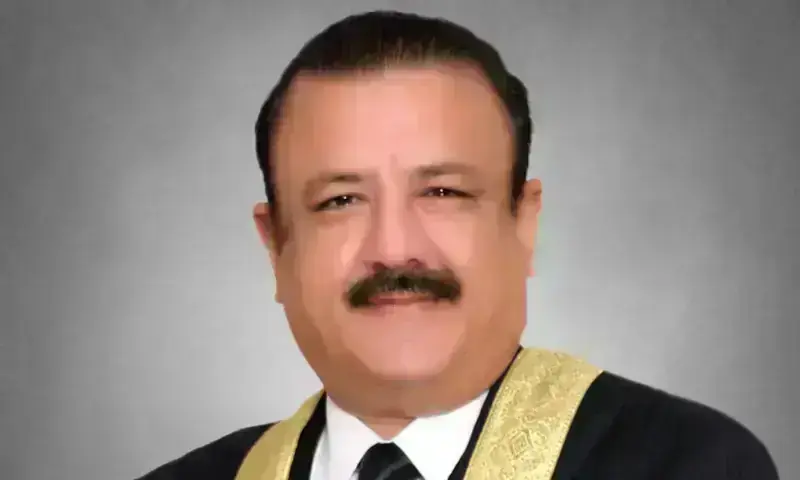
ISLAMABAD, DEC 15 /DNA/: Justice Tariq Mehmood Jahangiri appeared before the Islamabad High Court (IHC) as a defendant on Monday in a case that centres on a plea challenging the legitimacy of his law degree and appointment as a judge.
The controversy surrounding the IHC judge’s law degree originated from a letter that began circulating last year on social media, purportedly from the University of Karachi’s (KU) controller of examinations.
Subsequently, a complaint pertaining to his allegedly fake degree was submitted to the Supreme Judicial Council — the the top forum for judicial accountability that probes allegations of misconduct against judges — last year in July while a petition challenging his appointment was also filed in the IHC earlier this year by lawyer Mian Daud.
A two-member IHC bench, comprising Chief Justice Sardar Muhammad Sarfraz Dogar and Justice Muhammad Azam Khan, took up the matter on Monday and gave Justice Jahangiri three days to engage a lawyer.
The bench, which had declared Daud’s plea maintainable at the last hearing on December 9, also summoned the KU registrar in his personal capacity at the next hearing and sought from him a record of Justice Jahangiri’s degree.
Justice Jahangiri and four other IHC judges — Justices Mohsin Akhtar Kayani, Babar Sattar, Sardar Ejaz Ishaq Khan, and Saman Rafat Imtiaz — had earlier appeared before the Supreme Court (SC) as well in connection with the case.
Protracted legal trajectory
The controversy around Justice Jahangiri’s law degree has followed a protracted legal trajectory since Sept 16, when the same IHC division bench first took up the petition and issued an interim order restraining Justice Jahangiri from performing judicial functions until the maintainability of the petition could be decided.
The decision, made without issuing prior notice to the judge, had sparked debate within the legal community over whether a high court could suspend a sitting judge through an interim order. On Sept 29, the SC intervened, setting aside the restraining order.
A five-member constitutional bench, headed by Justice Aminuddin Khan, held that a high court could not bar a judge from performing judicial functions while hearing a quo warranto petition.
The ruling clarified that it addressed only the legality of the interim order and not the merits of the allegations. The SC later directed the IHC to decide all preliminary objections and proceed with the matter in accordance with law.
















 as a defendant on Monday in a)