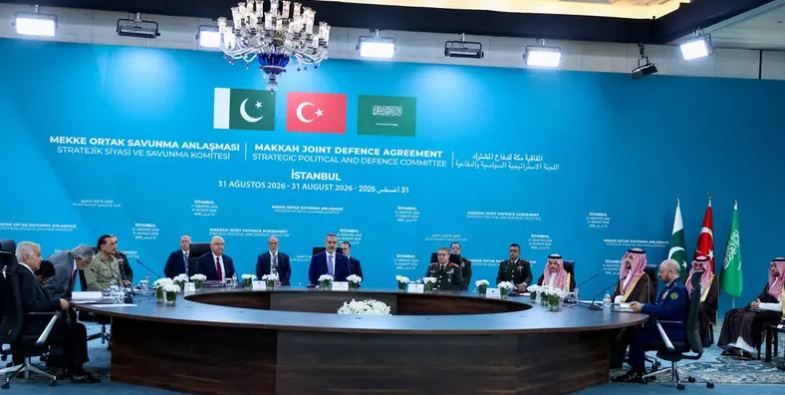
ISTANBUL, AUG 31: Less than a month after the establishment of the historic Mecca Joint Defense Agreement, Saudi Arabia, Turkey and Pakistan, held the first meeting of the Strategic Political and Defense Committee established under the pact.
The meeting, being held in Turkey, signals the countries’ determination to activate a permanent mechanism for defense coordination, the exchange of information and expertise, and stronger levels of preparedness and joint deterrence, according to political researchers who spoke to Al Arabiya.
Moving toward implementation
The convening of the committee reflects the three countries’ desire to turn the agreement into a sustainable operational and institutional framework and move toward a multilateral system based on a permanent organizational structure, according to the researchers.
International security issues
The meeting, the first since the agreement was established in Mecca at the beginning of August, is expected to address international security issues.
It will also discuss strengthening defense capabilities, improving interoperability between the countries’ armed forces and deepening defense cooperation, including joint production and development, according to Turkish sources.
Regional and global stability
Earlier this month, Saudi Arabia, Pakistan and Turkey signed the Mecca Joint Defense Agreement which reflects the three countries’ commitment to strengthening their common security and achieving security, peace and stability in the region and the world in pursuit of a secure and prosperous future.
Joint deterrence
The agreement strengthens joint deterrence against any act of aggression and stipulates that an armed attack against any one of the three countries will be considered an attack against all of them.
It also provides for the development of all aspects of defense cooperation between the three states.
Observers view the first meeting of the three countries as the beginning of the practical and institutional implementation of the Mecca pact, aimed at establishing consultation mechanisms and building systems for deterrence and proactive response.
Saudi political researcher Nayef Ashour said the meeting of the strategic defense committee under the Mecca Joint Defense Agreement represents a practical step toward transforming the political alliance into a sustainable operational and institutional reality.
“The speed with which the meeting has been convened reflects the level of alignment among the three countries,” Ashour said.
“One of the clearest indications is their desire to move toward institutionalization and sustainability, and to establish a multilateral system based on a permanent organizational structure.”
Establishing the broader framework
Ashour said the first meeting could help lay the broader framework for a general secretariat and establish a structure capable of managing crises.
He added that the speed at which the three countries are moving toward these steps reflects their seriousness at a time of growing security threats in the region, including risks to energy facilities, the closure of the Strait of Hormuz and developments in the Bab al-Mandeb Strait.
He also said the meeting is expected to lay the foundations for greater defense and operational alignment among the three countries by unifying military concepts and defining mechanisms for mutual assistance, including intelligence cooperation and logistical support.
Ashour described the meeting as “the actual beginning of what could be called joint security production.”
Taha Oudaoglu, Al Arabiya’s adviser on Turkish affairs, told Al Arabiya that the meeting represents an important milestone and a clear indication that the Mecca deal is moving from a political framework into a phase of practical and institutional implementation.
“The first meeting of the defense and strategic committee established under the Mecca Joint Defense Agreement reflects the seriousness of the three countries in building a permanent mechanism for defense coordination and the exchange of information and expertise, while increasing readiness and joint deterrence,” he said.
“It also establishes a rapid consultation mechanism in the event that any party faces a security or military threat.”
Oudaoglu said the agreement reflects a growing trend toward greater reliance on the region’s own capabilities in the fields of security and defense.
He also said this sends a strategic message that “the three countries want to have an additional security option in the event that the region faces a major crisis.”
Senior officials at the table
Senior officials from Saudi Arabia, Turkey and Pakistan gathered in Istanbul for the first meeting.
Saudi Defense Minister Prince Khalid bin Salman, who led the Kingdom’s delegation, arrived earlier accompanied by Foreign Minister Prince Faisal bin Farhan and other senior military officials.
Defense and foreign ministers and military chiefs from the three countries are also attending the meeting.
“The first meeting of the defense and strategic committee can be viewed as the institutional test of the Mecca Agreement,” Dr. Ahmed al-Shahri, head of the Saudi Expertise Forum, said.
“The agreement’s success will not be measured by the strength of its wording alone, but by its results, including permanent structures, mechanisms for consultation, planning and training, information sharing, defense and industrial cooperation, and improving the ability to operate jointly.”
Not waiting for crises
Al-Shahri concluded that the committee meeting reflects a broader transformation in the concept of regional security.
It sends a message, he said, that countries in the region are no longer simply waiting for crises to emerge and then searching for solutions, but are instead building deterrence capabilities and mechanisms for proactive response.