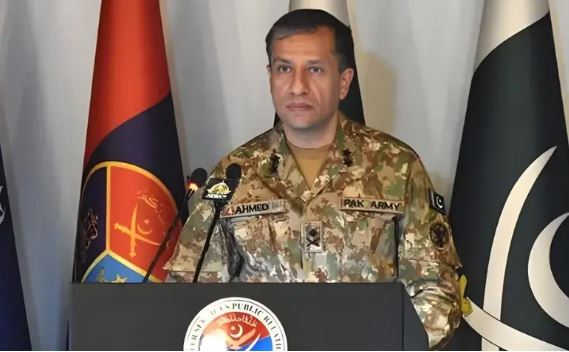
ISPR DG Lt Chaudhry says hard state does not mean “military is running the state”
DNA
RAWALPINDI: Inter-Services Public Relations (ISPR) Director General Lt Gen Ahmed Sharif Chaudhry on Friday stressed the importance of good governance, saying it was “extremely important” for Pakistan’s security.
“Good governance is essential for Pakistan’s security. If the issues are not being resolved, it means that there should be done something for good governance,” the ISPR DG said while addressing a press conference on counterterrorism and security.
According to the ISPR DG, the country’s challenges cannot not be resolved without ensuring good governance in the country.
On Interior Minister Mohsin Naqvi’s remarks, the ISPR DG declined to comment, calling them personal opinion of the former. The ISPR chief said the National Action Plan consisted of 14 points on which all political parties were in agreement.
The military’s spokesperson was referring to Naqvi’s remarks saying Pakistan’s existing governance system had collapsed and was no longer capable of addressing the country’s challenges, calling for administrative reforms, including the creation of new administrative units.
“The system we are living under has collapsed. Problems cannot be solved through it […] If this system continues, we will still be sitting here 10 years from now discussing the same issues […] You have to move towards administrative units. Call them provinces or give them any other name,” he told an event in Islamabad on Thursday.
Lt Gen Chaudhry ruled out any talks with terrorists, rejecting the false impression of deteriorating security situation in Balochistan.
He said that some of the elite and Sardars (tribal leaders) in Balochistan did not want children from poor families to progress.
“We will not talk to you; we will talk to the people of Balochistan,” he added.
The ISPR chief said that Pakistan was not a hard state if the Constitution and law were not equal for every citizen.
“Are we a hard state? No,” the DG ISPR said, adding that a hard state meant one where the Constitution and law were equal for everyone.
“It [hard state] does not mean the military is running the state,” he said.
According to the ISPR DG, a sustained negative propaganda campaign was being waged against the state on the pretext of the situation in the province.
Turning to the issue of missing persons, the chief military spokesperson said the commission on missing persons had received 201 applications.
He questioned the composition of the missing persons list, saying that individuals killed during counterterrorism operations were later found to be listed as missing persons.
He said that those present in militant camps could also be found on the missing persons list.
Addressing the situation in Balochistan, he said the province’s geography and terrain were also challenges.
He said Balochistan’s population was 14.89 million and distances between posts extended across large areas.
He further said that specific elements were involved in worsening conditions in the province, saying some groups were involved in activities including terrorism, robbery, drug trafficking and diesel smuggling.
The ISPR DG said the people of Balochistan were the province’s real stakeholders. He added that security forces were targeting militants and carrying out operations against them.
The military spokesperson ruled out further negotiations with terrorists, saying there was no room left for talks.
“Either you surrender, or we will fight you,” he said.
The military’s spokesperson began his presser by giving a breakdown of the operations conducted against terrorists during the ongoing year.
According to Lt Gen Chaudhry, security forces carried out 40,348 operations, killing 2,084 confirmed terrorists, while an average of 10 militants were eliminated daily.
Presenting an overview of the security situation, the ISPR DG said that security forces conducted an average of 194 operations every day. He added that 1,971 operations were carried out alone in Khyber Pakhtunkhwa.
The military spokesperson said 2,084 confirmed terrorists were killed during the operations, averaging 10 militant deaths each day.
As many as 819 people embraced martyrdom during the ongoing year, including 303 army personnel, 194 law enforcement personnel, and 322 civilians, he said.
According to the ISPR DG, a total of 28 suicide attacks were recorded across the country, with Afghan nationals responsible for the recent attacks in KP’s Tank and Karachi.
Lt Gen Chaudhry said figures regarding missing persons are often presented inconsistently, with claims ranging from 10,000 to 20,000 individuals.
Speaking on the issue, the DG ISPR said that a commission had been established to address cases of missing persons, and that applications had been submitted to the body for investigation.
He stated that the commission received 2,900 applications from Balochistan, adding that the identities of 2,700 individuals mentioned in those cases had since been established.
The military spokesperson further said that many of the militants killed during security operations were found to be among those previously reported as missing persons.
He also highlighted the security situation in Balochistan, saying there had been 105 incidents targeting police and Levies personnel.
According to the ISPR DG, the province recorded 178 martyrs, 55 abductions and the destruction of 24 bridges.
During the press conference, tribute was paid to the police personnel martyred in Balochistan, with the ISPR chief describing martyrdom as a position of great honour.
The chief military spokesperson highlighted the role of police officers and personnel in countering militant attacks across the province. Referring to an attack in Kachhi on October 27 last year, he said police remained at their posts and confronted the assailants, ultimately forcing the militants to retreat.
He also cited a major terrorist attack on a police station in Dhadar — a town in Balochistan’s Kachhi district — on April 24, saying such incidents were often followed by coordinated propaganda campaigns.
According to the ISPR DG, videos related to these attacks were circulated on social media and amplified by a significant section of the Indian media.
Lt Gen Chaudhry further said that more than 300 Indian websites were involved in spreading propaganda against Pakistan.
He said hostile networks were using online honey-trapping tactics, abductions and blackmail to target young women.