
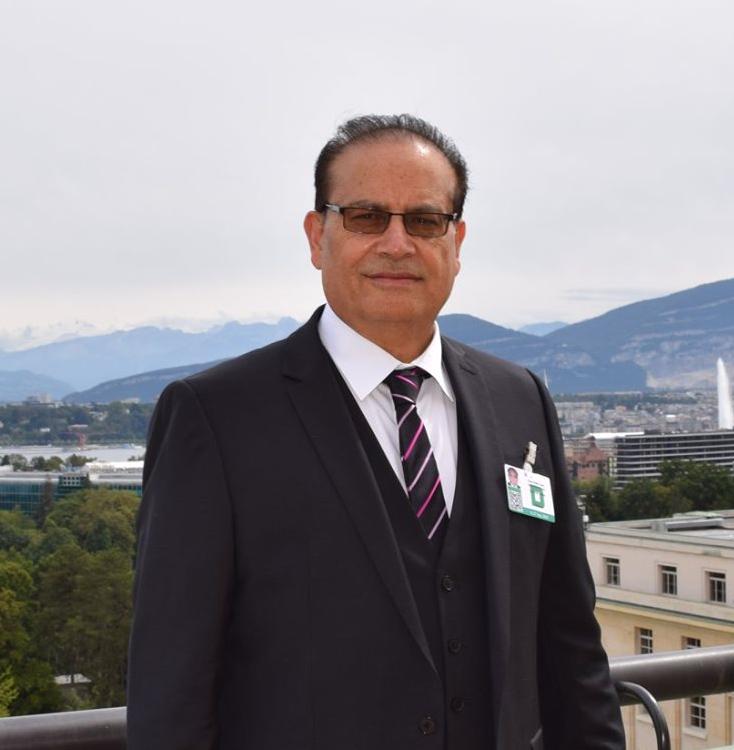
Qamar Bashir
The past twenty-four hours have altered the geopolitical landscape in ways few anticipated, yet many feared. After weeks of military buildup in the Persian Gulf and Arabian Sea, the United States and Israel launched what officials described as a coordinated offensive targeting Iranian leadership and military infrastructure. The reported confirmation by Iranian state media of the death of Supreme Leader Ayatollah Ali Khamenei marks a turning point not only for Iran but for the broader Middle East.
Images from inside Iran reflect a nation divided and shaken. Smoke rose above Tehran as airstrikes struck command centers and security compounds. Civilians were seen fleeing neighborhoods, rescuers searching through rubble, and families heading north from the capital amid uncertainty. In contrast, some pockets of the country witnessed celebrations following reports of Khamenei’s death—evidence of deep internal fractures that have long existed beneath the surface of the Islamic Republic.
Israeli officials have described the operation as one of the largest regime-decapitation strikes in modern warfare, claiming dozens of senior security and military figures were eliminated. Among those reported killed were high-ranking officials within the Revolutionary Guard, defense establishment, and intelligence apparatus. Whether every detail withstands independent verification remains to be seen, but the scale of the strike signals a deliberate attempt to dismantle the core of Iran’s command structure.
The central question is not simply what has happened—but why now.
For months, negotiations over Iran’s nuclear program had fluctuated between tension and cautious optimism. Technical discussions were reportedly scheduled to continue in Vienna. Yet amid those diplomatic channels, Washington and Tel Aviv appear to have concluded that the risks of waiting outweighed the risks of acting. Official statements emphasize preventing nuclear weaponization, degrading missile capabilities, and neutralizing what they call imminent threats. Critics, however, argue that the abrupt transition from negotiation to bombardment raises doubts about whether diplomacy was ever given sufficient space to succeed.
Beneath the surface of nuclear rhetoric lies a deeper strategic reality: energy leverage and global power competition.
Iran sits at the crossroads of one of the most vital arteries of global commerce—the Strait of Hormuz. Roughly one-fifth of the world’s oil and gas supply transits this narrow corridor. Any serious disruption there sends immediate shockwaves through global markets. Energy prices spike, supply chains tighten, shipping insurance costs rise, and inflationary pressures intensify worldwide.
China, in particular, relies heavily on Gulf energy flows. Even as Beijing invests aggressively in renewable energy and alternative supply chains, oil remains central to industrial continuity and economic growth. If the United States and its allies consolidate influence over major energy producers across the Gulf, they acquire a powerful instrument of geopolitical leverage. In an era defined by U.S.–China rivalry, control over energy corridors is not merely economic—it is strategic.
This broader context helps explain why Iran’s position extends beyond its borders. The confrontation is not solely about enrichment levels or centrifuge counts; it intersects with global power balances, trade routes, and long-term strategic containment.
At the same time, regime decapitation does not automatically produce stability. History offers multiple examples where eliminating leadership structures created power vacuums that fueled prolonged instability rather than swift transition. Within hours of the reported strike, the National Council of Resistance of Iran (NCRI) reintroduced its 10-point democratic plan, led by president-elect Maryam Rajavi. The proposal calls for universal suffrage, separation of religion and state, abolition of the death penalty, gender equality, dismantling of the IRGC, and a non-nuclear Iran aligned with international norms.
On paper, the plan outlines a comprehensive democratic transformation. In practice, implementing such reforms requires security guarantees, institutional continuity, and broad domestic consensus—conditions rarely present amid aerial bombardment and political shock.
International reactions have reflected caution rather than celebration. European leaders have urged restraint and a return to negotiations. Russia condemned the strikes as destabilizing. China expressed concern and called for de-escalation. Gulf states fear maritime disruption and regional spillover. The United Nations has warned that continued escalation risks undermining international peace and security.
Perhaps the most immediate economic concern remains the Strait of Hormuz. Iran’s parliament reportedly approved a motion to close the corridor, though final authority rests with its Supreme National Security Council. Analysts note that a full blockade would also harm Iran’s own economy and risk military confrontation with U.S. naval forces. Nonetheless, even partial interference could disrupt approximately 20 million barrels of oil per day—an amount sufficient to destabilize markets globally.
Markets have already responded with volatility. Aviation disruptions across the region have stranded travelers. Shipping routes are being recalculated. Energy futures have fluctuated sharply. For import-dependent nations in Asia, the stakes are profound.
Inside Iran, public sentiment appears complex and layered. Years of economic hardship, political repression, and protest crackdowns have eroded confidence in the clerical establishment for many citizens. Yet external military strikes can rapidly transform internal grievances into nationalist solidarity. Civilian casualties, if confirmed and sustained, may intensify anti-foreign sentiment rather than facilitate internal reform.
Israel, for its part, calculates that neutralizing Iran’s senior command reduces long-term threats from missile arsenals and proxy networks. The United States frames the action as defensive and preventive. However, military planners must now consider retaliation—whether through missile exchanges, cyber operations, or asymmetric tactics targeting U.S. assets in the region.
Russia and China, meanwhile, observe carefully. Both powers may seek to avoid direct confrontation while allowing geopolitical dynamics to weaken American influence if escalation becomes prolonged. A drawn-out conflict risks draining U.S. resources, complicating alliances, and eroding soft power credibility.
In this environment, the probability of swift resolution appears low. Decapitation strikes often initiate new phases of contestation rather than closure. Leadership succession struggles, regional retaliation, and diplomatic fragmentation can extend instability for months—or longer.
The humanitarian dimension must not be overlooked. Images of collapsed buildings and fleeing civilians underscore the human cost. Infrastructure damage, potential refugee flows, and economic paralysis could follow if hostilities persist.
Ultimately, this moment represents more than a bilateral confrontation. It is a strategic inflection point involving energy security, nuclear proliferation, regime legitimacy, and global power competition. The intersection of these forces makes the trajectory unpredictable and potentially prolonged.
The world must therefore prepare—not for a brief shock—but for sustained volatility. Energy markets, diplomatic channels, and regional security architectures will remain under strain. Whether the coming weeks produce negotiations, containment, or escalation will depend on decisions made in Tehran, Washington, Tel Aviv, Beijing, and Moscow.
What is clear is that the consequences of this operation will extend far beyond the initial strike. The Middle East has entered a new phase of uncertainty, and the global community must brace for economic, political, and strategic reverberations that may reshape the region for years to come.
When examined through this lens, the United States’ decision reflects calculated confidence in its strengths, yet it is shadowed by significant structural risks. Military superiority provides tactical advantage, but the strategic outcome will depend on political evolution inside Iran, the resilience of global markets, and the restraint—or escalation—of regional actors.
The war is unlikely to conclude swiftly. Leadership strikes may change faces, but they rarely end confrontations overnight. Economic volatility, diplomatic recalibration, and security tensions will likely persist for an extended period.
The world must prepare for sustained turbulence. Whether this moment becomes a gateway to negotiated transformation or a prolonged cycle of retaliation depends not only on battlefield capability but on strategic wisdom in the days ahead.