ISLAMABAD, Oct 16 (DNA):Coordinator to the Prime Minister on Commerce and Industries Rana Ihsaan Afzal Khan has reaffirmed the government’s commitment to achieving $100 billion in annual exports by 2035 through comprehensive trade reforms, improved market access, industrial competitiveness and sustained policy implementation.
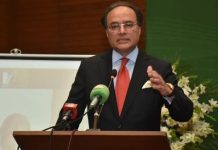
Addressing the closing ceremony of the 39th Annual General Meeting and International Conference of the Pakistan Society of Development Economists (PSDE), organised at the Pakistan Institute of Development Economics (PIDE) here, he said Pakistan was moving towards an export-oriented economy to overcome recurring economic challenges and ensure sustainable growth, said a news release.
The two-day conference, themed “Mission $100 Billion: The National Race for Sustainable Export-led Prosperity,” brought together policymakers, economists, researchers and business representatives to discuss strategies for enhancing Pakistan’s exports.
Rana Ihsaan said the government’s export targets of $60 billion in the medium term and $100 billion by 2035 required structural reforms, export diversification and stronger industrial productivity.
Highlighting key initiatives, he said the National Tariff Policy 2025–30 aimed to rationalise duties across approximately 7,500 tariff lines, gradually eliminate regulatory and additional customs duties, and reduce the maximum customs duty to 15 percent to improve industrial competitiveness.
He said the government was reviewing approximately 500 regulatory requirements and removing unnecessary certification and inspection procedures under the Export Policy Order to facilitate businesses.
Rana Ihsaan said the Prime Minister had approved a Trade Facilitation Board to improve coordination among government agencies, streamline export logistics and reduce port-related costs.
On financing, he said efforts were underway to increase SME financing from Rs1 trillion to Rs2 trillion, while exporters were being supported through concessional financing arrangements involving EXIM Bank and commercial banks.
The He said that tax collection on export proceeds had been reduced from 2 percent to 1.25 percent in the 2026–27 federal budget to ease financial pressure on exporters.
Discussing international trade, the coordinator highlighted Pakistan’s progress under the European Union’s GSP Plus arrangement, the Pakistan–UK Trade Dialogue and existing trade agreements with several partner countries.
He said trade negotiations and engagements with Vietnam, South Korea, Cambodia, Bangladesh and African countries were aimed at expanding market access. He also highlighted 16 sanitary and phytosanitary protocols with China that had opened additional opportunities for Pakistani agricultural exports.
Referring to trade promotion, he said the Trade Development Authority of Pakistan (TDAP) was strengthening international business linkages through trade exhibitions and business-to-business engagements. He particularly highlighted the upcoming FoodAg 2026 exhibition in Karachi as an important platform for promoting agricultural and value-added exports.
He further said Pakistan Single Window was connecting more than 108,000 traders with 32 government agencies, while 19 sectoral councils were ensuring private-sector participation in trade policymaking.
Rana Ihsaan emphasised that artificial intelligence, ICT services, agriculture, minerals, tourism, the blue economy and creative industries offered significant potential for diversifying Pakistan’s export base.
Earlier, Dr. Faheem Jehangir, Dean (Policy), PIDE and Secretary PSDE, presented the conference’s recommendations, identifying policy inconsistency, high trading costs, limited export diversification and weak investor confidence as major challenges.
He called for policy continuity, export-oriented investment, improved skills, industrial upgrading and greater emphasis on productivity rather than protectionism.
The conference featured panel discussions, technical sessions, research presentations and a PhD symposium. During the closing ceremony, outstanding researchers were recognised with Best Research Paper and Poster Awards.
Dr. Jamshaid ur Rehman secured first position in the research paper competition, receiving Rs300,000, followed by Dr. Muhammad Ali with Rs200,000 and Dr. Fatima Ejaz with Rs100,000. Prizes of Rs150,000 and Rs100,000 were also announced for the top two research posters.
In his concluding remarks, Dr. Nadeem Javaid, Vice Chancellor of PIDE and President of PSDE, stressed that Pakistan’s economic stability depended on sustained export growth and evidence-based policymaking.
He urged young researchers to continue examining the country’s economic challenges and translating academic research into practical policy solutions, emphasising that economic planning must focus not only on managing scarce resources but also on creating prosperity.
Concluding his address, Rana Ihsaan assured participants that the conference’s recommendations would be examined for incorporation into the government’s ongoing trade reform agenda.
He expressed confidence that consistent reforms, stronger public-private cooperation and enhanced export competitiveness would enable Pakistan to achieve its $100 billion export target by 2035.