
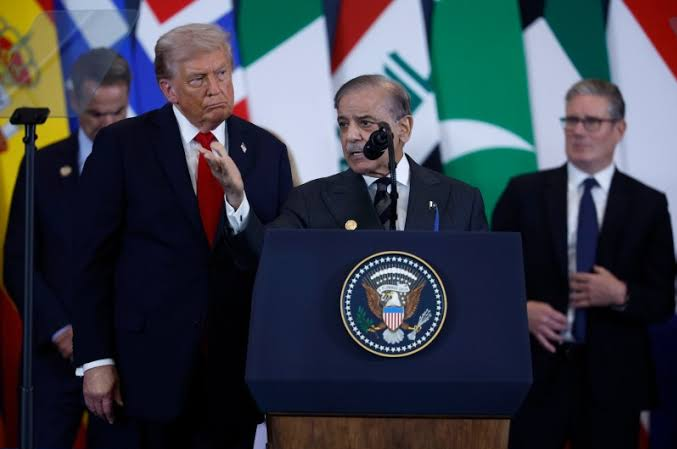
ISLAMABAD, JAN 15 (DNA):As the United States announced the start of the second phase of Gaza Peace Plan, Pakistan on Thursday expressed the hope that it would lead to further stabilization of the situation, scaled-up humanitarian assistance, an end to civilian suffering, and a credible, time-bound political process.
“We express the hope that these steps will lead to further stabilization of the situation, upscaling of humanitarian assistance, and an end to the sacrifices of the people. We also hope that these efforts will lead to a credible, time-bound political process consistent with international legitimacy and relevant UN resolutions to establish an independent, sovereign, contiguous State of Palestine based on pre-1967 borders with Al-Quds Al-Sharif as its capital,” Foreign Office spokesperson Tahir Andrabi said in his weekly press briefing.
He told the media that Pakistan remained engaged in the Gaza peace process and was part of the group of Arab-Islamic countries, and also supported the UN Security Council resolution endorsing the plan to save the lives of innocent Palestinians, maintain the ceasefire, and secure the full withdrawal of occupation forces from Gaza.
Asked about Pakistan’s participation in the International Stabilization Force (ISF), he said no decision had been taken as the mandate of the ISF was also yet to be finalized.
Discussing the situation in Iran, he said Iran, with its sagacity and resilience would overcome the challenge.
As regards the role of Pakistan in the US-Iran situation, he said that the country had a very positive and principled position between Iran and its partners during the nuclear issue talks last year.
He said the very principled position enabled Pakistan to play the role of bridge-builder and facilitator for channels of communication as Pakistan’s leadership held multiple telephone conversations with the Secretary of State, Marco Rubio, and Iranian Foreign Minister Abbas Araghchi.
“We are willing to play such a role… We have good relations with both Tehran and Washington, and we continue to maintain those relations, and those relations do enable us to play a positive role if the situation warrants.”
Coming to the Indian human rights violations, he strongly condemned the conviction of prominent Kashmiri political leader and activist Asiya Andrabi, along with her two associates by a Delhi court.
“This conviction underscores the continued misuse of draconian laws to silence legitimate political voices in Indian Illegally Occupied Jammu and Kashmir (IIOJK). Asiya Andrabi has spent several years in incarceration for peacefully advocating the fundamental rights and freedoms of the Kashmiri people. Her conviction reflects a broader pattern of reprisals, intimidation, and coercion faced by genuine Kashmiri leaders.”
He said that such a treatment served as a stark reminder of the suffering of the population subjected to systemic repression, and reiterated Pakistan’s steadfast diplomatic, political, and moral support for the Kashmiri people and their just struggle for the realization of their inalienable right to self-determination, as enshrined in numerous United Nations resolutions.
Commenting on the statement by the Indian army chief regarding the presence of terrorist camps in Pakistan, he rejected the baseless allegations, saying that the country’s unparalleled sacrifices in blood and treasure in combating terrorism were internationally acknowledged and recognized.
“India would be well-advised to refrain from such baseless rhetoric, focus on the growing extremism and religiously motivated terrorism—particularly state-patronized Islamophobia—within its own territory, which poses a threat not only to their own society but also to neighboring countries,” he said and advised India to learn to observe civilized interstate norms.
To a question, he said India had no locus standi to comment on the bilateral and important international project between Pakistan and China, which was actually focused on development and regional connectivity.
Asked about the gains and losses incurred by the closure of Afghan border, the spokesperson said that in the economic and trade sense, there was some deficit. However, it would be a gain if it stopped the level of incursion from Afghan side and attacks on the border posts and killing of Pakistani security forces.
He said that the only issue between the two countries was the terrorism emanating from Afghan soil against Pakistan.
Asked about the US government’s suspension of the immigration visa processes for 75 countries, including Pakistan, he said that was an internal, ongoing process of review of U.S. immigration policies, and hoped that the routine processing of immigrant visas would resume soon.
Regarding the imposition of 25% tariff by the US for any country doing business with Iran, he expressed the hope to have very smooth trade relations with the US. The trade with Iran, he said, followed international trade regulations and relevant international law governing these trades.
To a question about the Abraham Accord, Spokesperson Andrabi said that Pakistan’s benchmarks were a viable, contiguous state of Palestine with Al-Quds Al-Sharif, Jerusalem as its capital, and then to see how the state had relationships with other countries, potentially with Israel.
Apprising the media of the diplomatic engagements, he mentioned a telephone call from Qatari Amir Tamim bin Hamad Al Thani to Prime Minister Shehbaz Sharif on Wednesday, wherein they expressed satisfaction over the state of bilateral relations, including the current trade trajectory. They reaffirmed their shared resolve to further strengthen these time-tested fraternal bonds, besides discussing the developments in the Middle East.
Regarding President Asif Ali Zardari’s ongoing official visit to Bahrain from January 13 to 16, he referred to his meeting with King Hamad bin Isa Al Khalifa and the talks covered trade, investment, defence cooperation, support for the Pakistani community, and regional and global issues. The King also conferred Sheikh Isa Award on President Zardari.
He also highlighted DPM Dar’s participation in the 22nd Extraordinary Session of the OIC Council of Foreign Ministers in Jeddah on the issue of Somaliland region of Somalia. In his address, Dar strongly condemned the illegal and unlawful recognition by Israel of the Somaliland region, as well as the subsequent unwarranted and highly provocative visits by Israeli officials to the territory.
He also rejected any proposal for the dislocation of the Palestinian people and appreciated the OIC’s principled position and consistent support for the resolution of the Jammu and Kashmir dispute.
Besides meeting his counterparts from Azerbaijan, Bangladesh, Maldives, and Egypt, Deputy Foreign Minister of Saudi Arabia and the Secretary General of the OIC, the deputy prime minister also inaugurated the new building of Pakistan’s Consulate General in Jeddah.
He told the media that during the week, DPM Dar also held telephonic calls with foreign ministers of Uzbekistan, Iran, Myanmar, and the Indonesian Minister for Investment.













:As the United States announced the start of the second phase of Gaza Peace Plan, Pakistan on Thursday expressed the)