ISLAMABAD/RIYADH: Pakistan’s political divide has been temporarily overshadowed by a display of solidarity with Saudi Arabia, as politicians, civil society voices and members of the public rally behind Prime Minister Shehbaz Sharif’s government and Pakistan’s armed forces over the Kingdom’s confrontation with the Houthis.
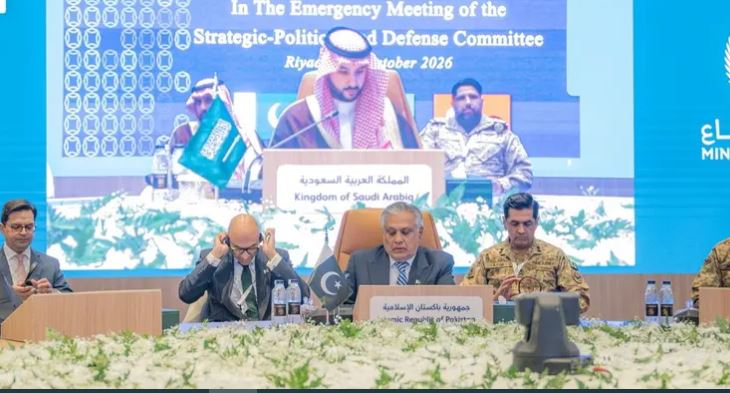
That domestic alignment gives the October 5 meeting of the Mecca Defense Alliance in Riyadh an added significance. Saudi Arabia, Pakistan and Turkey agreed to move immediately toward implementing their collective-defense commitments, including measures for the rapid deployment of agreed military forces and capabilities inside Saudi Arabia.
The decision comes as Saudi-backed Yemeni forces push against Houthi positions along the Red Sea coast, creating the first major security test for the alliance since it was established in August.
“The landmark October 5 meeting officially transitions the Mecca Defense Alliance from political intent to an operational collective-defense framework,” Dr. Yerzhan Dosmukhamedov, an independent policy analyst based in London and a former senior Kazakh diplomat who served as Deputy Chief of Mission in Germany and as Chief of Staff to the Vice President of Kazakhstan, told Al Arabiya English.
The committee also appointed retired Pakistani Lieutenant General Nauman Mahmood as the alliance’s first secretary-general for a three-year term.
“By uniting Saudi Arabia’s strategic leadership, Turkey’s cutting-edge military technology, and Pakistan’s elite combat experience under Secretary-General Lt. Gen. (Retd) Nauman Mahmood, this historic trilateral bloc establishes a formidable shield for the region. Together, these major Islamic powers usher in a powerful new era of unified security, regional stability, and mutual strength,” the analyst said.
The three countries said they would take measures to provide agreed military forces and capabilities and ensure their rapid deployment in Saudi Arabia under approved arrangements and national legislation.
For Riyadh, the timing is critical.
Houthi drones and missiles have demonstrated how a relatively inexpensive arsenal can threaten Saudi cities, airports, military installations, energy infrastructure and other strategic facilities.
Saudi-backed Yemeni forces have launched Operation “Dawn of Yemen”, advancing toward areas around Mokha, Dhubab and the Bab al-Mandeb corridor. Yemeni government forces have reported gains around the strategic waterway, while the Houthis have responded with missile and drone attacks against targets in Saudi Arabia.
Bab al-Mandeb connects the Red Sea with the Gulf of Aden and is a crucial passage for global shipping. Prolonged disruption could increase freight and insurance costs and force vessels to take longer routes around Africa.
The strategic danger becomes greater because of continuing tensions around the Strait of Hormuz. A prolonged crisis affecting both waterways could disrupt energy supplies, raise transport costs and put additional pressure on Asian importers, European consumers and global supply chains.
Pakistan’s support for Riyadh is rooted in a defense relationship that predates the Makkah alliance. Pakistani military personnel have served in Saudi Arabia for decades, while the two countries strengthened their security relationship through a Strategic Mutual Defense Agreement signed in 2025.
Pakistan’s delegation at the Riyadh meeting included Deputy Prime Minister and Foreign Minister Ishaq Dar, Defense Minister Khawaja Asif and Chief of Army Staff and Chief of Defense Forces Field Marshal Asim Munir.
Asif has said Pakistan is ready to provide whatever assistance Saudi Arabia requires while emphasizing the defensive nature of the cooperation. He has also indicated that Pakistani and Turkish forces currently have a presence in the theatre, while Saudi forces are conducting combat operations.
Ijaz ul Haq, a member of Pakistan’s parliament and former federal minister, said the new arrangement builds on decades of defense cooperation between Islamabad and Riyadh.
“Pakistan’s role recently in the trilateral Mecca Pact between Saudi Arabia, Turkey and Pakistan has been as a central player in this deal making,” Haq told Al Arabiya English. “Saudi Pakistan defense pact has been in place since early 1980s with active participation of two brigades in Tabouk. After this pact we have moved one step further in strengthening our participation to safeguard the borders against any aggressive act against any one of the countries in the pact.”
The current political support in Pakistan goes beyond the government. Opposition figures, political commentators and sections of the public have publicly backed stronger support for Saudi Arabia. Given the intensity of Pakistan’s domestic political divisions, the breadth of this response is unusual.
Turkey contributes another major component to the alliance. Its defense industry has developed capabilities in drones, surveillance, electronic warfare and precision systems. Pakistan brings extensive military experience and established defense capabilities, while Saudi Arabia provides strategic depth, financial resources and geographic importance.
But the alliance is not yet a fully integrated military command, and its credibility will depend on compatible procedures, intelligence networks, air-defense coordination, joint exercises and rapid-response mechanisms.
A deeper military role could strengthen deterrence against the Houthis but could also increase the risk of retaliation against Saudi targets and maritime infrastructure. The alliance will therefore have to balance military readiness with efforts to prevent the Yemen conflict from becoming a broader regional war.
Diplomacy remains part of that calculation. Turkish Foreign Minister Hakan Fidan has said political and diplomatic options were discussed alongside military measures. Pakistan has also maintained channels with Iran, which has advocated dialogue with the Houthis.
The political dimension may prove almost as important as the military one. Pakistan’s leaders are signaling that Saudi security is being treated as a national strategic interest, not simply as an issue for the government of the day. That message matters in Riyadh because the alliance requires sustained political backing as its commitments become more concrete amid intense regional uncertainty and growing strategic pressure now.
For Saudi Arabia, the Pakistani response offers reassurance at a moment when the Kingdom is confronting threats on multiple fronts. It also demonstrates that the alliance has a constituency beyond defense ministries and military headquarters, giving the emerging security arrangement a broader political base.
The October 5 meeting nevertheless represents a major change. Saudi Arabia now has two powerful partners preparing to coordinate defense capabilities around the Kingdom, while Pakistan and Turkey are assuming greater responsibility for Saudi security.
Its success will depend not simply on troop numbers but on intelligence sharing, air defense, command coordination, maritime security and political discipline.
The Makkah Defense Alliance has therefore crossed an important threshold. It is moving beyond a political declaration toward an operational security structure, while Pakistan’s unusual domestic unity has given the alliance an important political foundation.
If Riyadh, Islamabad and Ankara can combine military readiness with diplomatic restraint, the alliance could become a durable element of regional security. If escalation overtakes diplomacy, however, the same framework could draw all three members deeper into a conflict already reshaping the security map of the Middle East.