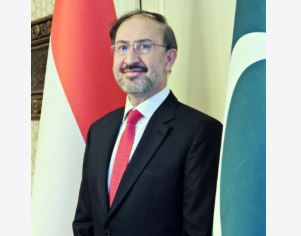
UNITED NATIONS, Nov 24 (DNA):Warning that “there can be no lasting food security without peace,” Pakistan has called on all warring parties to halt strikes on civilian energy grids and commercial vessels and pursue a negotiated settlement to the Russia-Ukraine conflict, now in its fifth year.
“There can be no substitute for the actual resolution of conflicts, through peaceful means, in accordance with the UN Charter and international law,” Ambassador Syed Haider Shah, permanent representative of Pakistan to the United Nations, told a high-level UN Security Council briefing on Monday amid heightened attacks and tensions between the two countries..
The briefing on Ukraine, “Protecting Critical Energy Infrastructure and Black Sea Lifelines of Global Food Supply,” initiated by Latvia with support from Liberia and Panama. Latvian President Edgars Rinkevics presided over the meeting.
The conflict began when Russia invaded Ukraine in February 2022, arguing it was a “special military operation” for Ukraine’s “demilitarization”, protecting Russian-speaking people from “genocide,” and preventing NATO expansion.
In his remarks, Ambassador Haider Shah highlighted the widespread economic and humanitarian toll of the conflict resulting in an unstable geo-political situation, while urging adherence to International Humanitarian Law (IHL) and a return to peace.
“We remain concerned by these conflict-driven disruptions and underscore the urgent need to safeguard critical infrastructure, ensure the uninterrupted flow of essential supplies, and prevent further escalation of humanitarian and economic crises,” the Pakistani envoy said.
The conflict, he added, is straining global food and energy markets, fracturing supply chains, and driving up commodity prices that severely impact developing nations outside the immediate conflict zone.
In this regard, Ambassador Haider Shah outlined three key priorities: protecting civilians and critical infrastructure under IHL, ensuring unimpeded humanitarian aid, and strengthening international cooperation to safeguard global supply chains.
Stressing that “there can be no lasting food security without peace,” he called for peaceful conflict resolution via the UN Charter and reaffirmed Pakistan’s support for global mitigation efforts.
Briefing the Security Council, UN Under-Secretary-General Rosemary DiCarlo from the Department of Political and Peacebuilding Affairs said that large-scale attacks were continuing across Ukraine, destroying lives and infrastructure.
“Millions live with the fear that a strike could hit their home, their children’s school, or their loved ones,” she said. With winter approaching, families were once again bracing for life without electricity, water or heat.
Meanwhile, beyond Ukraine, attacks in the Black Sea continue to disrupt food exports, with implications for food security far beyond the region.
On 23 November, at least five people were reportedly killed in Russian Federation attacks in Donetsk, Kharkiv, Zaporizhzhia and Sumy regions of Ukraine, Ms. DiCarlo said, while attacks on population centres took place over the weekend.
“International humanitarian law is clear,” she said, “attacks against civilians and civilian infrastructure are prohibited.” Repeated attacks on energy and other civilian infrastructure are driving humanitarian needs far beyond the front lines, while disruptions to heating, electricity and water are affecting civilians.
“Attacks on energy infrastructure this year are even more extensive and systematic compared to the same time last year,” Ms. DiCarlo said, underscoring that “the outlook for this winter is deeply concerning”.
She reiterated the Secretary-General’s call for a full, immediate and unconditional ceasefire, as a critical step towards a just, lasting and comprehensive peace, in accordance with international law and the Charter of the United Nations.