
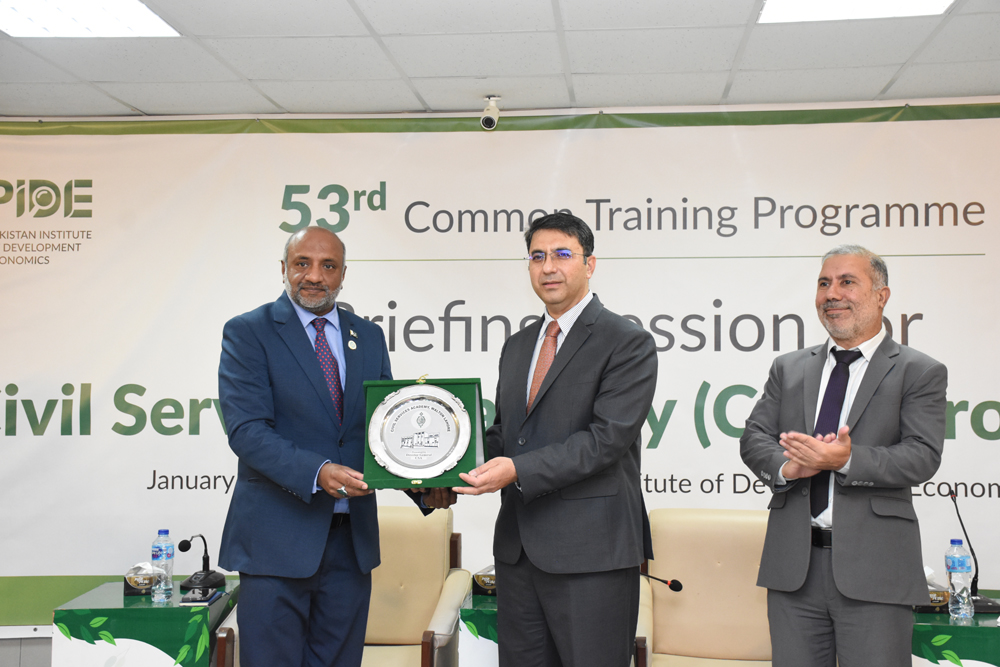
ISLAMABAD: JAN 9 (DNA): The Pakistan Institute of Development Economics (PIDE) hosted a comprehensive briefing session for the probationers of the 53rd Common Training Programme (CTP) of the Civil Services Academy (CSA). The session was part of their CSA Probationers Islamabad study tour. It aimed to familiarize future civil servants with contemporary policy challenges, evidence-based research, and emerging development priorities, while strengthening their analytical and research capacities essential for effective public service.
The session opened with welcome remarks of Dr. Nadeem Javaid (SI), Vice Chancellor, PIDE, who underscored the central role of research-driven and people-centered policymaking in governance. Welcoming the probationers, particularly those from Balochistan and other far-flung areas, Dr. Javaid highlighted the immense responsibility they would soon shoulder as future leaders of the state. He noted that Pakistan’s governance challenges are shaped by a complex social fabric influenced by religion, tribe, caste, and provincial identities, requiring nuanced and context-sensitive policy responses.
Drawing on his academic and policy experience, Dr. Javaid introduced the distinction between machine bureaucracy and intelligent bureaucracy, explaining that while the former rigidly applies rules without context, the latter relies on judgment, empathy, and innovation to respond to real-world challenges. He stressed that meaningful civil service reform requires moving beyond inherited colonial mindsets and questioned the effectiveness of partial reforms that preserve control without addressing systemic inefficiencies. Highlighting Pakistan’s pressing realities, including rapid population growth, child stunting, persistent poverty, and declining household consumption, he emphasized that failure to address these challenges would weaken the state. He urged the probationers to use their institutional space wisely and practice ethical, inclusive, and citizen-focused governance.
Dr. Karim Khan, Dean (Academics), PIDE, delivered a comprehensive presentation highlighting PIDE’s academic strength, research depth, and policy engagement framework. He outlined PIDE’s legacy as Pakistan’s leading economic think tank and graduate institution, emphasizing its role in producing economists and public policy professionals serving in government, international organizations, and the private sector. Dr. Karim Khan shared insights into PIDE’s postgraduate programmes, strong employability outcomes of its graduates, and the institute’s close integration with policymaking processes. He underscored PIDE’s emphasis on analytical rigor, evidence-based reasoning, and real-world policy engagement—skills that are particularly critical for civil servants tasked with complex decision-making and public sector reform.
Speaking on behalf of the Civil Services Academy, Dr. Syed Shabbir Akbar Zaidi, Director (Common Training Programme/Capacity Building), explained that the primary objective of the visit was to strengthen officers’ analytical and research capabilities, which are essential across all service groups. He noted that syndicate research is a core component of the CTP, enabling officers to analyze complex public policy problems, identify implementation gaps, and propose informed solutions. He shared that the CTP has evolved into a simulation-based model, where officers work in smaller research groups under faculty guidance, engage with government departments, conduct field visits, and interact with relevant institutions.
Dr. Zaidi emphasized that the visit to PIDE was particularly valuable as officers would soon defend their research reports, and that PIDE’s role as a leading public policy research institution and advisor to the Government of Pakistan makes it a critical partner in capacity building. He appreciated PIDE’s continued support and shared that there are plans to further institutionalize collaboration between CSA and PIDE, potentially integrating the syndicate research module more formally into future training programmes.
The core of the briefing session comprised a series of parallel syndicate lectures facilitated by senior PIDE faculty and policy experts. These sessions covered a wide range of critical national and global issues, including carbon markets and sustainable agriculture and forestry, artificial intelligence and ethics, regional connectivity and logistics performance, demographic transition and population dynamics, drug addiction and community-based interventions, health sector governance, international migration, smart cities, heritage conservation, fiscal viability of new provinces, and the reconstruction of marginalized historical narratives. The interactive format enabled probationers to engage in focused group discussions and thematic research deliberations.















: The Pakistan Institute of Development Economics (PIDE) hosted a comprehensive briefing session for the probationers of)