DNA
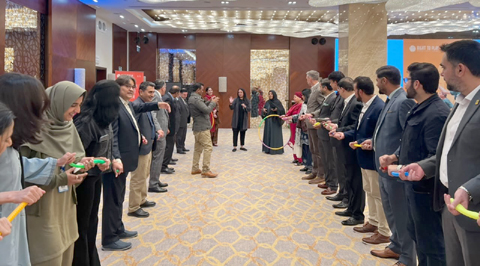
ISLAMABAD, Pakistan – [19th November, 2026] — Right To Play Pakistan today launched its Annual Report at a high-level stakeholder gathering in Islamabad, demonstrating how structured, play-based learning is driving measurable systems change across Pakistan’s education, child protection, and youth employability landscape.
Featuring keynote remarks by Jessie Thomson, Global President and CEO of Right To Play International, alongside a comprehensive impact overview by Ali Khayam, Country Director of Right To Play Pakistan, the event convened senior government officials, diplomatic missions, civil society leaders, and private-sector partners to celebrate 25 years of global impact and chart the future of child-centered education in Pakistan.
Addressing an education emergency where 26 million children remain out of school and 77% experience learning poverty, Right To Play’s report proves that play is not a luxury—it is essential educational infrastructure. Over the past year, Right To Play Pakistan’s direct and partner-led interventions reached 150,000+ children across 500+ government partner schools and 130 non-formal education centres, supported by 1,800+ trained educators and youth coaches delivering more than 10,000 play-based learning sessions.
Speaking at the launch, Global President and CEO Jessie Thomson underscored Pakistan’s leadership as a global hub of evidence and innovation for Right To Play’s worldwide mission across 47 countries:
“Across the world, we see that when children are given safe spaces to play, learn, and lead, entire communities transform. Pakistan stands at the forefront of this movement—proving that integrating play-based pedagogy into public education systems doesn’t just keep children in classrooms; it builds resilience, reduces violence, and equips young people—especially girls—with the agency to shape their own futures.”
Presenting the strategic highlights of the Annual Report, Country Director Ali Khayam emphasized how Right To Play Pakistan has transitioned from isolated classroom interventions to scalable, government-led institutional reforms:
“Behind every statistic in this report is a child who found their voice, a teacher who replaced rote memorization with joyful active learning, and a community that opened its doors to girls’ leadership. Through deep partnerships with federal and provincial governments, donors, and local civil society organizations, we are embedding play into the DNA of Pakistan’s public schools so that no child is left behind.”
Key Impact Highlights from the Report
• Public Education Systems Reform: In partnership with the Ministry of Federal Education and Professional Training (MoFEPT) and the Federal Directorate of Education (FDE), Right To Play is integrating play-based learning across all 347 government primary schools in Islamabad, reaching 103,800 students and training 700+ teachers. In Sindh, RTP’s evidence directly informed the provincial Physical Education curriculum now rolling out across 60,000+ public schools.
• Safer, Violence-Free Schools: Under the UK International Development-supported What Works to Prevent Violence – Phase II initiative with Aahung, 90% of intervention schools took concrete action to strengthen child protection, while 88% of learners demonstrated improved violence-recognition knowledge.
• Breaking Barriers for Young Women: Through the GOAL Accelerator programme—supported by Women Win and Standard Chartered Bank—255 young women across Sindh, Punjab, and Islamabad achieved a 100% retention rate, with 195 young women now earning sustainable incomes through formal job placements and youth-led startups.
• Community Infrastructure & Crisis Resilience: Working with local partners like the Indus Resource Centre (IRC) and community champions, Right To Play inaugurated the Parveen Elahi Girls Sports Centre in Sialkot before 500+ community members and formalized a SELD- and UNICEF-endorsed Psychosocial Support (PSS) framework for Education in Emergencies.
• Financial Stewardship & Accountability: Demonstrating rigorous operational efficiency, 93.7% (PKR 397.9 million) of Right To Play Pakistan’s total expenditure went directly toward high-impact field programming.
As Right To Play Pakistan looks ahead to 2026 and beyond, the organization reaffirmed its commitment to scaling social-emotional and play-based learning across public school networks while deepening holistic safety and economic pathways for adolescent girls nationwide.
About Right To Play
Founded in 2000, Right To Play is a global organization that protects, educates, and empowers children to rise above adversity using the power of play. Operating in Pakistan since 2006, Right To Play works alongside children, teachers, parents, communities, and government institutions across Sindh, Punjab, Khyber Pakhtunkhwa, Gilgit-Baltistan, Balochistan, and the Federal Capital Territory to build inclusive classrooms, prevent gender-based violence, and unlock economic opportunities for youth.