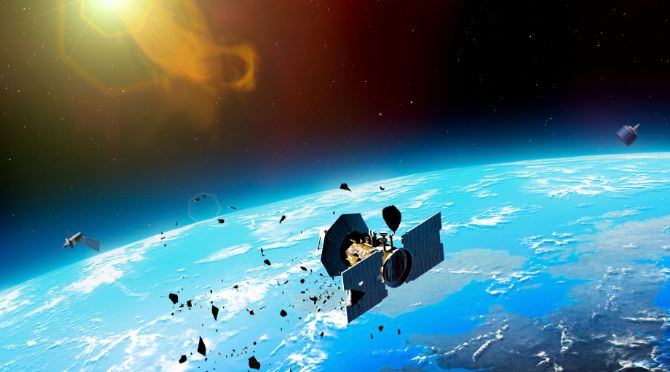
Baku, Jan 6: Once a week, on average, a spacecraft (or part of one) falls back into Earth's atmosphere; most of these objects are empty rocket stages, but some are dead satellites whose low orbits finally decayed enough for them to slip into the atmosphere, according to Space.com.They’re basically like human-made meteors, but most of them don’t survive long. This is because of the heat and shredding force that come with high-speed collisions with the air. However, some bits of debris from the objects can exist long enough to plummet through the sky, ranging from dust-mote-sized particles to whole propellant tanks. And this can be a big problem.
There’s a risk one of those stray pieces can hit a passing aircraft — that risk is small, but it’s growing enough that experts are now trying to figure out how to reduce it. Even in space, what goes up sometimes comes back down: spent rocket stages, defunct satellites and other bits of space debris are falling back into Earth’s atmosphere with increasing regularity. And as satellite constellations and general spacecraft operations continue to become more common, the risk of deorbiting space debris will only go up.
There’s a 26% chance that sometime in the coming year, space debris will fall through some of the world’s busiest airspace during an uncontrolled re-entry, according to a paper published early in 2025 by researchers at the University of British Columbia. The odds of that debris actually striking an aircraft (or vice versa) are small but measurable: By 2030, the chances of any given commercial flight hitting a piece of falling space debris could be around 1 in 1,000, according to a 2020 study.
Those odds don’t sound terribly daunting if you’re the gambling type, but given the number of planes crisscrossing the friendly skies at any given moment, that’s a lot of rolls of the dice. And it’s a high-stakes gamble; risk includes not just the likelihood of an event, but the potential outcome (hundreds of people dead, in this case of that 2020 study). That’s partly because commercial aircraft carry so many passengers, but it’s also because it takes a much smaller bit of debris to cause a catastrophe in the air than on the ground, especially where jet engines are concerned.
“Aircraft can be affected by much smaller pieces of debris. For example, airplanes flying through the ash of a volcano is risky because of the small particles,” European Space Agency space debris system engineer Benjamin Virgili Bastida told Space.com. “Kind of a similar thing could happen with re-entering debris.” Virgili Bastida and his colleagues recently published a paper in the Journal of Space Safety Engineering outlining the challenges of deciding when and where to close airspace for falling space debris.
One of the best known incidents of space debris affecting air traffic happened in November 2022, when the core stage of a Chinese Long March 5B rocket re-entered Earth’s atmosphere. It was the fourth time a Long March 5B had made an uncontrolled re-entry, and this time its ground track passed over Spain, prompting a flurry of airspace closures.
The Long March rocket was an unusual problem even by space debris standards; the roughly 20-ton core stage was much, much more massive than most spacecraft and rocket parts that drop back into the atmosphere (and China is no longer using that version of the rocket now that the final modules of its Tiangong space station are in orbit). China’s space agency also wasn’t very forthcoming about the rocket’s track or the fact that it was going to re-enter the atmosphere at all. But despite being an anomaly, the Long March incident is also a good illustration of both the potential danger and the need for more specific warnings, rather than broad ones.