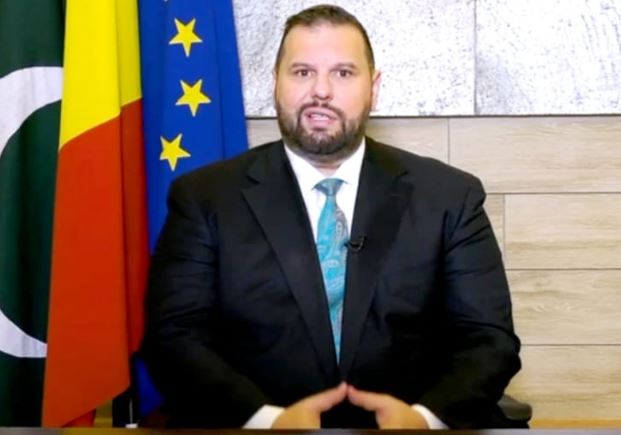
ISLAMABAD, MAR 22 /DNA/ – In a historic cultural gesture marking Pakistan Day, the Embassy of Romania in Islamabad has officially launched the world’s first choral arrangement and professionally prepared choral score of Pakistan’s national anthem, the Qaumi Tarāna.
The landmark initiative, realized by Romania’s renowned National Chamber Choir “Madrigal – Marin Constantin,” stands as a tribute to Pakistan’s rich musical heritage and a symbol of deepening friendship between the two nations.
The ambitious project, part of the Madrigal Choir’s broader “Diplomacy – The Anthems of the World” program, reimagines Pakistan’s national anthem—originally composed as an orchestral piece—for a polyphonic choir.
The arrangement distributes the melody across soprano, alto, tenor, and bass voices, carefully preserving the solemn character and musical complexity of the original work.
Composed in 1949 by Ahmed Ghulam Ali Chagla with lyrics penned in 1952 by renowned Urdu poet Hafeez Jalandhari, the Qaumi Tarāna was first broadcast on Radio Pakistan on August 13, 1954. Its first multi-voice recording followed in 1955, performed by eleven prominent Pakistani singers.
The new choral interpretation by the Madrigal Choir builds upon this tradition, offering a refined rendition that highlights the anthem’s expressive depth. Translating the anthem for choir presented significant artistic challenges.
The original orchestral composition encompasses approximately 38 distinct tones and was scored for around 21 instruments, resulting in a wide tonal range and complex harmonic progression. The anthem’s structure, which unfolds through continuously evolving musical phrases without a repeated refrain, added further complexity.
Additionally, the highly Persianized Urdu lyrics demanded precise articulation and coordinated pronunciation in a choral setting. Through extensive preparation and rehearsal, the Madrigal Choir successfully transformed these orchestral elements into balanced, singable vocal lines, creating a performance that honors the anthem’s musical integrity while showcasing the expressive power of collective vocal interpretation.
Dr. Dan Stoenescu, Ambassador of Romania to Pakistan, stated that his country was honored to bring to fruition this truly historic cultural project that would forever link the two nations. He noted that for the first time, Pakistan’s national anthem would have a dedicated choral arrangement and a professionally prepared choral score, made possible through the remarkable artistry of the National Chamber Choir “Madrigal – Marin Constantin” of Romania. He emphasized that this initiative stood as a testament to the power of culture and music to build bridges between peoples and to celebrate the shared values of friendship, respect, and artistic excellence.
As part of the initiative, the official album of the choral arrangement and the newly prepared choral score are being formally presented by Ambassador Stoenescu to Pakistan’s highest authorities, including President Asif Ali Zardari, Prime Minister Shehbaz Sharif, the Speaker of the National Assembly Sardar Ayaz Sadiq, the Chairman of the Senate Syed Yousaf Raza Gillani, and Chief of Army Staff General Asim Munir.
The ceremonial presentation symbolizes the spirit of friendship and cultural dialogue between Romania and Pakistan.
Founded in 1963 by the legendary conductor Marin Constantin, the Madrigal – Marin Constantin National Chamber Choir has become an emblem of musical excellence and cultural diplomacy. Renowned for its distinctive sound, non-vibrato technique, stereophonic stage placement, and imposing costumes, the ensemble has performed thousands of concerts on some of the world’s most prestigious stages and received numerous international awards.
The world-premiere choral arrangement of Qaumi Tarāna forms part of the program “Diplomacy – The Anthems of the World,” initiated in 2021 by the Madrigal Choir, dedicated to promoting cultural diplomacy and international dialogue through music.
Through this artistic tribute, Romania expresses its profound respect for Pakistan’s history, identity, and national values, reaffirming the shared belief that culture and music can bring nations closer together.