By Shazia Malik
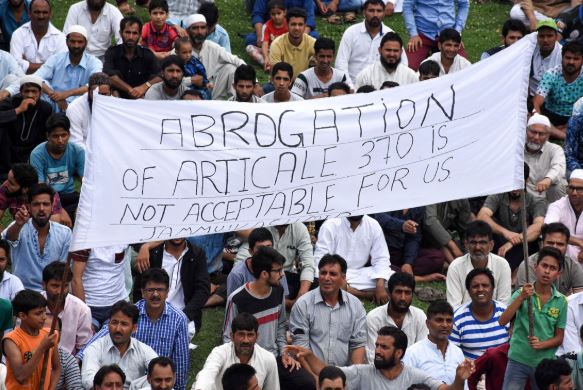
On the morning of August 5, 2019, India awoke to one of the most cruel constitutional decisions ever made in India, since Independence. In a move that had been central to the Bharatiya Janata Party’s (BJP) political agenda for decades, and an election promise, Prime Minister Narendra Modi’s government revoked Article 370, ending Jammu and Kashmir’s special constitutional status and reorganizing the state into two Union Territories.
Supporters hailed the decision as the final step toward India’s complete national integration, saying it would dismantle barriers to investment, curb separatism, strengthen security and bring Jammu and Kashmir under the same constitutional framework as the rest of the country.
As a highly controversial political decision in modern India’s history, constitutional experts, opposition leaders, human rights organizations, former civil servants, and academics have consistently argued that the manner in which Article 370 was revoked undermined India’s federal structure, weakened democratic institutions, and raised serious concerns about civil liberties.
Constitutional Questions
One of the strongest criticisms has focused not on whether Article 370 could eventually be amended, but on how it was revoked. Constitutional scholar A.G. Noorani, author of Article 370: A Constitutional History of Jammu and Kashmir, argued that the government bypassed the constitutional safeguards built into Article 370. He maintained that replacing the consent of the Jammu and Kashmir Constituent Assembly with the approval of Parliament—while the state was under President’s Rule—was constitutionally questionable.
Legal scholar, Gautam Bhatia, similarly argued that the government effectively used President’s Rule to alter the federal relationship between the Union and a state, creating a precedent whereby the Centre could substantially alter a state’s constitutional position while simultaneously acting on behalf of that state. Constitutional expert, Faizan Mustafa, also questioned whether Parliament could legally substitute itself for an elected state legislature in matters involving the state’s constitutional autonomy.
Critics pointed out that the procedure adopted by the BJP government stretched constitutional provisions beyond their intended purpose, weakening India’s federal framework.
Federalism Under Strain
India’s Constitution establishes a federal system in which states possess defined constitutional powers. Critics argue that the revocation of Article 370 fundamentally altered this balance. Former Finance Minister, P. Chidambaram, described the move as a dangerous precedent, arguing that if the Centre could downgrade one state into a Union Territory without its consent, similar powers might theoretically be exercised elsewhere. He along with another Congress leader Kapil Sibal, and several constitutional lawyers warned that allowing the Union government to alter statehood without elected state approval could weaken constitutional protections available to all Indian states. Political scientist Christophe Jaffrelot, has argued that the decision reflected increasing centralization of political power under the Modi government.
Democratic Deficit
Another major criticism concerns the political circumstances surrounding the revocation. Before the announcement, thousands of additional troops were deployed across Kashmir. Political leaders including Farooq Abdullah, IOJ&K’s current chief minister Omar Abdullah, and Mehbooba Mufti were detained. Internet services were suspended, curfews imposed, and communication networks shut down for months. Critics argue that such sweeping restrictions prevented democratic debate over one of the most significant constitutional changes since India’s independence.
Former bureaucrats belonging to the ‘Constitutional Conduct Group’, a collective of retired civil servants, questioned whether constitutional democracy could function effectively when elected representatives were detained during a constitutional transformation affecting their own state.
Human Rights Concerns
Human rights organizations have repeatedly criticized the restrictions imposed following the revocation. Amnesty International argued that prolonged communications blackouts, preventive detentions, and restrictions on peaceful assembly infringed upon fundamental human rights. Human Rights Watch, similarly documented concerns regarding arbitrary detention, limits on press freedom, and prolonged internet shutdowns.
The Office of the United Nations High Commissioner for Human Rights (OHCHR) also expressed concern regarding restrictions affecting freedom of expression, movement, and political participation. International media outlets including The New York Times, The Washington Post, The Guardian, and BBC News published extensive reporting highlighting the impact of communication restrictions on ordinary Kashmiris. The Modi government rejected many of these criticisms, maintaining that the temporary restrictions were necessary to prevent violence and terrorism during a sensitive transition.
Economic Promises Under Scrutiny
The government argued that removing Article 370 would unlock investment, create employment, reduce corruption, and integrate Jammu and Kashmir more fully with India’s economy. Critics acknowledge improvements in infrastructure and increased tourism but argue that economic gains have not matched the ambitious promises made in 2019. Economists and regional analysts point to persistent unemployment, limited private-sector investment, and continuing dependence on key government funding.
Business organizations have noted that security concerns and political uncertainty continue to influence investor confidence. Some critics also argue that economic development cannot substitute for political representation and democratic participation.
Political Representation
The conversion of Jammu and Kashmir from a full-fledged state into a Union Territory remains another contentious issue. Opposition leaders argue that reducing the status of a historic state into a centrally administered territory diminished democratic accountability.
The absence of an elected legislative assembly for extended periods after the reorganization further fueled criticism that the region was being governed primarily through bureaucratic administration rather than representative government. The government has maintained that full statehood would be restored at an appropriate time after delimitation and elections.
Supreme Court Judgment
The constitutional validity of the revocation was challenged before the Supreme Court of India. In December 2023, a five-judge Constitution Bench upheld the government’s decision, ruling that Article 370 had become a temporary provision and that the President possessed authority to issue the constitutional orders that facilitated its revocation.
The Court also directed the government to restore statehood to Jammu and Kashmir at the earliest opportunity and to conduct assembly elections. Although the judgment settled the legal challenge, many constitutional scholars continue to disagree with the Court’s reasoning, arguing that legality does not necessarily resolve broader debates about constitutional convention, democratic legitimacy, or federalism.
Continuing Debate
Seven years later, Article 370 remains one of India’s most talked about issue across the globe. Supporters of the Modi government point to declining militant violence in some areas, increased infrastructure spending, expanded welfare programs, and record tourist arrivals as evidence that the decision has strengthened national integration.
Critics, however, argue that constitutional procedures, democratic participation, and civil liberties were compromised in pursuit of political objectives. They contend that the revocation has fundamentally reshaped the relationship between the Union and the states, raising important questions about federalism, executive power, and constitutional safeguards. Whether viewed as a landmark act of national integration or a troubling departure from India’s constitutional traditions, the revocation of Article 370 is still driving political discourse.
Pakistan called revocation of Article 370 as an “illegal and unilateral” attempt to change the internationally recognized disputed status of Jammu and Kashmir. Islamabad accused the Modi government of violating international law and warned that the move could further destabilize South Asia. Islamabad maintained that Jammu and Kashmir is a disputed territory under United Nations Security Council (UNSC) resolutions and argued that no country could unilaterally alter its status pending a final settlement.
The Pakistani government responded by downgrading diplomatic relations with India, suspending bilateral trade, expelling the Indian High Commissioner, and recalling Pakistan’s envoy from New Delhi. It also launched an extensive diplomatic campaign at the United Nations, the Organisation of Islamic Cooperation (OIC), and other international forums, urging the international community to intervene over what it described as human rights violations and demographic changes in the region.
Pakistan’s Foreign Office repeatedly maintained that India’s actions violated the Fourth Geneva Convention, the Simla Agreement of 1972, and various UNSC resolutions concerning Kashmir. Islamabad also criticized the prolonged communications blackout, detention of Kashmiri political leaders, and restrictions on civil liberties imposed after the constitutional changes.
Successive Pakistani governments—including those led by Shehbaz Sharif—have continued to reject India’s decision, maintaining that lasting peace in South Asia depends on resolving the Kashmir dispute through dialogue in accordance with UNSC resolutions and the aspirations of the Kashmiri people. India has consistently rejected Pakistan’s position, asserting that the constitutional changes were an internal matter and that Jammu and Kashmir is an integral part of India. New Delhi has also maintained that Article 370 hindered development and that its removal has strengthened governance, security and economic opportunities in the region.
As elections, legal debates, and discussions about restoring full statehood continue, the decision remains a defining chapter in the constitutional history of modern India.