ISLAMABAD, DEC 8 /DNA/ – The geopolitical climate after the May 2025 Pakistan-India conflict has created a more conducive environment for Islamabad to advance the Kashmir cause through constructive diplomacy. In this regard, Pakistan’s enhanced regional stature and its strengthening relationship with the US should be leveraged to reinvigorate international attention toward Kashmir in line with UN resolutions. At the same time, Pakistan should exercise caution regarding India’s hegemonic ambitions and shifting strategic alignments in the region.
Such diplomatic openings matter because Kashmir is not a territorial dispute; it is an issue rooted in the denial of the right to self-determination. Despite decades of Indian repression, the Kashmiri people continue to demonstrate unwavering resolve in their pursuit of a just and dignified solution.
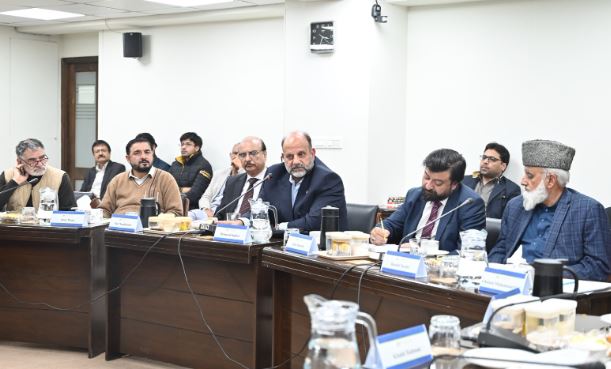
This was observed by speakers representing a diverse set of the Kashmiri diaspora during a session titled “Kashmir: Current Situation and a Possible Future Scenario,” held at the Institute of Policy Studies. The participants included Khalid Rahman, chairman IPS, Ambassador (r) Syed Abrar Hussain, vice-chairman IPS, Dr Waleed Rasool, senior research fellow IPS, Dr Ghulam Nabi Fai, secretary general of the World Kashmir Awareness Forum, and representatives of different Kashmiri-led global awareness forums.
Participants said that before May 2025, Kashmir was a forgotten issue. Despite the efforts of the Kashmiri diaspora across the world, scant attention was paid to the severity of human rights abuses in IIOJ&K. However, following Pakistan’s sweeping victory over India, the Kashmir resistance movement has been internationalized, and its unresolved status as a threat to regional security re-realized.
Speakers suggested that moving forward, building on its political, diplomatic, and military proficiency, Pakistan should leverage its close ties with the incumbent American leadership to resolve the Kashmir issue. To do so, Pakistan’s political leadership should engage with and convince the American leadership to make India abide by the UN resolutions on Kashmir. As part of this engagement, pressure on India should also be created to answer for human rights violations in IIOJ&K and the release of Kashmiri prisoners.
Furthermore, the international community also needs to be sensitized about a nuclear threat in South Asia that would keep looming until India abides by the UN resolutions on Kashmir.
Participants emphasized that the effectiveness of Pakistan’s Kashmir policy would depend on a coherent national position, backed by political consensus and articulated through a comprehensive document for international forums, including the UN and OIC. They called for the formation of a specialized professional team within the Foreign Ministry, both legal and political, to present Pakistan’s case globally with clarity and factual grounding.
Participants discussed the role of the diaspora community and observed that unity within the Kashmiri diaspora is critical for effective global advocacy. The diaspora was urged to engage international institutions and legal forums proactively and to highlight human rights abuses, incarceration of Kashmiri leaders, and demographic engineering in IIOJ&K. Engagement with civil society voices in India, supportive of human rights, was also encouraged.
Concluding the session, participants reiterated that unity among Kashmiris – both within the Valley and across the diaspora – is essential for amplifying their voice. A consolidated platform with a unified message, they stressed, is the need of the hour to counter divisive policies and sustain global awareness regarding the situation in IIOJ&K.