
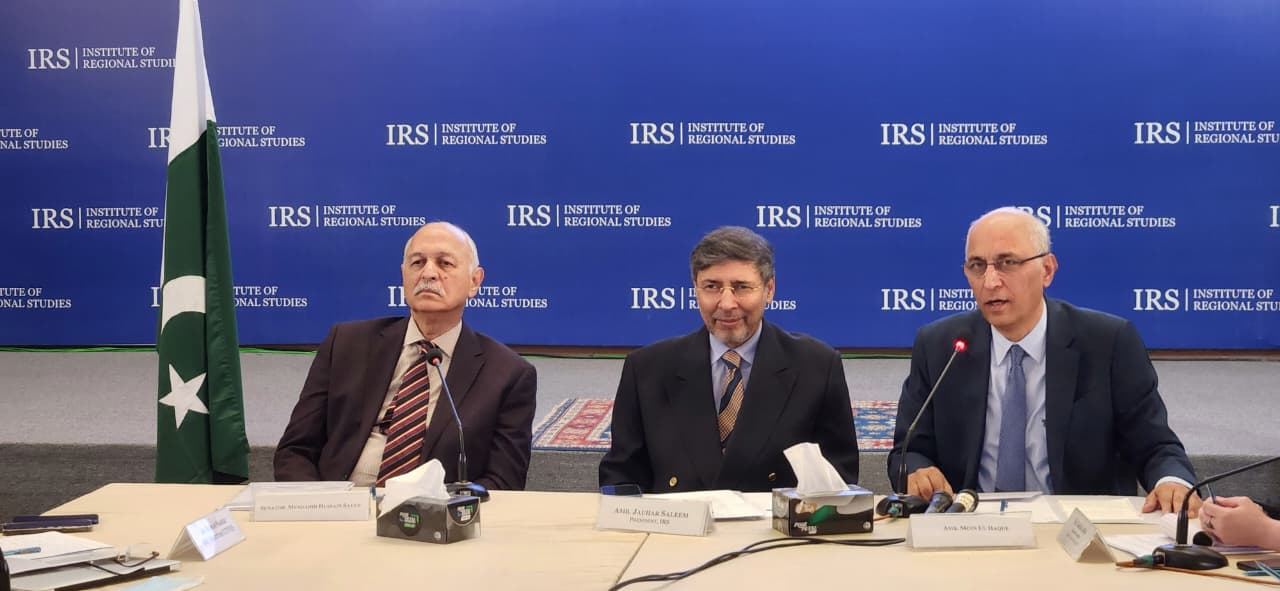
ISLAMABAD, MAR 12 /DNA/: The Institute of Regional Studies (IRS), Islamabad, hosted a roundtable discussion titled “Pakistan and China: Shared Perspectives on the Contemporary Regional Security Environment.” The event brought together prominent speakers Mushahid Hussain Sayed, Moin ul Haque, and IRS President Jauhar Saleem to discuss evolving geopolitical challenges and the convergence of Pakistani and Chinese perspectives on regional security.
The discussion examined the implications of the ongoing confrontation involving the United States, Israel, and Iran, as well as tensions between Pakistan and Afghanistan amid the resurgence of terrorism in Pakistan.
Ms. Nabila Jaffer, Lead of the China Program at IRS, introduced the speakers and highlighted the far-reaching consequences of the escalating conflict in West Asia.
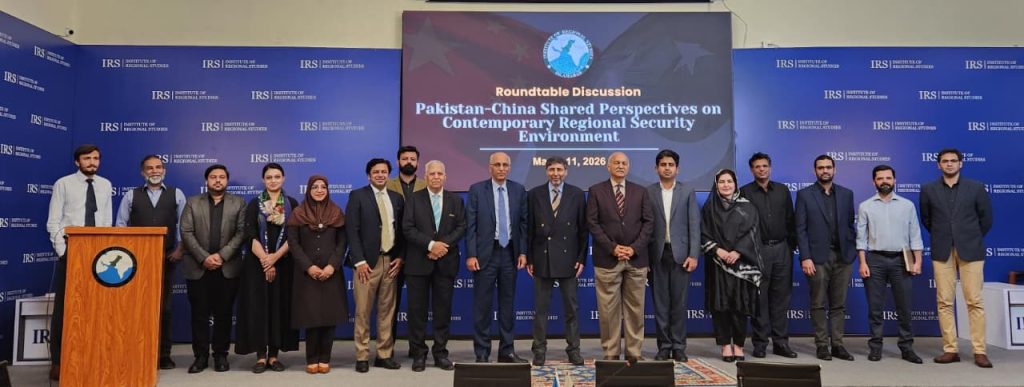
In his opening remarks, Ambassador Jauhar Saleem stressed that the ongoing conflict in West Asia has already sent shockwaves across the global political and economic landscape, warning that further escalation could trigger a significant economic shock. He delineated Pakistan’s principled position on the issue and underlined the need for resolving the widening conflict through peaceful dialogue. Referring to ongoing tensions between Pakistan and Afghanistan, he noted that the current situation reflects Kabul’s failure to respond positively to repeated diplomatic initiatives, through bilateral, regional, and international channels. He also drew attention to India’s role in fomenting terrorism in Pakistan and obstructing constructive engagement between Pakistan and Afghanistan.
Ambassador Saleem emphasized that the Pakistan–China partnership has remained an ‘important pillar of regional stability’ and highlighted the shared stance of Islamabad and Beijing in advocating dialogue and peaceful means to resolve conflicts.
Speaking on the occasion, Senator Mushahid Hussain Sayed described the current geopolitical situation as an “arc of conflict stretching from Israel to India.” Drawing attention to what he termed ideological parallels between Zionism and Hindutva, he remarked that “Modi and Netanyahu, Akhand Bharat and Eretz Israel, are two sides of the same coin,” arguing that both states have acted as “flagrant violators of international law, the United Nations Charter, and human rights.” He suggested that the recent actions by the United States and Israel against Iran were based on miscalculations, warning that such actions often prolong conflicts rather than resolve them. He also noted that Iran has demonstrated resilience despite mounting pressure, maintaining its political structure. Describing Iran and China as civilizational states with deep historical roots, he argued that such societies possess the endurance necessary for prolonged geopolitical competition. He also emphasized that developments across the Middle East, South Asia, and Afghanistan should be viewed as interconnected theatres shaping the broader regional security environment and added that Pakistan and China share closely aligned perspectives on regional peace and consistently advocate diplomatic solutions to conflicts.
Ambassador Moin ul Haque observed that the ongoing conflict carries implications far beyond geopolitics, affecting energy markets, trade routes, economic stability, and the livelihoods of millions of people. Referring to broader regional dynamics and the close strategic alignment between Israel and India, he characterized them as “expansionist, revisionist, and occupying powers,” with serious implications for Pakistan’s security environment. He emphasized that China has consistently stood by Pakistan in challenging times and noted that defence and security cooperation between the two countries plays an “irreplaceable and critical role in maintaining peace, stability, and strategic balance in the region.”
Ambassador Moin also stressed that both Pakistan and China remain committed to international law and the principles of the United Nations Charter, advocating “dialogue over confrontation, partnerships over alliances, multilateralism over unilateralism, and an equal and orderly international system.” Both countries, he noted, have condemned the attack on Iran as a violation of sovereignty and territorial integrity and called for ceasefire, dialogue, and de-escalation. He also cautioned that the conflict could escalate into wider regional involvement or other dangerous scenarios.












, Islamabad, hosted a roundtable discussion titled “Pakistan and China: Sha)