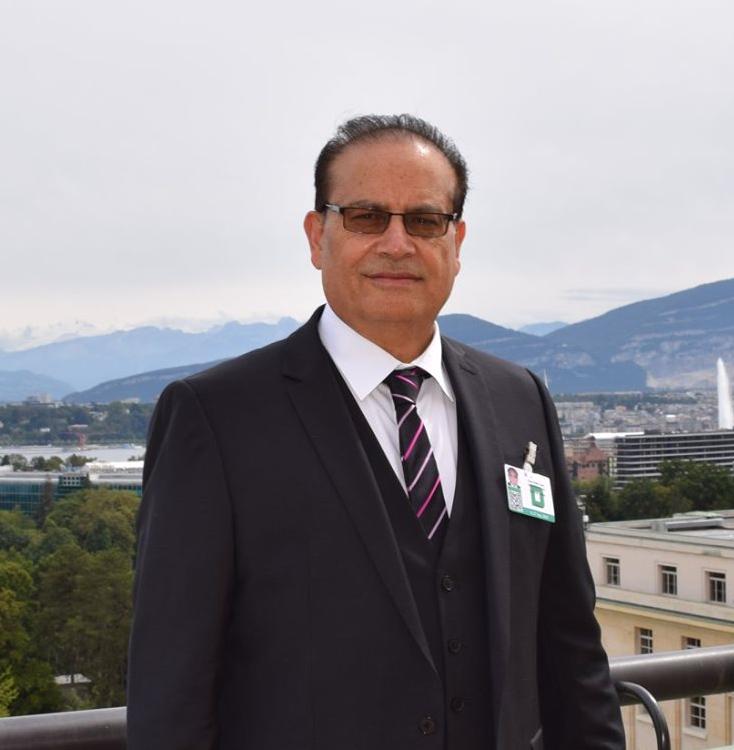
Qamar Bashir
In the ashes of the Second World War, humanity stood at the edge of civilizational collapse. Two catastrophic wars had devastated continents, killed more than 70 million people, and shattered the illusion that unrestrained nationalism and military power could coexist with global stability. Out of this devastation emerged one of the most ambitious political projects in human history: the creation of the United Nations in 1945. Designed largely under the leadership of the United States and its wartime allies, the institution was meant to prevent future wars, eliminate poverty, encourage diplomacy, and build a world governed by rules rather than brute force.
For nearly eight decades, the United Nations and its related institutions helped construct what came to be known as the “rules-based international order.” Agencies such as the World Health Organization, World Food Programme, International Monetary Fund, and World Bank worked to alleviate poverty, distribute health services, stabilize economies, and assist countries emerging from conflict. The United Nations oversaw peacekeeping missions in dozens of conflict zones, helped eradicate diseases like smallpox, and coordinated humanitarian aid to millions facing famine or displacement. The rule-based trading and financial architecture that followed—embodied in institutions like the World Trade Organization—enabled unprecedented economic growth across the globe.
Yet today, the institution that once symbolized humanity’s collective commitment to peace stands increasingly weakened. The very country that was instrumental in creating and enforcing this system appears to be drifting away from it. Since the return of Trump to the presidency, his rhetoric and actions have undermined the legitimacy of international law and institutions that once amplified American power. Trump has repeatedly emphasized that the United States possesses the most powerful military on Earth, the largest economy, and unmatched technological capability. While these facts are widely acknowledged—U.S. defense spending alone exceeds $850 billion annually, greater than the next ten countries combined—the repeated emphasis on raw power signals something deeper: a belief that international rules constrain American freedom of action.
For decades, the United States championed a system where even small nations possessed legal standing and diplomatic voice within the United Nations. The foundational principle was simple but revolutionary: sovereign equality. In theory, the smallest island nation had the same vote in the General Assembly as the largest superpower. This principle helped legitimize the system and ensured that disputes would be resolved through negotiation, consultation, and diplomacy rather than war.
However, the resurgence of “might-makes-right” thinking threatens to unravel that consensus. Increasingly, global politics appears to be drifting away from diplomacy toward unilateral action backed by military superiority. The use of strategic bombers such as the B-52 Stratofortress and stealth platforms like the B-2 Spirit symbolizes this shift. Rather than relying on multilateral consensus or international arbitration, military power is again being invoked as the ultimate arbiter of global disputes.
Nowhere is this erosion of international authority more visible than in the Middle East. Israel’s military operations across Gaza, Lebanon, Syria, and Iran have frequently proceeded despite criticism from international bodies and resolutions calling for restraint. Investigations and appeals from the International Court of Justice and multiple UN resolutions have had little practical effect on events on the ground. The devastating war in Gaza, which according to humanitarian agencies has resulted in tens of thousands of civilian casualties and widespread destruction of infrastructure, illustrates the limits of global institutions when powerful states choose to ignore them.
The inability of the United Nations to enforce its resolutions has led many analysts to question whether the organization still possesses meaningful authority. Critics increasingly describe it as toothless—a forum for speeches rather than an institution capable of imposing consequences on those who violate international law. In earlier decades, the credibility of the United Nations rested largely on the willingness of major powers, particularly the United States, to enforce its principles. When Washington itself begins to bypass those principles, the entire structure weakens.
Recent geopolitical events reinforce this perception. The United States has seized foreign oil shipments, imposed sweeping sanctions on adversaries, and conducted military strikes in multiple regions without clear UN authorization. Washington has also openly discussed strategic control over resources in regions such as Greenland and emphasized pre-emptive military action as a legitimate doctrine. These developments signal a shift away from the cooperative frameworks that once defined post-war international politics.
The consequences of this shift extend far beyond the Middle East. If international rules are no longer respected by their principal architect, other countries may follow the same path. Already, conflicts such as the war between Armenia and Azerbaijan, border tensions across Asia, and unilateral military actions by various regional powers reflect a growing willingness to bypass diplomacy in favor of force.
This erosion of legal norms creates a dangerous precedent. If powerful states feel free to violate borders, eliminate political leaders, or destroy infrastructure without accountability, smaller nations will face increasing insecurity. The collapse of trust in international law could also disrupt global commerce, maritime navigation, and air travel agreements that depend on mutual respect for established rules.
Ironically, this transformation could ultimately weaken the very country that once championed the rules-based order. The international system created after World War II magnified American influence by aligning global institutions with its values and interests. By abandoning those frameworks, Washington risks encouraging a fragmented world where competing blocs pursue power without restraint.
The war in Gaza illustrates another paradox. Despite overwhelming military superiority and the deployment of some of the world’s most advanced weapons systems, Israel and its allies have struggled to achieve decisive strategic outcomes against irregular forces. The persistence of groups such as Hamas and Hezbollah demonstrates that military might alone cannot resolve deeply rooted political conflicts. Even after years of bombardment and tens of thousands of casualties, the underlying grievances and power dynamics remain unresolved.
These realities raise a fundamental question: if overwhelming military force cannot eliminate small insurgent groups, what would be the consequences of applying the same strategy against a large and heavily armed nation like Iran? Iran has a population exceeding 90 million and a vast geographical landscape stretching across mountainous terrain. Any prolonged conflict would carry immense regional and global repercussions.
The deeper lesson may be that sustainable peace cannot be achieved through force alone. Lasting solutions require dialogue, diplomacy, and recognition of mutual sovereignty. The original vision behind the United Nations was precisely this: a system where disputes would be resolved through negotiation rather than war.
Today that vision appears battered, perhaps even buried. Yet history suggests that institutions often evolve through crisis. The devastation of two world wars gave birth to the United Nations. The present erosion of international law may eventually compel global leaders to reform and strengthen the very institutions that now appear weakened.
Humanity possesses one enduring advantage over the forces of chaos: the capacity for reflection and hope. If the United States and other major powers rediscover the value of the rules-based system they once built, the United Nations could yet regain its relevance. The alternative—a world governed solely by power and intimidation—would not merely undermine international stability. It would return civilization to the very conditions the United Nations was created to prevent.
In that sense, the future of the global order may depend not on military strength, but on whether humanity chooses once again to believe that law must stand above power.
Qamar Bashir
Press Secretary to the President (Rtd)
Former Press Minister, Embassy of Pakistan to France
Former Press Attaché to Malaysia
Former MD, SRBC | Macomb, Michigan