
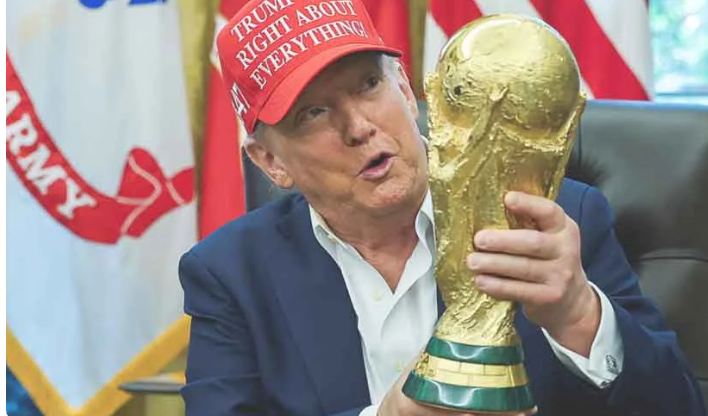
WASHINGTON: Donald Trump may still seem undecided on whether to call it soccer or football, but he clearly sees the sport as a tool to advance his diplomatic agenda.
On Friday, he will attempt to do just that during the 2026 World Cup draw in Washington, where he will meet the leaders of co-host nations Canada and Mexico.
The tournament, the first ever to be hosted by three countries simultaneously, offers a prime opportunity to showcase North American unity. The three leaders are expected to participate in a ceremonial draw dividing the 48 qualifying teams into 12 groups.
However, Trump’s contentious positions on trade, immigration, and drug trafficking complicate the diplomatic optics. For Mexican President Claudia Sheinbaum, this will be her first meeting with Trump. Sheinbaum told reporters that they would discuss bilateral trade during a brief meeting before the draw.
Canadian Prime Minister Mark Carney, who has previously visited the White House twice, will meet Trump for the first time since a brief encounter in South Korea last November, following a suspension of trade talks over a dispute involving an anti-tariff ad. Carney’s office confirmed he will also have a brief meeting with Sheinbaum during the draw at the Kennedy Center.
Trump has imposed steep tariffs on Canadian and Mexican exports not covered under the USMCA trade agreement and has threatened further action if either country fails to curb cross-border migration and drug trafficking. His earlier comments suggesting he would be “OK” with airstrikes on Mexico to target traffickers have particularly irked Sheinbaum. Canada, meanwhile, was offended earlier this year when Trump jokingly suggested it could become the 51st U.S. state.
Despite tensions, the three countries will host the world’s biggest sporting event together, following their joint bid launched in 2017 during Trump’s first term. The U.S. president has used the World Cup as a platform for political visibility, bolstered by his close ties with FIFA president Gianni Infantino, who has connections with multiple world leaders, including Vladimir Putin.
Trump even suggested the 2026 World Cup could serve as an “incentive” for Russia to end the war in Ukraine, though Russia remains banned from international football. On Friday, Infantino is expected to present a new FIFA “peace prize” that Trump is widely anticipated to receive.
Trump’s football diplomacy, however, clashes with his domestic immigration priorities. A special fast-track visa process was recently unveiled for World Cup ticket holders, but Secretary of State Marco Rubio cautioned that tickets do not guarantee entry to the U.S. Recent asylum freezes on 19 countries, including Haiti and Iran – both World Cup participants – have further fueled uncertainty.
Additionally, Trump has unsettled FIFA and foreign officials by threatening to move World Cup matches from Democratic-run cities where he has initiated anti-crime and immigration operations.
The 2026 World Cup draw thus presents a unique stage where Trump will attempt to balance sport, diplomacy, and domestic political priorities – with mixed optics likely on all fronts.