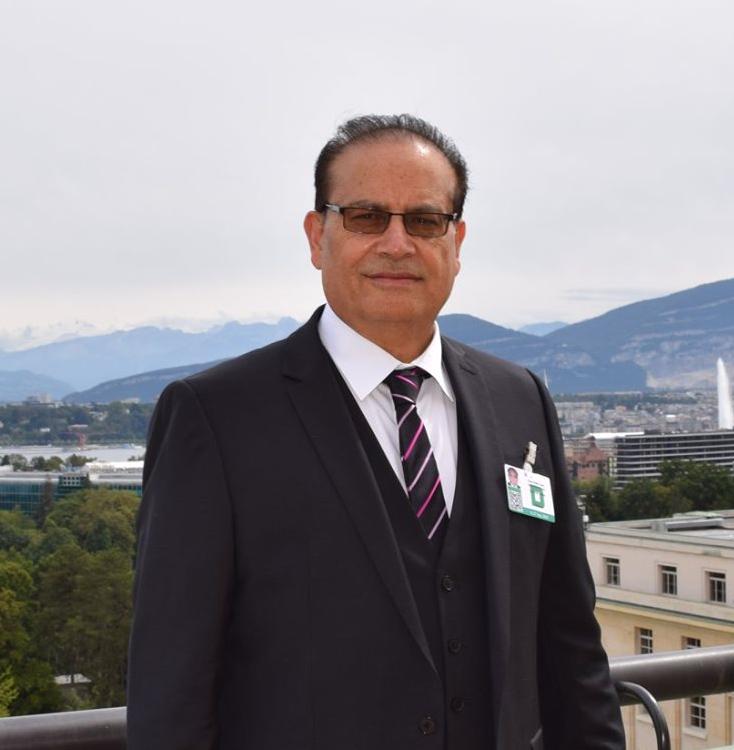
Qamar Bashir
Davos, the frostbitten alpine enclave carved into Switzerland’s high mountains, has long been more than a resort town. Each winter, it becomes a political and economic marketplace where presidents, CEOs, scholars, and strategists trade contracts, alliances, and narratives of power. Temperatures plunge far below freezing, yet inside the halls of the World Economic Forum, the climate of international relations often burns far hotter than the Alpine air outside.
This year, the world’s attention did not rest on climate pledges or investment forecasts. It centered on the arrival of U.S. President Donald Trump, whose speech was anticipated less as an economic update and more as a declaration of how Washington now intends to shape the global order.
Trump opened with triumph. He portrayed the United States as an economy in resurgence—investment surging, jobs expanding, inflation easing, and industrial capacity returning home. These claims are broadly aligned with recent U.S. data showing strong capital inflows into technology, defense, and energy sectors, alongside continued labor market resilience. But the applause quickly faded as Trump pivoted from domestic success to global power.
The real tremor came not from his economic optimism, but from his vision of security. At the center of his message stood Greenland.
For years, analysts speculated that American interest in Greenland stemmed from two forces reshaping the Arctic: the opening of polar shipping lanes as ice melts, and the presence of rare earth minerals essential for modern technologies. In Davos, Trump dismissed both assumptions outright. He made it clear, in unusually direct terms, that he neither needs Greenland’s minerals nor seeks control over emerging Arctic sea routes.
Instead, he framed Greenland as a cornerstone of what he described as a continental missile defense shield—“Golden Dome” over the Western Hemisphere. In his telling, the United States is building a layered system designed to detect, track, and intercept missiles from any direction, and Greenland’s geography, he argued, is indispensable to making that shield effective. Without Greenland, he suggested, the system would be incomplete—not only for the United States, but for Canada as well.
The message was stark: this was not about commerce or resources. It was about transforming the Arctic into a forward platform for hemispheric security. That declaration sent a ripple through European and North American delegations.
Denmark’s government has long and consistently rejected any notion of transferring Greenland. Danish Prime Minister Mette Frederiksen has publicly called the idea “absurd,” emphasizing that Greenland is not an object of transaction but a self-governing territory whose future lies in the hands of its people. Greenland’s own leadership has echoed this position, welcoming cooperation and investment, but insisting that sovereignty is non-negotiable.
French President Emmanuel Macron has framed the Arctic question as part of a wider European responsibility. He has warned against turning the polar region into a theater of militarization and great-power rivalry, arguing that Europe must defend both its territory and its principles through collective security, not through the logic of dominance.
Germany’s chancellor has taken a similar stance, stressing that the stability of the international system depends on respect for borders, multilateral institutions, and the rule-based order that emerged from the wreckage of the twentieth century. Berlin’s Arctic policy, like much of Europe’s, emphasizes environmental protection, scientific cooperation, and governance through international frameworks rather than unilateral security architecture.
Canada, placed directly under Trump’s proposed “dome,” found itself in an especially delicate position. Ottawa has repeatedly affirmed that Arctic defense must be managed through NATO, NORAD, and international law, not through territorial realignment. Canadian officials have consistently stated that security in the North is a shared responsibility among circumpolar nations, not a justification for redrawing sovereignty.
Even Russia, often cast as the primary strategic rival in the polar north, has responded with measured caution. While Moscow continues to expand its Arctic military and infrastructure footprint, its official statements warn against turning the region into a flashpoint for confrontation, arguing instead for stability through treaties and regional cooperation.
Trump’s response to this resistance was neither conciliatory nor ambiguous. He described American military power in sweeping terms, emphasizing precision, reach, and technological dominance. He portrayed the U.S. defense system as unmatched—capable of neutralizing adversaries’ air defenses, striking targets across continents, and shaping the battlefield before rivals can respond. The tone was not diplomatic. It was declarative.
Security, in this vision, does not flow from international law or collective institutions. It flows from capability. His criticism extended to the very architecture of global governance. He questioned the effectiveness of the United Nations, arguing that it has failed to prevent wars or enforce peace, and suggested that Washington would increasingly disengage from international bodies that do not align with U.S. strategic priorities. This echoed earlier American withdrawals from multilateral agreements and institutions, reinforcing the image of a superpower stepping away from the system it once helped build.
Inside Davos, the contrast could not have been sharper. European leaders spoke of interdependence, shared security, and the dangers of a world governed by raw power rather than negotiated norms. Policy analysts warned that transforming sovereignty into a strategic variable—something to be adjusted for defense planning—could unravel decades of diplomatic precedent.
Beyond the speeches and symbolism, the implications run deep.If security becomes transactional—granted in exchange for alignment rather than guaranteed by law—then smaller and middle powers face a narrowing set of choices. They can align themselves with a dominant power’s strategic architecture, or they can seek protection through alternative coalitions, regional defense pacts, and diversified economic networks.
This shift is already visible. Countries across Europe, Asia, and the Global South are exploring ways to reduce reliance on single markets, single currencies, and single security patrons. New trade corridors, regional financial arrangements, and defense dialogues reflect a world quietly preparing for a future where power is more fragmented and competition more explicit.
Trump’s Davos address suggested that the post–Cold War era of institutional globalism may be giving way to a new age of fortified blocs—where defense systems, trade networks, and political alliances align along hard lines of strategic interest rather than shared ideals.
The world now stands at a crossroads. One path leads toward renewed commitment to multilateralism, where power is constrained by law and cooperation tempers rivalry. The other points toward a landscape of competing spheres of influence, where technological dominance and military reach define who sets the terms of global order.
Davos, once a forum for consensus, has become a stage for confrontation. And as snow continues to fall on the Alpine peaks, the chill spreading across international relations may prove far more enduring than the winter cold. The question now confronting the world is no longer whether a new order is emerging—but whether it will be shaped by dialogue, or by the silent geometry of missile shields drawn across the sky.
Qamar Bashir
Press Secretary to the President (Rtd)
Former Press Minister, Embassy of Pakistan to France
Former Press Attaché to Malaysia
Former MD, SRBC | Macomb, Michigan