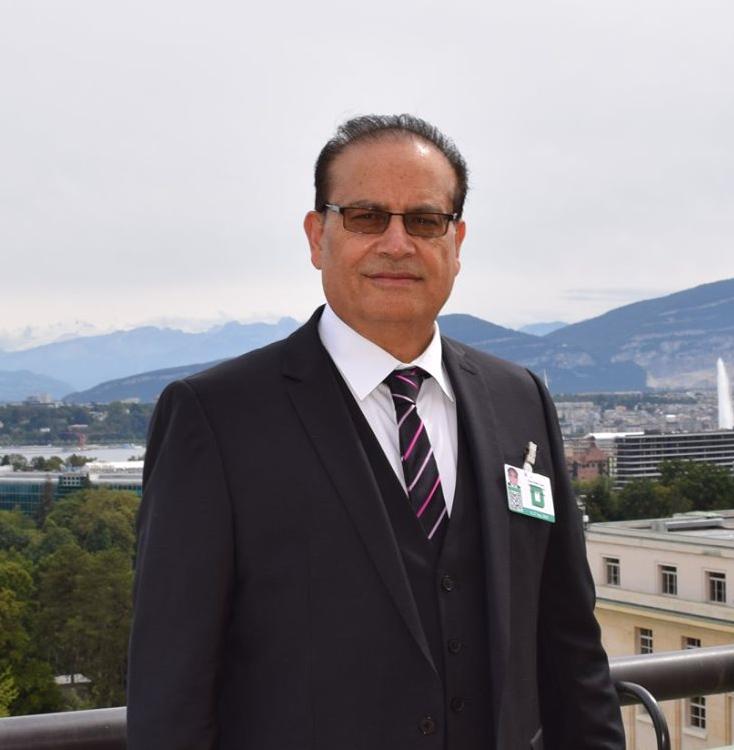
Qamar Bashir
President Donald Trump’s casual but chilling reference to an “armada” of U.S. warships heading toward the Middle East has once again pulled the world into a familiar but deeply unsettling theater of power, pressure, and peril. Speaking aboard Air Force One, he framed the movement of naval force as a precaution—“just in case”—while pointing to what he called a “good sign” that Iran had paused the hanging of protesters. Yet behind this language of conditional restraint lies a strategic pattern that many across the developing world, and especially in the Middle East, recognize all too well: the choreography of threat, softening, and sudden strike.
The USS Abraham Lincoln carrier strike group, with its five thousand sailors, squadrons of fighter jets, electronic attack aircraft, and escort ships, was already moving through the Indian Ocean as Trump spoke. It will soon join destroyers and littoral combat ships in a region that has rarely gone long without a U.S. aircraft carrier patrolling its waters. The official justification is deterrence—ensuring Iran does not escalate its response to mass protests that erupted in late December over worsening economic conditions.
There is a deeply rooted memory, especially in countries that have lived through the consequences of great-power intervention, of how negotiations and reassuring rhetoric can unfold alongside active military preparation. In Pakistan’s case, assurances were once delivered at the highest levels even as U.S. forces were already in motion—American cruise missiles crossed Pakistani airspace and struck targets inside Afghanistan, despite parallel diplomatic engagements and the presence of senior U.S. generals in Islamabad offering guarantees that Pakistan’s territorial integrity would not be violated. A similar pattern, in this view, emerged during periods when Iran was engaged in nuclear negotiations and discussions over its regional role, only to face sudden, precision strikes against sensitive military and nuclear-related sites under the cover of diplomatic dialogue. For many in the region, these episodes have fused into a collective perception that threats, softening gestures, and sudden force are not separate phases, but part of a single strategic sequence—one designed to lower vigilance before the moment of decisive action.
This is why Trump’s “armada” comment resonates far beyond Washington or Tehran. It revives fears of a scenario in which the visible calming of tensions becomes the prelude to a more devastating escalation. The strategic geography makes those fears sharper. The Middle East is not just a battlefield of ideologies and alliances; it is the heart of the global energy system. The Strait of Hormuz, a narrow maritime artery through which a significant share of the world’s oil supply passes, lies within the range of any serious confrontation between the United States, Iran, and their respective allies.
From a military perspective, the asymmetry of power is stark. The United States and Israel possess unmatched capabilities in intelligence, cyber operations, satellite surveillance, and precision strike. Carrier-based aircraft, submarines, and long-range missiles offer the ability to hit multiple targets across Iranian territory within hours. Analysts often point to the vulnerability of fixed installations—nuclear enrichment sites, command centers, and air defense systems—to such a coordinated assault. The possibility of decapitating strikes against senior leadership, a tactic seen in other conflicts, adds another layer of volatility to the equation.
Iran, for its part, is not without options. Its strategy has long relied on a combination of conventional forces, missile capabilities, and a network of regional allies and proxies across Iraq, Syria, Lebanon, and Yemen. Any large-scale attack on Iranian soil would almost certainly trigger responses against U.S. bases in the region and against Israel, potentially pulling multiple states into a widening conflict. Even limited engagements could spiral rapidly, driven by miscalculation, domestic political pressures, or the simple momentum of retaliation.
Yet the most complex challenge Iran faces today is not purely military. The protests that have shaken the country since late December represent a profound internal strain. Managing unrest at home while confronting external pressure stretches any state’s capacity. Energy, attention, and resources must be divided between maintaining domestic order and preparing for potential confrontation abroad. This dual-front reality complicates decision-making in Tehran and increases the risk of unintended escalation.
The specter of broader involvement looms as well. China and Russia, both significant players in global energy markets and strategic rivals of the United States, have their own stakes in the stability of the Gulf. Disruptions to Iranian oil exports or regional shipping would affect their economies and their geopolitical calculations. While direct military intervention by these powers may be unlikely, their diplomatic, economic, and possibly covert responses could further complicate an already crowded chessboard.
Beyond strategy and statecraft lies the human cost. The last decades of conflict in the Middle East have produced waves of refugees, shattered cities, and generations marked by trauma. A new, large-scale war involving the United States, Israel, and Iran would not be confined to military targets. It would reverberate through civilian populations, sending millions fleeing across borders and deepening humanitarian crises in countries already struggling with displacement and poverty.
This is why Trump’s offhand phrase—“just in case”—carries such weight. It suggests a readiness to cross a threshold that, once crossed, cannot easily be uncrossed. The movement of an armada is not a symbolic act; it is a material commitment of lives, resources, and global attention. It signals to allies and adversaries alike that the option of force is not theoretical but operational.
Yet there remains another path, one that history shows is harder to sustain but far less costly in the long run. Diplomacy, backed by genuine multilateral engagement rather than unilateral pressure, offers a way to address both Iran’s internal crisis and the region’s broader security dilemmas without lighting the fuse of a wider war. Such an approach requires patience, restraint, and a willingness to accept outcomes that may fall short of maximalist goals.
The world now watches as warships move across the Indian Ocean and protesters continue to fill Iran’s streets. Between these two forces—one internal, one external—lies a fragile moment in which choices made in Washington and Tehran will shape not only their own futures but the stability of the global system. An armada can project power, but it cannot rebuild trust, heal societies, or secure lasting peace.
In the end, the true test of leadership will not be measured by the number of ships deployed or the range of missiles at the ready, but by whether this moment of tension becomes another chapter in a long history of devastation or a turning point toward a more durable, if imperfect, equilibrium. The stakes are not just regional. They are global, and they will be felt in the lives of millions who have no voice in the decisions now being made over the waters of the Gulf.
Qamar Bashir
Press Secretary to the President (Rtd)
Former Press Minister, Embassy of Pakistan to France
Former Press Attaché to Malaysia
Former MD, SRBC | Macomb, Michigan