
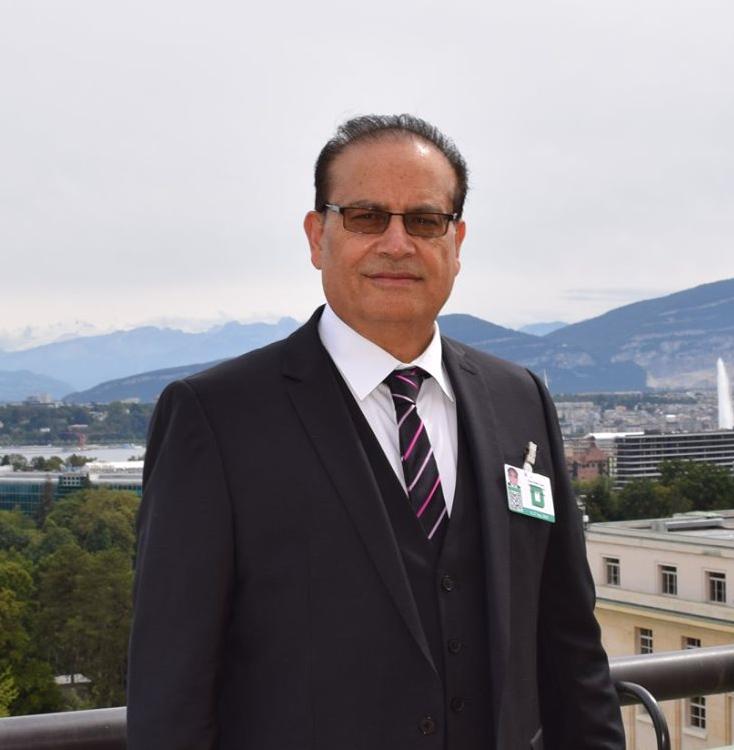
Qamar Bashir
In his first term, Donald Trump unsettled the international system but did not fully dismantle it. Bureaucratic inertia, judicial limits, and allied resistance acted as brakes. In his second term, those restraints have largely disappeared. What is unfolding now is not simply an assertive foreign policy, but a systematic effort to dismantle the post–World War II international order—an order built around the United Nations, collective security, multilateral problem-solving, and the idea that power must be tempered by rules.
That intent became unmistakable on January 7, 2026, when President Trump signed a Presidential Memorandum directing the United States to withdraw from 66 international organizations deemed no longer aligned with American interests. The order instructed all executive departments and agencies to cease participation in and funding for 35 non-UN bodies and 31 UN entities. This sweeping decision followed a government-wide review of every international organization, treaty, and convention in which the United States holds membership or provides financial support. The stated rationale was blunt: these institutions were judged to operate against U.S. national interests, sovereignty, economic prosperity, or security, or to function so inefficiently that American taxpayer dollars were “better allocated elsewhere.”
The administration framed the move as an act of reclamation—“restoring American sovereignty.” Officials argued that many of the targeted organizations promote what they describe as globalist governance, radical climate policies, and ideological agendas incompatible with U.S. priorities. Billions of dollars, they contended, had been spent on bodies that routinely criticize U.S. policy, dilute American influence through one-nation-one-vote structures, or fail to deliver measurable results. Withdrawal, in this view, was not isolationism but efficiency: cutting costs, ending constraints, and redirecting resources toward “America First” objectives.
This memorandum did not emerge in isolation. Immediately upon returning to office, President Trump renewed the U.S. withdrawal from the World Health Organization and the Paris Climate Agreement. On his first day, he also notified the Organization for Economic Co-operation and Development that its Global Tax Deal would have “no force or effect” in the United States, while ordering an investigation into whether foreign tax regimes unfairly target American companies. Weeks later, he signed an executive order withdrawing from the UN Human Rights Council and permanently prohibiting U.S. funding for the UN Relief and Works Agency for the Near East. The January 7 memorandum consolidated these actions into a single doctrine: disengage, defund, and dismantle multilateral constraints.
That institutional retreat has been paired with a dramatic expansion of hard power. The U.S. defense budget for 2026 stands at approximately US$901 billion, already the largest in the world by a wide margin. President Trump has now proposed raising military spending to US$1.5 trillion in 2027, citing “troubled and dangerous times.” This figure would exceed the combined defense spending of the next several major powers. By comparison, the entire European continent—including all NATO members except the United States—collectively spends roughly US$300–350 billion annually, lacks unified command, and depends heavily on U.S. strategic enablers. The gap underscores a shift from deterrence to dominance.
That dominance was displayed on January 3, 2026, when U.S. forces carried out a sudden military operation in Venezuela, capturing President Nicolás Maduro and transferring him to the United States to face federal drug-trafficking charges. U.S. naval and air assets surged in the Caribbean, while Venezuelan oil exports were effectively sealed off under intensified enforcement. Regardless of legal justifications, the geopolitical meaning was stark: a sitting head of state was removed by force. The precedent shattered long-standing norms of sovereignty and reinforced the administration’s belief that power, not process, is the ultimate arbiter.
From the Caribbean, the strategic focus turns northward—to the Arctic and Greenland. Greenland has moved to the center of U.S. attention because climate change is rapidly transforming the region. As Arctic ice melts, new sea routes are emerging that could shorten Asia–Europe shipping distances by up to 40 percent. Analysts estimate that a fully viable trans-Arctic corridor could eventually carry trade worth hundreds of billions of dollars annually, reducing reliance on chokepoints like the Suez Canal and reshaping global commerce.
Greenland also holds significant mineral potential. The island contains deposits of rare earth elements, zinc, iron ore, uranium, neodymium, dysprosium, cerium, gallium and other critical minerals essential for advanced electronics, defense systems, and energy technologies. The strategic value lies in future access combined with geography. Greenland sits astride the North Atlantic and Arctic approaches, offering proximity to Russia’s northern flank and growing Chinese polar interests.
Demographically and politically, Greenland is small but democratic. Its population of roughly 56,000, overwhelmingly Inuit, governs itself through an elected parliament under a system of extensive autonomy within the Kingdom of Denmark. What Greenland lacks is military capability. That asymmetry fuels the dangerous assumption that control could be asserted without resistance—a notion that sends shockwaves through Europe.
For European allies, particularly Denmark, this is a profound betrayal. Denmark was among NATO’s most committed contributors in Afghanistan, suffering one of the highest per-capita casualty rates. For decades, Europe accepted reduced military autonomy in exchange for American protection. Now, the prospect that territorial threat could originate from the alliance’s dominant power has forced a strategic reckoning. Only France and the United Kingdom retain full-spectrum capabilities, including nuclear deterrence. The rest are scrambling to rebuild defenses hollowed out by dependence.
This strikes at the heart of NATO. An alliance cannot survive when its strongest member behaves as a territorial revisionist. If the United States were to assert control over Greenland, NATO would not collapse under external attack; it would die of internal contradiction. In such a scenario, the strategic logic underpinning the war between Ukraine and Russia would also change. A hollowed-out NATO would no longer represent a coherent expansion threat to Russia, eroding the rationale that has sustained confrontation with Ukraine.
What emerges is a world in accelerated realignment. Europe is reconsidering dependence, Latin America braces for renewed interventionism, and Asia prepares for maritime and economic confrontation. With the United Nations weakened and multilateral forums abandoned, disputes that once might have been mediated now drift toward unilateral force.
These are perilous times. The January 7 withdrawal from 66 international organizations marks not a tactical adjustment, but a strategic severing from the architecture that once stabilized global politics. Power is being centralized, institutions dismantled, and restraint discarded. History suggests that such moments rarely end quietly. The choice before the world is stark: rebuild collective order—or prepare for an era in which power alone decides, and the world order is not merely weakened, but buried.
Qamar Bashir
Press Secretary to the President (Rtd)
Former Press Minister, Embassy of Pakistan to France
Former Press Attaché to Malaysia
Former MD, SRBC | Macomb, Michigan, USA
Trump’s War on the World Order: Burying the United Nations, NATO, and Multilateralism