
By Zhong Sheng, People’s Daily
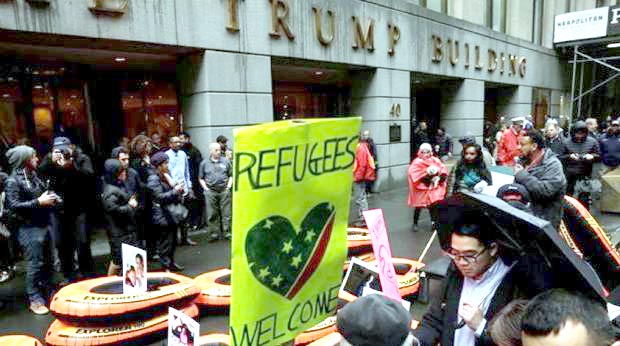
The United States is a nation of immigrants. However, the history of U.S. treatment of immigrants is one rife with inhumane tragedies such as discrimination, exclusion, arrest, detention, expulsion, and a litany of human rights abuses.
Worse still, recent years have witnessed one humanitarian disaster after another caused by the U.S. government on refugees and immigrants going to the country. Ironclad facts have laid bare the lies and double standards on the issue of refugees and immigrants in the country, a self-proclaimed “beacon of democracy.”
The U.S. has a dark history filled with inhumane tragedies in the treatment of immigrants. People of Irish, Japanese, Eastern European, Southern European, Latino, and Middle Eastern origins have all been discriminated against and excluded in the U.S.
The anti-Chinese movement is among the most infamous in discriminating and ostracizing immigrants in U.S. history. It led to the first and only law in the U.S. to ban all members of a specific ethnic group from immigrating to the country on the grounds of race and nationality, namely the Chinese Exclusion Act. It was not until 1943 that this act was formally repealed.
The harms of historical enslavement still haunt black descendants today. Their rights to life, development and political participation are not effectively secured.
The UN Committee on the Elimination of Racial Discrimination said in the Concluding observations on the combined tenth to twelfth reports of the United States of America released in September 2022 that the lingering legacies of colonialism and slavery continue to fuel racism and racial discrimination around the country.
In the 21st century, successive U.S. administrations have increasingly restricted immigration and treated immigrants harshly and inhumanely.
Migrant children have been forcibly separated from their parents and held in cages with only thin blankets on their bodies. Some refugees were brutalized by U.S. border enforcement agencies, with patrols on horseback wielding horse whips, charging into the crowd, and driving them into the river.
The migrant truck tragedy was the nation’s most serious migrant death case to date, in which 53 people died from the stifling heat.
Volker Turk, the UN High Commissioner for Human Rights, criticized the U.S. government’s border immigration policy as a threat to the basic rights of asylum seekers and undermines the foundation of international human rights and refugee law.
Today, the serious discrimination in American society against immigrants and their descendants remains. “Asia Hate” has been particularly prominent in recent years. According to a 2022 survey by Stop AAPI Hate, the organization had reported 11,467 hate incidents targeting Asian Americans and Pacific Islanders (AAPIs) over the past two years.
Deep-rooted racial discrimination in the U.S. is an important cause of its immigration problem, and political polarization in the country is worsening its immigrant issue.
Racism is embedded in U.S. immigration policies and its attitude toward immigrants. A poll indicated that 56 percent of American voters believed the U.S. remained a racist society, and 70 percent of black respondents believed that more than half of white Americans believe in white supremacy.
Both Democrats and Republicans had put forth their own immigration reform proposals, but they all hit a dead end very soon. Both parties have used the refugee and immigrant issue as political leverage, but neither of them has found real solutions.
Conservative politicians and media in the U.S. are hyping up the immigrant threat and stoking anti-immigration sentiment, and this extreme idea has led to multiple terrorist attacks targeting immigrants and ethnic minorities in the country.
The entrenched immigration and refugee problem in the country is to a large extent a result of its hegemonic, domineering, and bullying practices. Refugee issues always exist around the world wherever the U.S. brings its hegemony to.
According to UN statistics, U.S. military intervention in Syria has left at least 350,000 people dead, 12 million displaced and 14 million in urgent need of humanitarian assistance. The UN refers to the Syrian refugee problem as “the biggest humanitarian and refugee crisis of our time.”
Over the past two centuries since Monroe Doctrine came into being, the U.S. has conducted more than 30 military interventions in Latin American countries, forcibly exported U.S.-style democracy to regional countries, implemented predatory economic policies, and even instigated regime subversion. When the people there, driven to a desperate state by the poverty and turmoil created by the U.S., tried to flee north, they were denied access by the U.S. and were even violently arrested and incarcerated.
“The United States spent decades contributing to regime change and destabilization in Latin America,” criticized Alexandria Ocasio-Cortez, a Democratic member of the U.S. House of Representatives, “We can’t help set someone’s house on fire and then blame them for fleeing.”
The U.S. needs to seriously reflect on its terrible record on the issue of refugees and immigrants and correct its course, and make real efforts to improve the situations of foreign refugees and immigrants in the country. It should stop all hegemonic and bullying practices, stop creating new crises, stop acting like a “human rights guardian,” and stop using human rights as a pretext to smear and attack others.
(Zhong Sheng is a pen name often used by People’s Daily to express its views on foreign policy and international affairs.)