Qamar Bashir
In the dark and trembling hours of January 3, 2026, the mighty arms of the United States stretched deep into Caracas, Venezuela, in what President Donald Trump described as the most daring, precise, and coordinated military operation ever mounted in the Western Hemisphere. More than fifteen thousand U.S. ground, air, and naval personnel took part in the strike, moving with breathtaking speed, sealing borders, disabling command networks, neutralizing security systems, and overwhelming any potential resistance before the first rays of dawn touched the capital. By the time the city awoke, the mission was complete. Venezuelan President Nicolás Maduro and his wife had been captured and removed from Venezuelan soil without significant resistance from the military, intelligence, or political structures that once upheld the regime. Trump declared that Maduro would now face justice in New York under existing federal indictments accusing him of narcotics trafficking, financing cartel activities, and orchestrating the flow of cocaine into the United States — charges U.S. prosecutors had filed years earlier in the Southern District of New York.
Trump praised the operation as a triumph of intelligence mastery and overwhelming force, suggesting that every moment of Maduro’s movements and every layer of Venezuela’s security architecture had been mapped and anticipated before the first American boot touched the ground. But what followed in his press conference was more astonishing still. When asked who would now govern Venezuela, President Trump stated bluntly that the United States would run Venezuela — not temporarily in a symbolic sense, but practically, functionally, and administratively — until American oil companies were reimbursed for the assets that had been nationalized, until they had regained operational control, rebuilt production capacity, restored the pipeline grid, and resumed the pumping of oil to full capacity.
In other words, Trump declared that the United States would govern Venezuela until U.S. companies had recouped their economic losses and restored the flow of profits and petroleum. Only then, he said, would there be a transition to a Venezuelan-run government. For all intents and purposes, the United States had not only removed a president — it had taken control of a nation that holds the largest proven oil reserves in the world, greater even than Saudi Arabia’s. This was not framed as humanitarian intervention. This was open, unapologetic economic conquest tied directly to corporate loss and the restitution of American business rights.
Trump went further. He accused Cuba of embedding its personnel within Venezuelan security forces, of sustaining the Maduro system, and of overseeing elements of state control. He called the Cuban government corrupt and incompetent, running an economy in ruins, and he warned that Havana might be next. Argentina was also singled out as a government he described as mismanaged and resistant to American interests. Colombia, too, was placed on notice. Even Greenland was mentioned again in the familiar language of strategic ambition. The message was clear and deliberate. If a nation resists U.S. political or economic priorities, if it obstructs American corporate assets, or if it stands in alignment with Washington’s adversaries, it may now face overwhelming military and economic pressure — up to and including regime removal.
At the same time, the Middle East trembles. Iran, long sanctioned and squeezed, now faces an internal economic collapse that has pushed people into the streets in more than thirty cities. The Iranian rial has plunged to record lows. Prices for food and basic goods have soared. Salaries have evaporated. Inflation has hollowed out household life. The working poor and middle class alike now carry the unbearable weight of survival. Demonstrations echo across Tehran, Isfahan, Shiraz, Mashhad, and beyond. Women remove their hijabs openly on camera as an act of defiance. Chants fill the air. Shops shutter. Traffic stops. Security units respond with force. Arrests multiply. The government insists it will restore order. Yet history quietly whispers that revolutions endure only as long as they provide bread.
Since the 1979 revolution, Iran has withstood sanctions, sabotage, cyber-warfare, covert operations, assassinations, and countless diplomatic isolations. But this crisis is different. This crisis lives in the kitchen, the market, the currency exchange, the child’s empty lunchbox, the unpaid electricity bill, and the father who cannot afford medicine. Economic pain has become political reality. If Iran cannot stabilize its crippled currency, reconnect to global markets, relieve sanctions pressure, and prove to its people that life can improve, then the flames of protest will not vanish. They will deepen. They will harden. They will return again and again.
Benjamin Netanyahu has long called Iran an existential threat, urging action and regime change. Trump now echoes a new chorus: the Iranian regime is weakening, faltering, running out of breath. Tehran, meanwhile, insists it remains unbroken. But the truth is simple. No government survives forever on slogans alone. It must feed its people.
Against this backdrop, the United Nations appears increasingly sidelined. International law looks fragile. Sovereignty — the sacred shield of nations — now seems conditional on power. When a superpower can enter a sovereign nation, remove its president, place him on a military aircraft, fly him to New York, declare that it will govern that nation until private corporate losses are fully reimbursed, and then warn a list of additional countries that they may be next — the global order has shifted in real time.
Two great human stories now run in parallel. Venezuela has been conquered not metaphorically, but administratively and economically under a new form of corporate-military governance. Iran teeters on the brink of internal fracture driven by economic collapse. And Trump has openly declared to Cuba, Argentina, Colombia, and Greenland that they too will face American power if they stand in Washington’s way. The map is being redrawn. Not quietly. Not diplomatically. But with microphones, sanctions, indictments, and armies.
Let us hope that from these convulsions emerge not only new borders and new alliances, but dignity, prosperity, and justice for the ordinary people whose lives move beneath the gears of great power. Because in the age now dawning, might does not whisper. It speaks in the open.
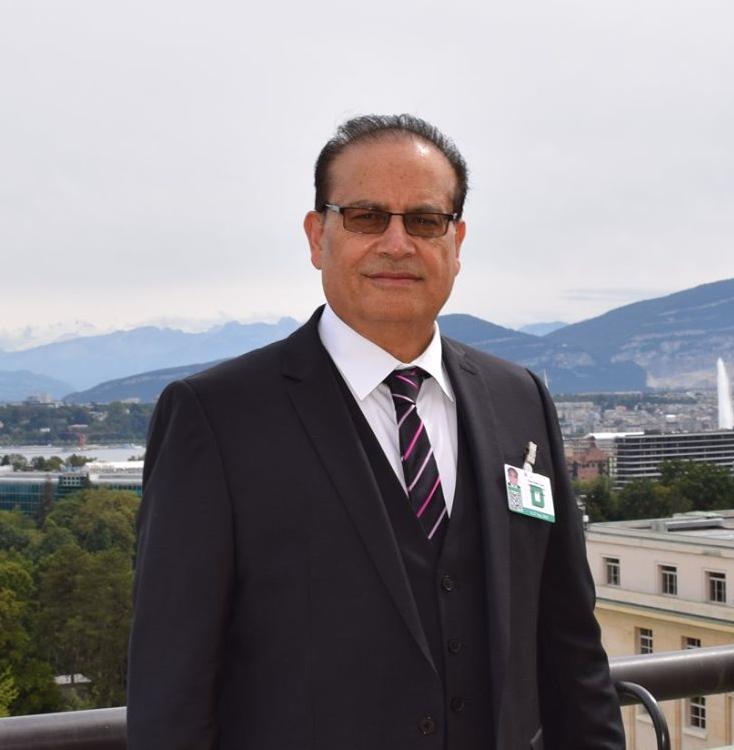
Qamar Bashir
Press Secretary to the President (Rtd)
Former Press Minister, Embassy of Pakistan to France
Former Press Attaché to Malaysia
Former MD, SRBC | Macomb, Michigan, USA