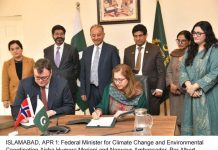
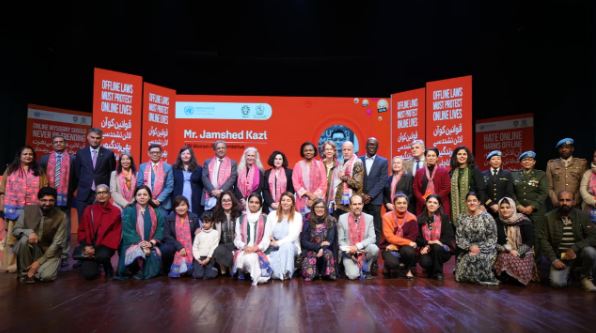
ISLAMABAD, DEC 2 /DNA/ – Today, the United Nations in Pakistan marked the ’16 Days of Activism Against Gender-Based Violence’ by calling for urgent global action against digital violenceduring an event at Islamabad’s Pakistan National Council of Arts (PNCA). It alerted on the need to adapt the legislation to evolving technologies as nearly half of the world’s women and girls lack legal protection from digital abuse.
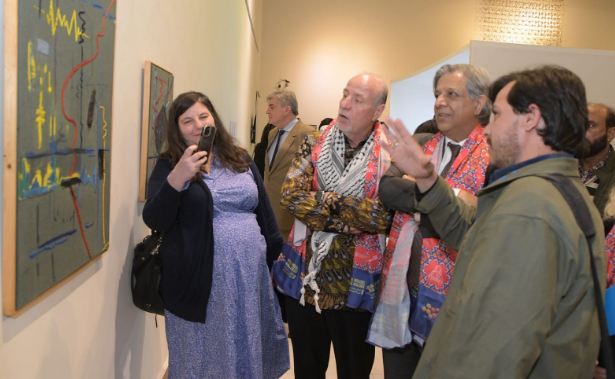
The event, chaired by the Federal Minister for Human Rights,Senator Azam Nazeer Tarar,in presence of UN Women Regional Director, Christine Arab, also marked the opening of ‘Seen& Unseen’, an Art exhibition featuring renowned Pakistani artists, with Prof. Salima Hashmi as Honorary Advisor. It was part of a series offour other UN events that discussed how to keep women and girls safe online, and empower them to lead and shape the digital future, in Karachi, Lahore, Peshawar, and Quetta.
“During the 16 Days of Activism, we must invest in the vision and leadership of young people,” said Christine Arab, UN Women Regional Director for Asia and the Pacific. “When innovation is shaped by gender equality, we create digital spaces where women and girls are not just included, but protected, empowered and able to thrive,” she added as she launched UN Women’s Firewall Feminist Lab.
The five events brought together the Government, law enforcement, the legislature, and civil society, together with IOM, UNAIDS, UNDP, UNFPA, UNHCR, UNIC, UNICEF, UNESCO, UN WOMEN, and WHO. They took place in Punjab Safe City Authorities in Lahore on 25 November, Governor House in Quetta on 27 November, Peshawar Stadium on 1 December, and PNCA Islamabad on 2 December, with support from Marriott Islamabad. The fifth event will take place at State Bank of Pakistan Museum in Karachi on 4 December.
“The digital world promised connection and empowerment. Yet for millions of women and girls across the world, it has become a minefield of harassment and abuse,” said Pernille Ironside, Acting UN Resident & Humanitarian Coordinator. “We cannot letonline platforms become yet another space where women and girls are silenced, shamed, and intimidated — in Pakistan or across the world.We must urgentlyadapt the legislation to evolving technologies, and end the impunity of both perpetrators and online platforms. Just like the offline world, the online world should not threaten women and girls, but help them thrive. There is no excuse for online abuse.”
Digital violence is spreading at an alarming speed fueled by artificial intelligence, anonymity, and a lack of effective laws and accountability. It comes under many forms — online harassment, cyberstalking, doxing, non-consensual image sharing, deep fakes, and disinformation. Digital abuse can spill into real life, sometimes leading to physical violence.
“Technology has transformed the nature of abuse, and our laws, institutions, and social responses must evolve accordingly,” said Chief Guest, Federal Minister for Human Rights, Senator Azam Nazeer Tarar, in his keynote remarks.He added, “The Government of Pakistan is committed to strengthening legal protections, expanding access to justice, and ensuring that every woman and girl can participate in society—online and offline—with safety, dignity, and equality.”
During the event, UNDP and UNPFA introduced their work around digital and technology-facilitated gender-based violence; IOM shared testimonies of survivors; UNFPA launched its new Reels ‘Salma Lives’ about child marriage; and WHO shared its perspective on the clinical and health impact of gender-based violence.
The United Nations calls for: 1) Global cooperation to ensure digital platforms and AI tools meet safety and ethics standards; 2) Support for survivors of digital violence by funding women’s rights organizations; 3) Holding perpetrators accountable through better laws and enforcement; 4) Tech companies to step up by hiring more women to create safer online spaces, removing harmful content quickly, and responding to reports of abuse; 5) Investments in prevention and culture change through digital literacy and online safety training for women and girls, and programmes that challenge toxic online cultures.