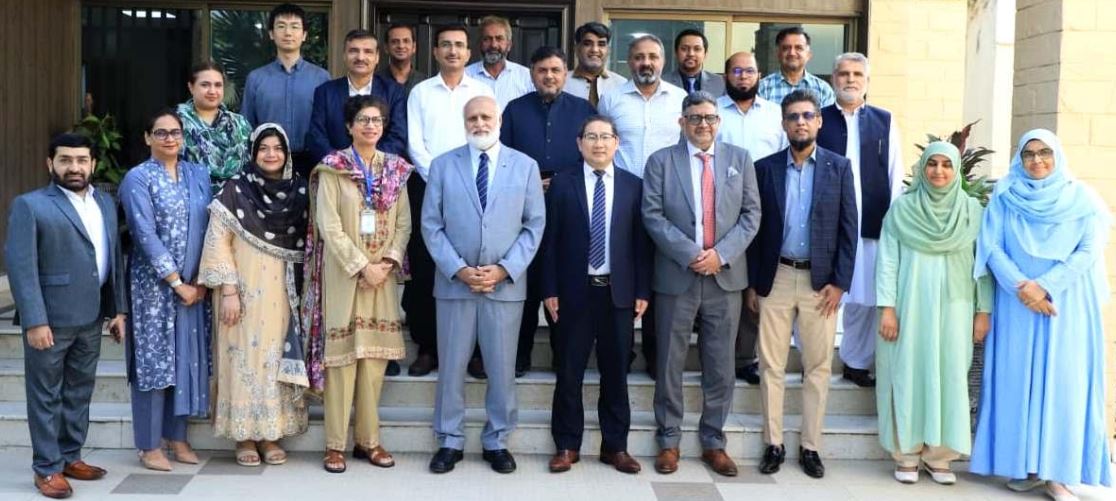
ISLAMABAD, SEP 12 /DNA/ – The National Academy for Higher Education (NAHE), Higher Education Commission (HEC) Pakistan, organised a consultative meeting on Artificial Intelligence (AI), institutional preparedness, and capacity building in higher education.
Chairman HEC Dr. Niaz Ahmad Akhtar chaired the meeting, attended by Managing Director NAHE Dr. Noor Amna Malik, Vice Chancellors, senior faculty members and representatives of public sector universities, HEC Regional Centres, and Huawei Technologies.
The meeting stressed a coordinated national approach to AI adoption and institutional readiness, covering AI literacy, digital infrastructure, High-Performance Computing (HPC), cybersecurity, human resource development, governance, academic programmes and responsible use of emerging technologies. The discussions assumed particular importance in view of HEC’s recently circulated requirement for a three-credit-hour AI-related course for undergraduate and graduate students from Fall 2026.
The Chairman HEC emphasised that AI is rapidly transforming education, research, industry, governance, healthcare, agriculture and academic administration. He stressed that universities must move beyond viewing AI merely as a collection of tools, and develop institutional capacity to understand, manage and responsibly integrate AI.
He highlighted that AI readiness requires digital infrastructure, computing capacity, trained human resources, cybersecurity, institutional governance, academic expertise and ethical safeguards.
He also highlighted the digital preparedness gap across the higher education sector, emphasising the need to strengthen national capacity in HPC, data infrastructure, cybersecurity and specialised AI expertise, while encouraging stronger collaboration among universities, technology companies, researchers and policymakers.
Dr. Noor Amna Malik highlighted NAHE’s ongoing efforts to develop AI capacity among university faculty and management. She informed the meeting that NAHE has successfully completed two AI training cohorts, comprising 64 participants physically and 366 participants virtually. She informed the participants that additional comprehensive AI training programmes are being planned through HEC Regional Centres and 15 identified cluster points to extend capacity-building opportunities across Pakistan.
During the meeting, Mr. Meng Gengchang, Solution Expert, Huawei Technologies, and Mr. Leo shared the industry perspectives. University leaders shared practical examples of AI adoption, including AI-enabled admissions at Abdul Wali Khan University Mardan, AI academic programmes at BUITEMS, and AI-related initiatives at PIEAS.
The meeting underscored that AI readiness is a whole-of-institution responsibility requiring AI-literate faculty, trained management, appropriate policies, robust infrastructure, cybersecurity safeguards, ethical frameworks and continuous professional development.
The meeting concluded with a shared understanding of the need for a nationally coordinated roadmap for AI training, infrastructure development, responsible AI adoption and institutional preparedness. A follow-up meeting will be convened within the next few days to further deliberate on and finalise the strategy, with university management, faculty, IT professionals, researchers and other relevant stakeholders to be brought on board.=DNA