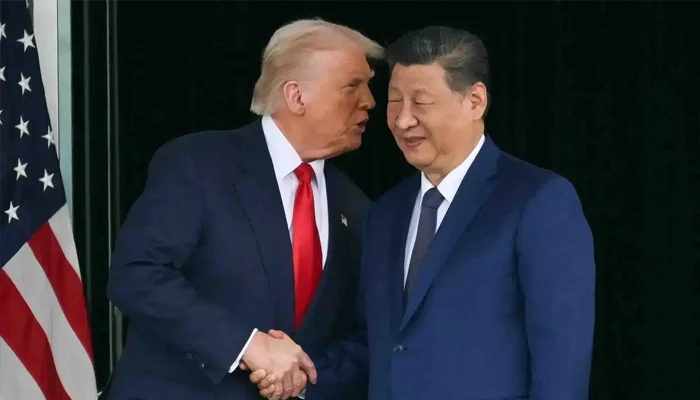
BUSAN, MAR 16 /DNA/: Top US and Chinese economic officials were due to conclude talks in Paris on Monday, with potential areas of agreement in agriculture, critical minerals and managed trade that could be taken up by US President Donald Trump and Chinese President Xi Jinping in Beijing, sources familiar with the discussions said.
The sources told Reuters that the “remarkably stable” talks led by US Treasury Secretary Scott Bessent and Chinese Vice Premier He Lifeng would set in motion possible “deliverables” for Trump’s expected trip to China at the end of March to meet with Xi.
But the leaders would have the final say, they added.
Trump, however, told the Financial Times in an interview published on Sunday that he could also delay his summit with Xi later this month as he presses Beijing to help unblock the crucial Strait of Hormuz closed by Iran.
“We may delay,” he said of the trip.
The US and Chinese delegations met for more than six hours on Sunday at the Paris headquarters of the Organisation for Economic Cooperation and Development, a club of mostly wealthy democracies that does not count China as a member.
In the talks, the Chinese side showed openness to potential additional purchases of US agricultural goods including poultry, beef and non-soybean row crops, one of the sources said.
China was still committed to buying 25 million metric tons of American soybeans for each of the next three years under the Trump-Xi October 2025 trade truce, the source added.
Spokespersons for the US Treasury and the U.S. Trade Representative’s office declined to characterise the talks, while Chinese officials left on Sunday without speaking to reporters.
In a statement on Monday, China’s commerce ministry rebuked the United States over a trade investigation into forced labour, urging Washington to “correct its wrongdoings”, and citing representations made to the United States
“Meaningful” progress in Sino‑US economic cooperation could restore confidence to an increasingly fragile global economy, the official Xinhua news agency said in a commentary on Sunday.
The Paris talks follow several meetings to ease tension last year between Bessent, He, US Trade Representative Jamieson Greer and Chinese chief trade negotiator Li Chenggang.
Managed trade mechanism
The two sides discussed the establishment of new formal mechanisms to help manage trade and investment between the world’s two largest economies that may be considered by Trump and Xi in Beijing, the sources said. Technical talks on the proposed US-China “Board of Trade” and “Board of Investment” were expected on Monday.
One of the sources said that the Board of Trade was the more developed of the two proposals, and would be aimed at finding products and sectors where the U.S. and China could grow trade in a balanced way without compromising each other’s national security or critical supply chains.
The Board of Investment would not set broad investment policies but would address “discrete investment issues” that may arise between the countries, the source said.
Critical minerals, energy
The sources also said US officials discussed the flow of Chinese-produced critical minerals to US companies and raised concerns about the US aerospace industry’s lack of access to yttrium from China, which is used in jet engine turbines, among other applications.
One of the sources said the two sides “found some ways to loosen up” more challenging areas in critical minerals, but did not provide specifics.
Before the talks, Greer had told CNBC on Friday that the US wanted “to make sure that we continue to get the rare earths we need for our manufacturing base, that they keep buying the kinds of things they should be buying from us, and that the leaders have a chance to get together and make sure that the relationship is going the way we want it to go.”
Greer and Bessent also emphasised in the talks the US desire for China to increase purchases of Boeing BA.N jetliners and US coal, oil and natural gas, which could be further discussed on Monday, the sources said.
But with little time to prepare and Washington’s attention focused on the US-Israeli war on Iran, prospects for such major trade breakthroughs were limited, in Paris or at the Beijing summit, trade analysts said.
“Given that the leaders may meet up to four times this year, these deliverables may be spread out, rolled out over the year,” said Wendy Cutler, a former US trade negotiator who now heads the Asia Society’s Washington policy centre.
These meetings include a potential visit to Washington for Xi, a China-hosted APEC summit in November and a US-hosted G20 summit in December.