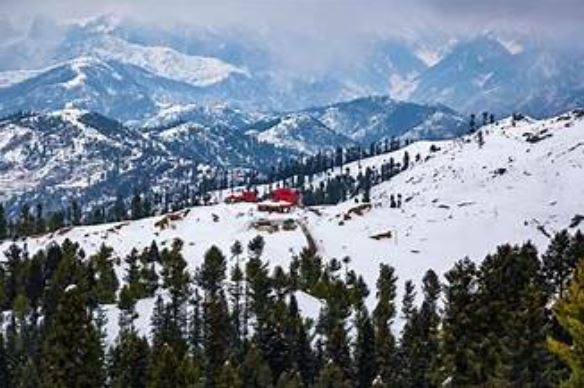
SWAT, Jan 02 (APP/DNA): As winter sunlight filters through the pine forests of the Oshu mountains, 57-year-old hotelier Ataullah Khan sits quietly on a wooden chair outside his hotel in Kalam valley, anxiously scanning the road for tourists who hardly seem to arrive unless snowfall.For nearly three decades, Ataullah’s small hotel used to be fully booked during winter, especially around New Year, when heavy snowfall transformed Kalam into a magnet for tourists and snow sports enthusiasts.
This year, however, the valley has remained largely snowless which is a worrying sign for the local tourism and hospitality industry.
“The lack of snowfall in Kalam and Bahrain has badly affected the hotel industry and transport sector,” Ataullah told APP.
“In the past, tourists would flood the area at this time of year just to enjoy snow.”
Asking his lone servant to open the windows to let sunlight in, Ataullah said that even the recent Snow Gala at Kalam failed to attract substantial number of visitors in numbers seen in previous years.
“Attendance at snow gala was much lower compared to earlier winters, which affected hotels and transport sectors negatively in Upper Swat” he added.
Like many locals, Ataullah believes climate change and deforestation are altering Kalam’s weather patterns. “Each passing year, winters are becoming warmer, with irregular rains and snowfall in this region,” he said.
According to the Pakistan Meteorological Department, the country has witnessed nearly a 40 percent decline in rainfall compared to the 30-year historical average. Regions such as Potohar experienced particularly dry conditions, while Malakand, Hazara, and parts of northern Punjab recorded inadequate snowfall and rainfall last year, resulting in unusually intense sun heat.
Deputy Director of the Department of Climate Change, Forest and Environment, Afsar Khan, warned that the absence of winter precipitation is no longer just a tourism issue.
“The lack of winter rainfall and snowfall in northern Pakistan is threatening food security,” he said, stressing the urgent need for massive plantation drives to counter environmental degradation.
He explained that winter rains and snowfall traditionally began in early December. “However, in 2025, the first winter rains arrived only at the end of December, and the season has yet to fully establish itself,” he said.
This delay, he warned, increases the risk of drought and desertification, especially in southern Pakistan, which relies heavily on glacier-fed water from the Indus River system.
Although some sporadic rainfall and snowfall were recorded in northern and mountainous areas on December 31, vast stretches of Khyber Pakhtunkhwa, Punjab, and Sindh continue to face a severe shortfall.
Former Conservator of Forests Tauheedul Haq cautioned that continued snowless winters could accelerate desertification, land degradation, and drought (DDLD).
“If left unchecked, DDLD could cause annual economic losses of up to $42 billion globally, while nearly six million hectares of productive land are lost every year,” he said.
Nearly two-thirds of Pakistan’s agricultural land and 80 percent of its arid and semi-arid regions are vulnerable to DDLD, a situation worsened by reduced rainfall, declining snowfall, and illegal deforestation.
National Forest Policy reveals that Pakistan loses about 27,000 hectares of forest annually, particularly in community-managed forests in Khyber Pakhtunkhwa and Gilgit-Baltistan.
To combat these challenges, the government has launched several initiatives, including the Sustainable Land Management Project (SLMP) in 2014, which rehabilitated over 12,000 hectares of degraded rangeland in its first phase. The project later expanded to include sustainable agriculture and water conservation over an additional 8,000 hectares.
Following its success, SLMP Phase-II was launched across 14 desertification-prone districts in Punjab, Sindh, KP, and Balochistan, targeting high-risk areas such as Chakwal, Bhakkar, Tharparkar, and Omarkot.
In Khyber Pakhtunkhwa, programs like REDD+ and the Green Growth Initiative (GGI) aim to reduce deforestation and promote sustainable land use.
Chief Conservator of Forests KP Ahmad Jalil said that under the 10 Billion Tree Afforestation Project, 711.35 million saplings of various species have been planted in the province.
“The department has achieved 98.08 percent of its enclosure targets and over 85 percent of its farm forestry and free distribution goals,” he said, calling the initiative a global model for landscape restoration.
However, challenges remain. Ahmad Jalil noted that out of 7,425 sanctioned posts in the Forest Department, over 2,100 remain vacant including a major shortfall of Forest Guards hampering effective field operations.
Back in Kalam, Ataullah Khan fears that if winters continue without snow, the valley’s tourism-based economy may never recover.
“Snow is our identity,” he said quietly. “Without it, tourists will stop coming in winter, and people like us will be left struggling.”
As Pakistan ranks among the world’s top ten most climate-vulnerable countries, experts warn that only urgent environmental action particularly large-scale plantations and forest protection can prevent further economic and ecological losses.