Iftikhar Ali
UNITED NATIONS, Mar 10: A senior Pakistani diplomat told the UN Security Council Monday that Pakistan’s counter-terrorism operations are only meant to neutralize the persistent threat of terrorism emanating from Afghan soil, not directed against the “brotherly” Afghan people, as he hit back at India and the so-called representative of Afghanistan who brought up civilian casualties in the ongoing clashes between the the two neighbours.
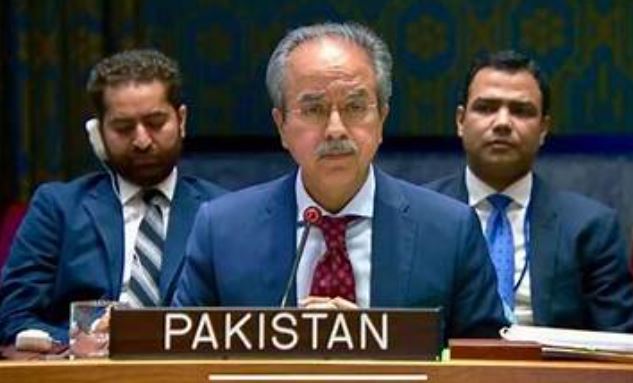
“India, in particular, must cease and desist from its policy of stoking terrorism inside Pakistan from Afghan soil, now together with their new found friends in the Taliban regime,” Ambassador Asim Iftikhar Ahmad, permanent representative of Pakistan to the UN, said in the Council’s discussion on the situation in Afghanistan.
Addressing himself to the “sequestered” representative of Afghanistan Naseer Ahmad Faiq — an appointee of the previous Afghan government since the UN has not yet recognized the Taliban government — the Pakistani envoy said he does not represent anyone but himself.
“(Faiq) is completely cut off from ground realities, and he chose to selectively comment on some aspects of the situation, particularly with reference to Pakistan,” Ambassador Asim Ahmad said.
“So it was not surprising that Mr. Faiq had nothing to say about the cross border terrorism from Afghanistan that is so heavily impacting Pakistan in terms of casualties among civilians, among our armed forces, law enforcement agencies and infrastructure.”
The Pakistani envoy said that the international community had offered an olive branch to the Taliban to change its behaviour, but to no avail.
“Today, Afghanistan is sanctuary for terrorist groups and proxies,” Ambassador Asim Ahmad said. Elements within the Taliban have chosen the path of “complicity and active support”, with grave impacts for its neighbours.
Warning of wider regional spillover, he declared: “Pakistan will not sit idle while suffering from terrorist attacks from across the border.”
The meeting was presided by the United States, which hold the presidency of the 15-member Council for the month of March.
Earlier, in a further blow to the Taliban, the US State Department designated Afghanistan as a “State Sponsor of Wrongful Detention.”
“The Taliban continues to use terrorist tactics, kidnapping individuals for ransom or to seek policy concessions,” Secretary of State Marco Rubio said in a statement, adding, “These despicable tactics need to end.”
As regards his Indian counterpart Parvathaneni Harish’s comments, Ambassador Asim Ahmad noted, “Given India’s animosity towards Pakistan and the sole objective of its Afghan policy being to destabilize Pakistan, including by actively supporting and sponsoring terrorist groups, operating from Afghan soil, such as TTP (Tehrik i Taliban Pakistan) and BLA (Balochistan Liberation Army) ,” the Indian envoy had said not a word about the terrorist threat emanating from Afghanistan, which has targeted Pakista.
India, he said, was complicit in all of this, and Pakistan had provided irrefutable evidence of New Delhi’s collusion with terrorist groups.
“One can sense India’s pain in seeing its heavy investment in the Afghan terrorist franchise going to waste as a result of Pakistan’s precise and effective action against terrorist camps and support bases inside Afghanistan,” the Pakistani envy added.
“And the world needs no lectures from a serial violator of international law like India, a state that illegally occupies territory, violates UN Charter and Security Council resolutions, perpetrates state terrorism in the Indian Illegally Occupied Jammu and Kashmir and beyond, systematically marginalizes its minorities, spreads hate, even weaponizes water with the express goal of starving Pakistan’s population, and continues to use disinformation as a state policy.”
While India has always played the role of a spoiler in Afghanistan, he said, Pakistan has engaged responsibly in promoting peace, stability and prosperity in that country.
‘But these goals can only be promoted if the Taliban regime fulfills its commitments with respect to counter-terrorism, inclusive governance and upholding the rights of Afghan women and girls, the three key areas that were highlighted by the Council members in today’s discussion,” Ambassador Asim Ahmad said.
“While India has long played this dangerous game, we will not allow their sabotage and subversion from Afghan soil to nourish and harm Pakistan,” he warned.
Earlier in his main statement to the Security Council, he said Pakistan regularly facilitated dialogue and engagement with the Taliban authorities, citing last year’s series of high-level visits to Kabul presenting a number of initiatives, assisting in humanitarian relief efforts, offering bilateral trade incentives, liberalized visa regime, transit concessions and participating in regional platforms to help Afghanistan integrate with the region and beyond.
But the Pakistani envoy said, terrorist entities including TTP, BLA and its Majeed Brigade, ISIL-K, Al-Qaeda and ETIM enjoy safe havens inside Afghanistan from where they launch cross-border infiltration, violent attacks and suicide bombings.
Pakistan, he said, has since, witnessed a surge in terrorist attacks; planned, financed and orchestrated from Afghan soil under the Taliban regime’s direct watch. “We have lost thousands of lives to terrorism related incidents since the Taliban takeover and just last month, more than 175 innocent Pakistani lives were lost, including in three suicide attacks.”
“The Taliban’s continued failure to undertake substantive action, their rigid reluctance to provide assurances and guarantees, and refusal of their leadership to publicly denounce and condemn terrorist groups such as the TTP and BLA, highlights the scale of their complicity and active support.”
Pakistan, he said, had confiscated large caches of sophisticated military grade modern equipment left behind by foreign forces in Afghanistan.
“We will take all necessary defensive measures for the protection of its citizens, territory and sovereignty,” Ambassador Asim Ahmad said, adding, “Our counter terrorism operations will continue for as long as it takes to degrade the combat capabilities of terrorist groups and support infrastructure.”
While UNAMA (UN Assistance Mission in Afghanistan) mentions reported “civilian casualties” during cross border clashes, he pointed out it is not presented a realistic overview of Afghanistan’s security dynamics and efforts to prevent illicit trade and destabilizing accumulation of small arms and light weapons and their diversion in Afghanistan and the region as mandated by the Council. The presence of terrorist entities, he added, cannot be delinked with the security situation.
“UNAMA’s ability to accurately verify incidents of border clashes and reports of civilian casualties, in an environment where access to areas outside Kabul is restricted and strictly monitored by the Taliban poses serious questions of credibility.”
Continued restrictions on women and girls inside Afghanistan are inconsistent with Islamic traditions and norms of Muslim society, the Pakistani envoy said. Pakistan, he said, fully shares the international community’s concerns on human rights, and the discriminatory treatment of women and girls.
Opening the debate, UNAMA’s Deputy Head of Mission said the Taliban’s good-faith engagement with the international community, coupled with the prompt lifting of deeply harmful restrictions on women and girls, are crucial for Afghanistan to succeed as a country and society.
“Afghanistan’s continued alienation from the international system remains the central issue,” said Georgette Gagnon, Deputy Special Representative of the Secretary-General and Officer-in-Charge of the UN Assistance Mission in Afghanistan (UNAMA). The country’s isolation prevents progress on economic issues, security cooperation, counter-terrorism and human rights.
The Taliban, which most recently seized control of Afghanistan in August 2021, has engaged in relatively limited ways with the international community. Many countries have condemned their imposition of new laws that further curtail women’s rights, while allegations that terrorist groups are increasingly active on Afghan soil have raised widespread concern and sparked military clashes with neighbouring Pakistan in recent weeks.
Briefing the Council on those developments, Ms. Gagnon added that the widening crisis in the Middle East is already taking a toll on Afghanistan, with the prices of basic commodities rising sharply against the backdrop of an already fragile economy.
In that context, she said, UNAMA — whose mandate is slated for renewal by the Council next week — is working to advance a political pathway forward. The Doha process, first initiated in 2020, balances necessary pragmatism and patience with adherence to the UN’s core principles. “It has maintained existing channels for constructive engagement and opened new ones, and has ensured that the rights, well-being and aspirations of the Afghan people remain front and centre of our efforts.”