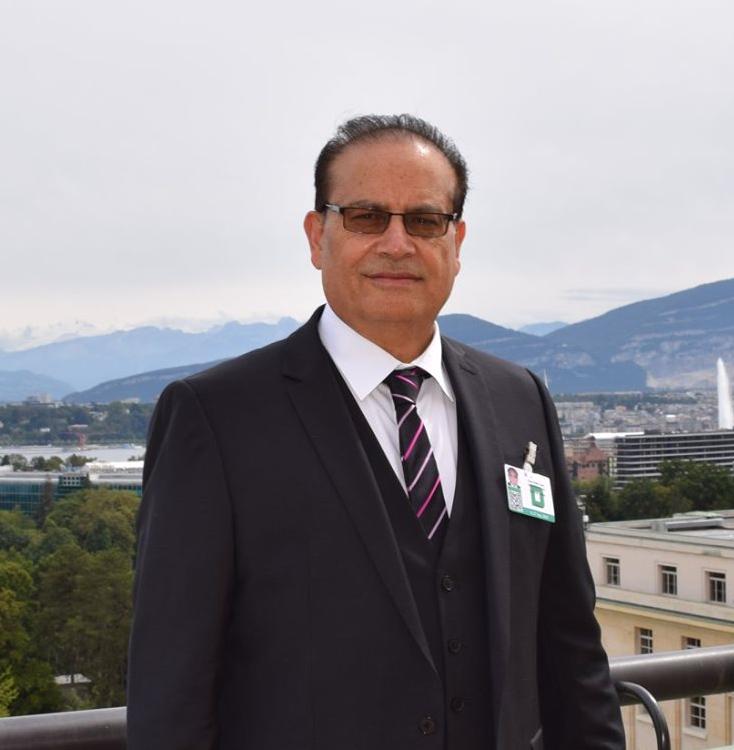
Qamar Bashir
The clock has been reset, but the tension has not. In a dramatic turn of events, Donald Trump has extended the deadline for potential U.S. strikes on Iran’s energy infrastructure to April 6, 2026, granting a critical 10-day window for diplomacy to prevail over destruction. What was initially framed as a five-day tactical pause has now evolved into a high-stakes diplomatic interlude—one that may determine whether the region descends into a broader war or steps back from the brink.
At the center of this unfolding drama stands an unlikely but increasingly pivotal actor: Pakistan. Quietly but assertively, Pakistan has emerged as a key mediator between Washington and Tehran, joined by regional players such as Egypt and Turkey. Their mission is as delicate as it is urgent—bring two deeply mistrustful adversaries to the negotiating table before military escalation becomes irreversible.
The extension itself did not come in a vacuum. It followed signals—subtle yet significant—that Iran may be willing to explore an “off-ramp” from the conflict. According to U.S. envoy Steve Witkoff, a 15-point framework has been conveyed to Tehran through backchannels, outlining a possible pathway toward de-escalation. While Iranian officials have publicly maintained a posture of defiance, behind the scenes there are indications of cautious engagement. The hesitation, however, is rooted in history. Tehran’s leadership remains deeply skeptical, fearing that diplomacy could once again be used as a prelude to military action—a pattern they believe has repeated itself in past engagements.
Pakistan’s role has not been limited to facilitating dialogue. In a move that underscores both the fragility and importance of ongoing talks, Islamabad reportedly urged Washington to restrain Israel from targeting Iran’s foreign minister. The reasoning was stark and pragmatic: eliminate the diplomatic channel, and negotiations collapse instantly. This intervention reflects Pakistan’s growing stature as a stabilizing force—one capable of understanding both the military calculus and the diplomatic necessity of preserving interlocutors during wartime.
Simultaneously, a curious and controversial narrative has emerged from Washington. President Trump hinted at receiving a “precious gift” from Iran—later described as oil shipments allegedly en route to the United States under a Pakistani flag. While this claim remains unverified, its strategic implication is profound. If true, it could signal a covert willingness by Iran to soften its stance and engage economically even as public rhetoric remains uncompromising. Whether symbolic or substantive, such gestures suggest that beneath the surface hostility lies a complex web of negotiation, signaling, and strategic ambiguity.
Markets, as always, have reacted swiftly. The announcement of the deadline extension came minutes after a sharp downturn in global equities, highlighting the deep interconnection between geopolitics and financial stability. Oil prices, already volatile, hovered above $100 per barrel amid fears surrounding the Strait of Hormuz—through which nearly one-fifth of the world’s oil supply flows. Any disruption here reverberates instantly across global markets. Ironically, while supply remains abundant due to sanctions relief on Russian and Iranian exports, much of it is effectively “trapped” by insecurity in transit routes. This paradox—plenty of oil but constrained delivery—has created a market environment driven more by fear than fundamentals.
Yet beyond diplomacy and economics lies a more profound transformation—one that this conflict has brought into sharp relief. The war between the United States and Iran is not merely a geopolitical contest; it is a technological and doctrinal inflection point. The traditional architecture of military power—aircraft carriers, fighter jets, tanks, and heavy artillery—appears increasingly inadequate against the realities of 21st-century warfare.
Iran, despite lacking the conventional superiority of its adversaries, has demonstrated a capacity to challenge them through asymmetric means. Its arsenal of ballistic missiles, drones, and unmanned systems has extended its reach far beyond its borders, reportedly capable of striking targets thousands of kilometers away, including strategic installations such as Diego Garcia. This shift from platform-based dominance to precision-strike capability represents a fundamental reordering of military hierarchies.
Even more striking is the hypothetical scenario often discussed in strategic circles: what if the United States were to seize control of Iran’s key energy nodes—particularly Kharg Island and the Strait of Hormuz itself? On paper, such a move would appear decisive, effectively placing Iran’s النفط lifeline under external control. In reality, however, the outcome could prove far less consequential than conventional doctrine suggests.
Iran’s doctrine of asymmetric warfare is designed precisely to neutralize such scenarios. Even if American forces were to physically occupy Kharg Island or secure maritime dominance over Hormuz, those positions would remain under constant threat. Iran possesses thousands of short-range missiles, loitering munitions, and cost-effective drones—many reportedly concealed in hardened underground facilities, dispersed across vast terrain, and engineered for survivability against even the most advanced bunker-busting munitions. These systems do not require air superiority or naval parity; they rely on saturation, precision, and persistence.
In such an environment, any occupying force would face a relentless cycle of attrition. Fixed installations on Kharg Island could be repeatedly targeted, supply lines disrupted, and naval assets harassed by swarms of unmanned systems. Commercial shipping—particularly vulnerable oil tankers—would remain exposed, making sustained control of the waterway economically and militarily burdensome. The very objective of securing energy flow could be undermined by the continuous threat environment created by these decentralized strike capabilities.
This explains a paradox observed throughout the conflict: despite repeated claims by the United States and Israel of degrading Iran’s missile and drone infrastructure, Iran continues to respond with sustained intensity and operational reach. The resilience lies not in singular high-value assets, but in the distributed nature of its arsenal—difficult to locate, harder to eliminate, and capable of rapid regeneration.
The implications are far-reaching. In this emerging paradigm, power is no longer defined solely by the size of fleets or the sophistication of aircraft, but by the accuracy, scalability, and survivability of missile systems and autonomous platforms. Even heavily defended naval assets become vulnerable when confronted with swarms of low-cost, high-precision projectiles. This reality has reportedly forced U.S. naval deployments to maintain greater distances from contested zones, altering long-standing doctrines of forward presence and deterrence.
The conflict also echoes lessons observed in regional dynamics involving Pakistan, where advancements in indigenous missile technology have reshaped deterrence equations. Precision, range, and reliability have become the new currency of power, enabling smaller or economically constrained nations to level the strategic playing field against traditionally dominant forces.
What emerges, therefore, is not simply a contest between nations, but between eras. The industrial-age war machine, forged in the crucible of the two World Wars, is confronting a digital-age battlefield defined by speed, precision, and decentralization. In this new landscape, asymmetry is not a weakness—it is an advantage.
Amid these shifting sands, Pakistan’s diplomatic initiative acquires added significance. It is not merely mediating a ceasefire; it is attempting to bridge two fundamentally different worldviews—one rooted in conventional dominance, the other in asymmetric resilience. The success or failure of this effort will have implications far beyond the immediate conflict, shaping perceptions of power, negotiation, and legitimacy in an increasingly multipolar world.
As April 6 approaches, the world watches with cautious anticipation. The extended deadline is both an opportunity and a warning. If diplomacy succeeds, it could mark the beginning of a new framework for conflict resolution—one that acknowledges the limits of force in an age of distributed power. If it fails, the consequences could be swift and severe, potentially triggering a chain reaction that engulfs the broader region.
For now, the pause holds. Negotiators continue their delicate work behind closed doors. Markets oscillate between hope and fear. And the battlefield, though momentarily silent, remains poised on a knife’s edge.
In this narrow window of time, the future of not just a conflict, but of warfare itself, hangs in the balance.
Qamar Bashir
Press Secretary to the President (Rtd)
Former Press Minister, Embassy of Pakistan to France
Former Press Attaché to Malaysia
Former MD, SRBC | Macomb, Michigan