
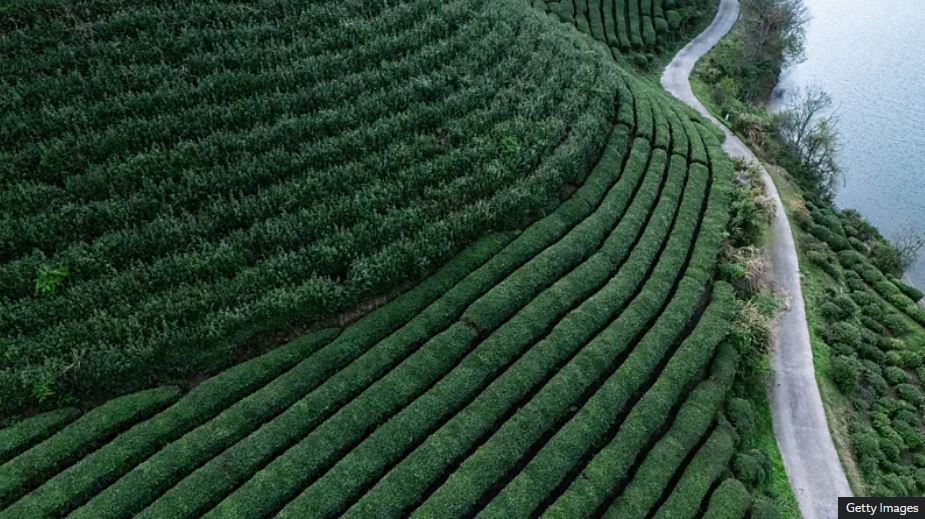
Longjing is one of China’s most revered green teas. But as its traditional production has dwindled, one of the best ways to taste the real thing is to head to the hills where it’s harvested.
On a lush hillside on the fringes of Hangzhou, Ge Xiaopeng stands between rows of tea bushes and examines a tiny leaf. He grips it between his thumb and forefinger and carefully lifts it upward, effortlessly detaching it from its stem. He drops the bud into his basket, which is already full of tender leaves, each one smooth and slender, green as jade.
Xiaopeng, like other farmers who grow Longjing tea, has been waiting for this moment all year. Literally meaning “Dragon Well”, Longjing is one of China’s most revered green teas, famous for flourishing in the rolling hills around West Lake in Hangzhou, a former imperial capital in eastern China’s Zhejiang Province. On this breezy day in March, right around the spring equinox, Xiaopeng says the leaves have finally reached the standard of 2.5cm in length, which means the annual spring harvest is underway.
Longjing has been a recognisable name among tea lovers for centuries, ever since the Qianlong Emperor visited Hangzhou in the 18th Century. According to legend, he was so taken with the tea that he ordered 18 bushes to be bestowed with imperial status and reserved their yields for the court.

In recent years, Longjing’s reputation has only deepened, driven by a tightened geographic designation, renewed domestic appetite for traditional goods, and rising global awareness of regional Chinese teas. At the same time, the case for visiting these hillside farms has never felt more pressing. A persistent counterfeit market has made genuine Longjing trickier to identify, while the labour-intensive hand-firing work that shapes the tea’s character is increasingly being replaced by machines.
You must spend time sitting with [Longjing] before it reveals its personality
Today, traditionally made Longjing is both more coveted and harder to come by. As a result, visiting Hangzhou’s tea villages is one of the surest ways to see the tea made at its source.
Harvesting Longjing
For Xiaopeng, a fourth-generation tea grower, the year has always been organised around the springtime harvest.
“Timing is highly important when it comes to Longjing,” he explains.
The earliest flushes, which bud in mid- to late-March, are the most prized, renowned for their restrained chestnut aroma and delicate, understated flavour. So treasured are these buds that Longjing is graded according to when it was plucked in the Chinese calendar, which divides the year into 24 micro-seasons based on the Earth’s position relative to the Sun.

The mingqian tier refers to the early batches plucked before Qingming, the solar term that begins on 4 or 5 April; while later harvests are called yuqian (meaning “before Guyu”, the following solar term). Even a few days’ difference when harvesting can significantly influence the value of the leaves: from Xiaopeng’s family farm, just 500g of the earliest mingqian batches can now fetch upwards of 30,000 yuan (roughly £3,250 or $4,400). Xiaopeng says this figure would have been unimaginable a generation ago – the result of rising labour costs and a widening gap between supply and demand.
I came to Xiaopeng’s family farm in Longwu Tea Village at the recommendation of my friend and Hangzhou native Meng Keqi, who previously owned a tea shop in Chicago before returning to his hometown. As I follow Xiaopeng through his field as part of a tour, the sky is overcast, the air balmy. “These conditions are ideal for the leaves,” he says, explaining that light, misty drizzles and gentle sunshine allow the shoots to grow slowly, lending the early harvests their signature clean, delicate flavour, free of astringency or grassiness.
Yet, this approximately two-week mingqian harvest window is as anticipated as it is narrow – not to mention increasingly hard to predict as climate change alters seasonal weather patterns. Once the calendar approaches Guyu, around 19 or 20 April, warmer temperatures and heavier rainfall hasten growth, drawing out more of the tea’s bitter notes. Not only do early-budding leaves have a sweeter, more subtle flavour, their delicateness also requires an especially careful and precise touch when wok-firing – a critical step in the craft of Longjing.
Pan-firing the tea leaves
After the leaves are plucked, artisans perform the laborious work of pan-firing them by hand, tossing the leaves in enormous woks heated up to 200C. I watch as Xiaopeng’s father, Ge Zhenghua, sweeps leaves across the wok, scoops them up, then releases them back down in precise, practiced strokes – all without wearing gloves.

Because my mother is from near Hangzhou, I grew up drinking Longjing, but this is my first time watching the wok-firing process up close, and I marvel at the fact that there are nothing but tea leaves protecting his palms from the searing hot pan.
The firing process is arguably what makes Longjing what it is, says Zhenghua. It halts oxidation, preserving the leaves’ green hue; and presses them into their distinctive spear shape, a Longjing hallmark. Importantly, it also evaporates moisture.
“Drying thoroughly is what helps release their fragrance, and it allows the leaves to be stored without spoiling,” says Zhenghua. “I don’t wear gloves because I need to feel the level of heat, the moisture.”
Nowadays, more farmers are relying on machines to handle the task of wok-firing, saving a great deal of time and exertion during the busy harvest season. “When we were young, we hardly slept during this stretch,” recalls Zhenghua, explaining how the family would fire leaves around the clock.

While machine-firing produces consistent-enough results that most drinkers likely wouldn’t perceive a difference, Zhenghua says he can still taste what is lost – a fuller-bodied fragrance and a more lingering sweetness. “Hands can decipher what machines cannot,” he says. “Machines are dead. These hands are alive.”
Where and how to experience Longjing
Mid-to-late March to early April is the best time to visit Hangzhou to see the Longjing harvest. To best access the tea villages, book a hotel in the West Lake scenic area and consider chartering a car for the day through the Chinese ride-share app Didi, or you can join a tour organised by a farm or tea centre.
• China National Tea Museum – A Hangzhou museum dedicated to Chinese and global tea cultures, where visitors can wander through Longjing tea plantations, watch tea demonstrations, trace the history of Longjing, sample brews and browse teaware and tea leaves to take home.
• Suye Tea Institute – A tea school in Hangzhou that organises Longjing farm tours, wok-firing demonstrations and tastings.
• Luzhenghao – A long-established tea brand with shops and tea houses across Hangzhou.
• Yige Tea House – A cafe in Longwu Tea Village owned by the Ge family, who run farm tours, pan-firing demonstrations, and tastings.
When the firing is complete, Zhenghua weighs the leaves and packages them, pressing a sticker certifying their authenticity onto each bundle. He explains that the government has limited the designated growing area for genuine West Lake Longjing to within a 168-sq-km region. In certain production zones elsewhere in Zhejiang Province, the tea can be called Longjing, without the West Lake designation. Anything grown outside of that can only legally be sold as green tea. To curb counterfeiting, authorities now issue a limited number of authentication stickers for verified growers to affix to their products; each sticker carries a QR code linking to a traceability system.
Tasting Longjing
Demand for real Longjing has surged in recent years, propelled in part by the guochao movement, a trend drawing younger Chinese consumers back towards traditional Chinese heritage products. But enthusiasm for Longjing – especially mingqian leaves – far surpasses what the hills can yield during the brief and variable harvest window. The supply gap has made Longjing a target for fraudulent buds grown elsewhere in China but still bearing the name.
For many customers, the most reliable guarantee is to know the hands that produced the leaves. It’s why, come spring, Zhenghua says that many of his regulars visit his farm, where they watch him fire the leaves with their own eyes. It’s also why the family opened Yige Tea House nearby, where the Longjing-curious can participate in farm tours, pan-firing demonstrations and tastings.

Tea education centres, too, can offer a more intimate look at Longjing, including guided farm visits, wok-firing workshops and expert-led tasting experiences. After leaving the tea fields, I head to one such school, Suye Tea Institute, to meet tea instructor Chen Yifang, who had just sourced a batch of the season’s mingqian leaves.
All the effort that goes into producing a batch of Longjing ultimately expresses itself in the cup – a flavour so delicate and subtle that I always find it hard to describe. Chen likens its clean, fresh quality to the gentle aroma of spring pea flowers or fava bean blossoms – softly floral, mildly nutty, the faintest bit sweet.
More like this:
• A Chinese spice so hot it cools
• The sweet Chinese dumpling that honours the dead
• Europe’s undisputed tea capital
“Part of the beauty is its understatedness,” says Chen, as she pours me a cup brewed from leaves harvested nearby just a few days earlier. Longjing, she explains, is a ritual that rewards patience and attention. She draws a comparison to bolder beverages, like black tea and coffee: “They will tell you very directly, ‘This is what I am,’ whereas with Longjing, you must spend time sitting with it before it reveals its personality.”
For years, Zhenghua worried that his craft might fade out with his generation. Many children of Longjing growers left the villages, pursuing university education and higher-paying jobs in the cities. Now, more people are returning to the fields to learn their parents’ skills, including his son, as the tea’s market value makes it a more sustainable livelihood than it once was. There is another pull, too: a recognition that if they do not inherit the knowledge, it could well die with their parents.

“Young people who grew up on these tea farms, they smell this every spring” says Zhenghua. “This is the aroma of their hometown.”
Over many visits to my mum’s home region throughout my life, I’ve come to understand that what draws people to Hangzhou every spring isn’t only the tea. It’s also the chance to experience a precious, fleeting seasonal window, one when timing and terroir align to summon the year’s first buds from those misty hillsides. Nowadays, perhaps it is also an opportunity to bear witness to a time-honoured trade that may not endure in its present form forever.