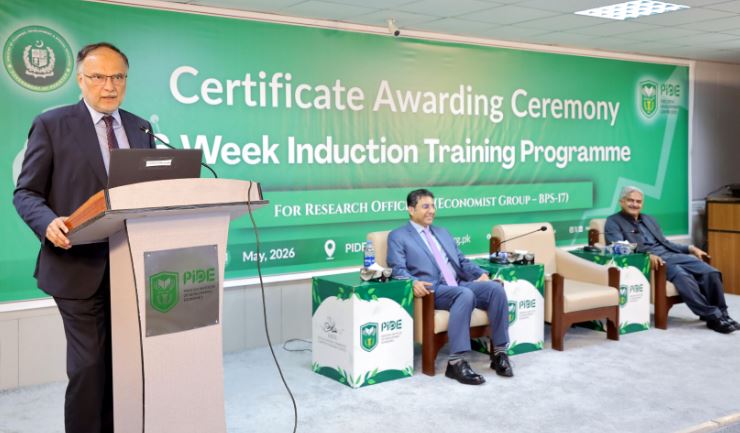
ISLAMABAD, MAY 13 /DNA/ – The Pakistan Institute of Development Economics (PIDE) hosted a Certificate Awarding Ceremony today to mark the completion of the “6-Week Induction Training Programme for Research Officers (Economist Group)” of the Ministry of Planning, Development & Special Initiatives.
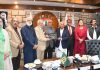
Honorable Prof. Ahsan Iqbal, Federal Minister for Planning, Development & Special Initiatives, graced the occasion as the Chief Guest and distributed certificates to the newly inducted officers at PIDE’s Junior Combination Room, Islamabad.
In his keynote address, Prof. Ahsan Iqbal described the Ministry of Planning as the “development brain” of the government and urged the new cohort to see themselves as architects of nation-building, not just routine functionaries. He encouraged them to make a difference in policy making, he mentioned that Pakistan was once considered champion of reforms but due to frequent policy reversals and political regime changes allowed its neighbors to surpass it economically. He highlighted that Pakistan’s policy culture needs professionals who can implement practical policy solutions.
Declaring that humanity has entered a “techno-economy era” driven by artificial intelligence, he warned that changes now occur within months, not decades. Economists who remain anchored in industrial-era frameworks, he cautioned, will be left behind. The Federal Minister called on the officers to master technology economics, digital economics, environmental economics, and behavioral economics, in addition to traditional economic tools. He urged the officers not to manipulate data under political pressure, describing it as the “fuel of future development.” He reminded them that every economic indicator has a human cost: inflation is not just a percentage on a chart, but families struggling to afford food; a growth slowdown is not just a statistic, but unemployment and hopelessness for youth.
Dr. Nadeem Javaid, Vice Chancellor of PIDE, reiterated that economists are crucial for economic policy making because each number and statistic has a story behind it, knowing the people of the country is important for every economist. He further emphasized that the newly inducted research officers should be aware of the invisible “status quo forces” embedded in institutions that systematically resist change. He argued that competence without courage is insufficient: officers must be willing to voice dissenting analysis in policy meetings and respectfully challenge ineffective practices, even before senior colleagues. Warning against the professional drift, by which talented officers gradually become captured by routine and bureaucratic inertia, he urged the cohort to remain intellectually restless. In the new global competition, he noted, nations win through the quality of their ideas and institutions.
Dr. Imtiaz Ahmed, Chief Economist at the Ministry of Planning, told the officers that throughout a career, a person is recognized by the quality and sincerity of their work. He urged each participant to leave every position better than they found it, a standard that he said is the true measure of public service.
Dr. Nadeem Khan, Director of the Executive Development Center, PIDE, who designed the programme, described its scale: 150 sessions over six weeks, structured around four pillars; knowledge, skills, behavior, and institutional exposure. Using inclusive pedagogy, the curriculum incorporated policy simulations, psychometric assessments, and practitioner-led sessions by economists, civil servants, and behavioral experts. Participants undertook field visits to the Ministry of Finance, the Ministry of Planning, and the Pakistan Bureau of Statistics, and each officer produced a supervised policy review paper with formal mentor feedback – an element rarely seen in public-sector induction programmes in Pakistan.
The Pakistan Institute of Development Economics (PIDE) is an autonomous research institution under the Ministry of Planning, Development & Special Initiatives, dedicated to evidence-based policymaking, economic research, and public-sector capacity-building in Pakistan.