BY: ANSAR MEHMOOD BHATTI
Ambassador of Indonesia to Pakistan, H.E. Chandra W. Sukotjo, gave an exclusive interview to Daily Islamabad POST/Centreline and the Diplomatic News Agency (DNA). During the conversation, the Ambassador discussed a wide range of issues spanning both bilateral and multilateral relations. The following is the text of the interview.
- Let us begin with the bilateral relations, please your vision with our readers as to how would you like to further strengthen these relations?
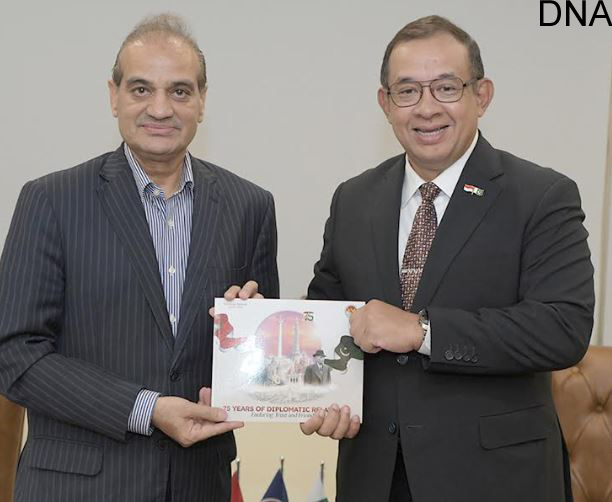
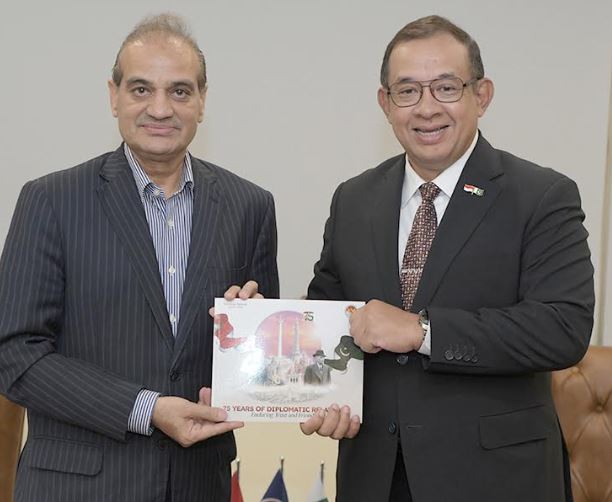
Well, the bilateral relations between Indonesia and Pakistan have reached a solid age. Last year, we proudly celebrated the 75years of diplomatic relations between the two brotherly countries.
The main theme of the celebration was, “Enduring Friendship and Mutual Trust,” which has paved the way for further avenues of cooperations in various fields at all levels of engagement.
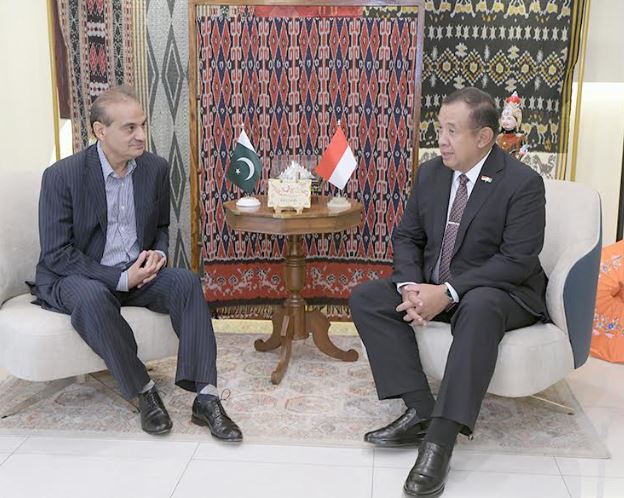
My vision in advancing the Indonesia-Pakistan bilateral relations does not stand alone, but it is a progressive continuation of the big vision laid down by our respective founding fathers; President Sukarno and Quaid-e-Azam Mohammad Ali Jinnah, deeply rooted in mutual respect and reciprocal support at the regional and global levels.
- Apart from trade and economy, political relations between Pakistan and Indonesia have also been phenomenal. If you could share some recent developments in this regard?
I think, Indonesia and Pakistan have successfully maintained strong political relations rooted in shared historical solidarity, cultural affinity, and mutual support.
Pakistan played a foundational role as one of the five co-sponsors of the historic 1955 Asia-Africa Conference in Bandung, which helped nations in Asia and Africa get their independence.
The Conference subsequently issued the Bandung Spirit which mainly champions solidarity, anti-imperialism, national sovereignty, peaceful coexistence, and economic cooperation among developing nations.
Currently, on bilateral level, the leaderships of the two fraternal countries have shown a very close bond. Last year, President Prabowo Subianto visited Pakistan for high-level bilateral talks, where he met with President Asif Ali Zardari, Prime Minister Shehbaz Sharif, and Chief of Defence Forces Field Marshal Asim Munir.
This state visit has opened the doors for further exchange visits on ministerial level and vice-ministerial or state-ministerial levels, as well as military leadership level.
On regional and global forum, both countries collaborate closely within the United Nations framework in addressing global issues especially on Palestinian cause.
Such close collaboration has also shown by the two countries under the frameworks of the Organization of Islamic Cooperation (OIC) and the Developing-8 (D-8) which Indonesia is currently the Chair of the Organization.
- Both countries share strong cultural and religious ties—how can these be further translated into stronger political and economic collaboration?

Indeed. Although geographically distant, Pakistan and Indonesia are united by shared cultural values and common religious heritage.
Indonesia is a home to the majestic Borobudur, the largest Buddhist temple in the world. Moreover, Pakistan also hosts a Gandhara civilization as a major center for Buddhist culture, acting as a historical crossroads for trade, learning, and religious harmony.
Indonesia and Pakistan are the two largest Muslim-majority countries in the world. Both also have pluralistic societies with different religions and faiths. I returned from a visit to Multan a few days ago. I witnessed that Sufism has strong roots in Pakistan, just as it does in Indonesia.
I believe that the culture and religion are more people-based approaches. So, both will definitely reflect in people-to-people (P-to-P) relations between the two brotherly countries.
When the government-to-government (G-to-G) relations supported by P-to-P relations, the bilateral ties will go forward by attracting other sectors of cooperation including economic collaboration.
- Excellency, could you give us examples of cultural and religious ties between the two countries?
Well, huge similarities have been found in the Indonesian and Pakistani cultures, ranging from language, art, taste, fashion, and many more.
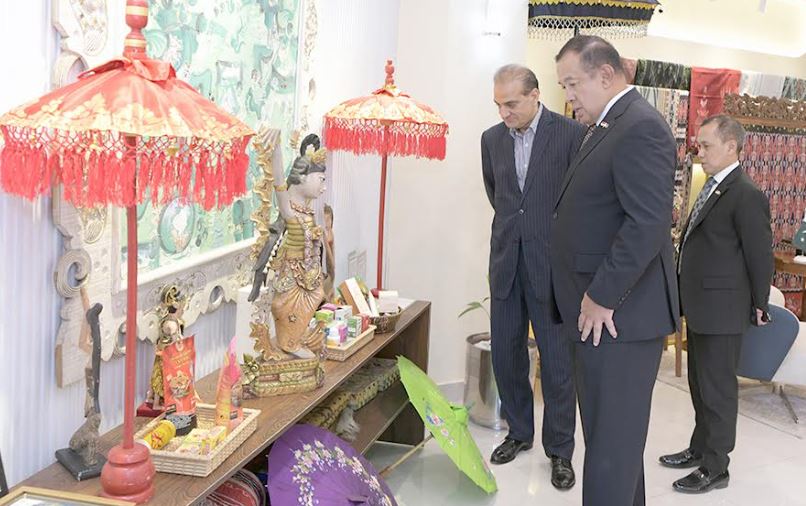
There are some terms in Urdu, similar or almost similar to the Indonesian language. Such as anggur, roti, kursi, lemari, kamus, ijazah, and many more.
Moreover, Pakistan also has a wonderful Arabic or Urdu calligraphy. But when we speak about it, there is an Indonesian bamboo Qalam in excellent calligraphy works.
Regarding both taste and fashion, I see more than similarities. Both can be potentially monetized as sources of collaboration.
I also see the potentials of collaboration through fashion. Indonesia is a global hub for modest fashion, driven by rising international demand for Muslim clothing. I think, Pakistani unique design on fashion can be part of it.
- What steps are being taken to increase student exchanges and academic cooperation?
The Indonesian government offers KNB Scholarship on annual basis. KNB stands for Kemitraan Negara Berkembang. The KNB Scholarship promotes international cooperation and offers students from developing countries the opportunity to pursue higher education in Indonesia. Currently, Pakistan is the largest recipient of KNB Scholarship with more than 500 Pakistani students.
In addition, several universities in Indonesia individually provide scholarships for international students, including Pakistan.
In Pakistan, there are hundreds of Indonesian students concentrated in International Islamic University Islamabad (IIUI) and Jaamia Binoria Aalamia in Karachi.
In line with your question. Just earlier this month, I received the Indonesian delegation representing the World Universities Association for Community Development (WUACD). They briefed me and the Embassy’s staff on the collaboration between OIC-COMSTECH and WUACD to strengthen academic collaboration among WUACD-affiliated universities.
I appreciated the initiative and would stand by ready to provide assistance for such collaboration to further contribute to the Indonesia-Pakistan bilateral relations
- Which sectors offer the most promising opportunities for Pakistani investors in Indonesia and vice versa?
For Pakistani investors in Indonesia, I believe that the most immediate and high-impact opportunity lies in halal pharmaceuticals and surgical equipment. Pakistani firms are well placed to move beyond exports and enter co-production models within Indonesia’s regulatory framework. Indonesia is increasingly focused on wellness and halal-certified health products.
In addition, Indonesia wishes to improve its healthcare sector across the Archipelago. This opens space for Pakistani investors to establish medical institutions in the country.
I would also emphasize agriculture logistics and cold chain infrastructure. Indonesia experiences significant post-harvest losses in perishable goods like potatoes, onions, and chilies. Pakistani investors can add real value by investing in storage, refrigeration, and distribution systems, thereby shifting from simple commodity trade toward infrastructure-led value creation.
Turning to Indonesian investors in Pakistan, the opportunity landscape is more infrastructure-driven and capital intensive.
One of the most strategic areas is edible oil refining and storage infrastructure. Indonesian firms, particularly from the palm oil sector, can move beyond raw exports and invest in port-based refining and bulk storage, capturing more value within Pakistan’s supply chain.
Equally important is vaccine and pharmaceutical manufacturing. Pakistan remains dependent on imports for many critical vaccines and biologics. Indonesian companies can play a transformative role by establishing local production facilities, starting with fill-and-finish operations and potentially expanding into full manufacturing partnerships.
It is also worth noting the strong potential in halal meat cold chains and modern abattoirs. Pakistan has one of the largest livestock bases globally, but lacks processing and refrigeration infrastructure. Indonesian investment can help formalize this sector and create structured export channels into regional halal markets.
In the digital space, I would point to captive IT development centers and fintech collaboration. Pakistan offers a cost-competitive, skilled IT workforce, while Indonesia brings advanced digital payment systems and platform experience like QRIS. Together, this creates room for offshore development hubs serving Indonesian banks, logistics companies, and e-commerce platforms.
I would also like to underline mining and mineral sector, particularly in copper, gold, and lithium. Pakistan’s resource base remains underdeveloped, and Indonesian mining firms can bring both technical expertise and structured investment models, similar in spirit to the Reko Diq framework.
- Indonesia happens to be a leading country in the ASEAN and earnestly wishes to see an enhanced partnership between ASEAN and Pakistan. How do you see this relationship with reference to Pakistan’s ‘Look East’ policy?
The Association of Southeast Asian Nations (ASEAN) continues to be a crucial component of Indonesia’s foreign policy. As a platform for regional stability, ASEAN is by no means outdated. For Indonesia, one of ASEAN’s most significant roles continues to be its commitment to regional stability.
Indonesia has proactively participated in establishing ASEAN principles, commonly referred to as the “ASEAN Way,” which include peaceful dispute resolution, non-interference, and consensus-based decision-making.
The East Asia Summit (EAS), the ASEAN Regional Forum (ARF), and the ASEAN Defense Ministers’ Meeting Plus (ADMM-Plus) are just a few of the ASEAN-led organizations that Indonesia has continuously backed. By using these forums, Indonesia may work cooperatively with both external and regional powers, lowering the possibility of misunderstandings and escalation.
For ASEAN-Pakistan relations, I think ASEAN is a central pillar of Pakistan’s “Look East” policy which aims to strengthen economic, political, and strategic integration with East and Southeast Asian countries.
ASEAN is a geopolitical and economic union of 11 member states which is representing a combined population of over 700 million people and an economy nearing USD 4 trillion.
- Tourism is yet another area of mutual cooperation. Being a leading tourist destination, how can Indonesia help Pakistan strengthen this sector?
Statistics Indonesia recorded that in 2025, Indonesia hosted 15.386.646 global tourists, which was few numbers of them were Pakistani tourists.
Indeed, both countries have witnessed an increase in the number of tourists from Pakistan to Indonesia and vice versa, it does not reflect the potential on the ground. In the last 5 years, Indonesia has received 974 (2021), 5.247 (2022), 14.264 (2023), 23.133 (2024), and 36.348 (2025).
Referring to data released by the Pakistan Tourism Development Corporation (PTDC), the number of Indonesian tourists has started to increase within the recent years. The data shows 5.755 (2023), 7.235 (2024), and 7.033 (2025)
Finally, there is strong potential in infrastructure and tourism development. Indonesian construction firms can participate in Pakistan’s logistics corridors and transport networks, while Indonesian hospitality expertise, especially the “Bali model”, can help unlock the tourism potential of northern Pakistan, including Hunza and Skardu.
- Anything you would like to add?
Let us translate the cordial relations between Indonesia and Pakistan to more concrete works for the benefits of the peoples of the two brotherly countries.
Indonesia-Pakistan, Doshti Zindabad!