ISLAMABAD, JUN 8 /DNA/ – With debt servicing consuming about Rs8.2 trillion – nearly 47 percent of Pakistan’s federal expenditure – a newly launched book confronts a contested but urgent question: should commercial banks be allowed to create money through lending?
Launched by the Institute of Policy Studies (IPS) in collaboration with PRIZE (Policy Research Initiative for Zakat-Based, Interest-Free Economy), “Breaking the Trap of Debt, Inflation, Interest and Poverty” is authored by Qanit Khalilullah and Sohaib Umar, both chartered accountants with extensive experience in Pakistan’s financial sector.
Speaking at the launch, the authors argued that the prevailing debt-based monetary system gives commercial banks the power to create most money simply by issuing loans. They contended that this mechanism is a primary driver of chronic inflation, rising public and private debt, wealth concentration, and financial instability.
“Money creation through private lending may be standard practice, but it comes at a cost,” the authors said. “It inflates asset prices, widens inequality, and shifts risk onto the public while profits remain private.”
As an alternative, the book proposes transitioning to a full-reserve banking framework. Under this model, money creation becomes a sovereign function, and banking activities are separated into risk-free deposit services and risk-bearing investment functions. The authors argue this change could reduce the government’s debt burden, curb structural inflation, improve financial stability, and align the financial sector more closely with Islamic finance principles.
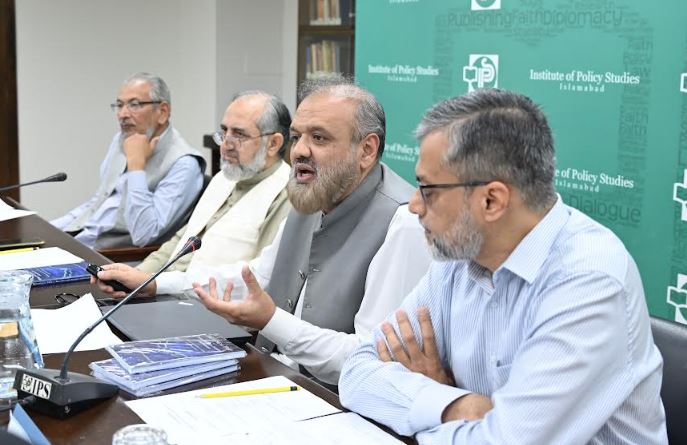
The launch event brought together economists, policymakers, bankers, academics, and Shariah scholars to discuss the arguments. Participants included Vice Chairman IPS Ambassador (r) Syed Abrar Hussain; Prof. Dr. Tahir Mansoori, former vice president of IIUI and Shariah Advisor to Askari Bank; Ahmad Wasim, former head of NIBAF-SBP; and Dr. Salman Syed Ali, former lead researcher at the Islamic Development Bank.
While attendees acknowledged that full-reserve banking remains a contested idea within mainstream economics, many agreed that the book raises critical questions about who benefits from money creation and at what social cost.
Participants appreciated the authors for presenting an out-of-the-box perspective and stressed the need for broader engagement with policymakers and regulators. The consensus was that meaningful progress requires challenging established assumptions and encouraging open debate on Pakistan’s economic future.