Shamim Shahid
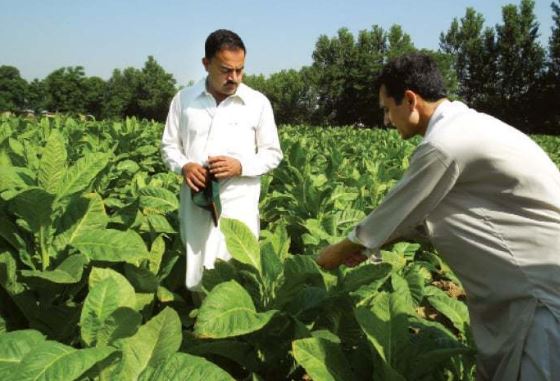
No one can neglect the fact that tobacco is considered a key factor of agriculture and agriculture based economy of the country. Almost of Peshawar Valley along with adjacent districts of Buner, Mansehra, Swat and several other parts and parcels throughout Khyber Pakhtunkhwa are known for production of quality tobacco crops.
All these regions are known for production of both Virginia and barley tobacco leaves. And beside others, almost cigarette manufacturing factories and industries are also exists in this region, thus tobacco is considered major revenue source for the government and Livelihoods for millions of people.
Since a long tobacco is considered major cash crop of making self reliant maximum farmers, peasants, labourers and even industrialists and entrepreneurs. Earlier, till end of 20th century, the systems of tobacco production, its drying and selling to companies was remained very systematic and satisfactory, in according to rules and regulations framed by previous British colonial rulers. Similarly, the government had also constituted Pakistan Tobacco Board for playing a role of mediator between the two sides.
Unfortunately, through one or the other ways, like other government, semi government and autonomous bodies, the PTB had lost its credibility and become a toy in hands of multi national companies. Due to failure of PTB and other givernment institutions from last over two decades, the multi national companies through one or the others made disturbed the procedures. Along with fixing choice rate, management of multi national, national and local companies are also reluctant to purchase almost of the produced crops. As a result, the growers ahead with huge losses. This time, the situation has been changed.
The affected tobacco growers from all over Khyber Pakhtunkhwa have initiated a movement in a bid to force both Government and companies for purchasing all production in return of reasonable rates or prices. The tobacco growers from Swabi, Mardan and Bunet have constituted an Action Committee with active socio-political figure Muhammad Irshad Khan as its chief. The Action Committee members are holding shuttle cock meeting with authorities concerned for resolving of the issue, which besides ensuring sale of all produced dry Virginia leaves and burley leaves.
Similarly, through Action Committee, the tobacco growers and exporters in Khyber Pakhtunkhwa have strongly criticized the government’s current tax policy, describing it as “tax upon tax” and an “economic massacre of thousands of families.” All such taxes posing bad impacts on growers rather than multi national companies and cigarette manufacturers. They demanding of both the federal and provincial governments to immediately abolish unnecessary and discriminatory taxes imposed on the tobacco sector in order to protect national exports and local employment.
According to leaders of the farmers’ associations, tobacco is the only agricultural crop in Pakistan that is subjected to 11 different types of taxes from cultivation to sale. In addition to the provincial government’s tobacco cess of Rs. 27.50 per kilogram, another separate tax of Rs. 50 per kilogram has also been imposed. Representatives of the Tobacco Action Committee complained that both the federal and provincial governments are treating this vital sector of Khyber Pakhtunkhwa unfairly. They stated that cotton farmers and textile exporters in Punjab receive billions of rupees in incentives through electricity, gas, and export-duty concessions, whereas the tobacco sector in Khyber Pakhtunkhwa is being burdened with additional taxes instead of being provided similar support.
Exporters pointed out that around the world, exports are generally exempted from taxes to encourage trade and economic growth. However, tobacco exports from Pakistan are subject to heavy duties, making Pakistani tobacco less competitive in international markets.
They further stated that available statistics clearly show that the tobacco sector is among the country’s largest contributors to tax revenues and plays a significant role in Pakistan’s economy. The tobacco growers, traders, and exporters jointly appealed to the Prime Minister, the Finance Minister, the Interior Minister, and the Chief Minister of Khyber Pakhtunkhwa to immediately withdraw the provincial tobacco cess and the additional tax. They also demanded that tobacco exporters be granted the same facilities and incentives available to other export sectors so that foreign exchange earnings can increase and the livelihoods of thousands of families can be safeguarded.