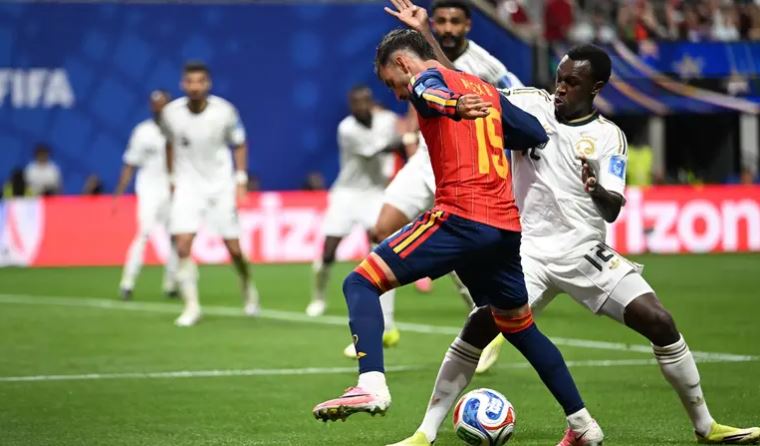
MEXICO, JUN 22: Saudi Arabia suffered a difficult afternoon in Atlanta as Spain ran out 4-0 winners to take control of Group H at the 2026 FIFA World Cup.
After earning an encouraging point against Uruguay in the opening match, the Green Falcons were unable to repeat that performance against one of the tournament favorites.
First-half goals from Lamine Yamal and Mikel Oyarzabal put Spain firmly in command before Alex Baena and Oyarzabal added further goals after the break to down Georgios Donis’ side.
For all the latest headlines follow our Google News channel online or via the app.
Here, Al Arabiya English highlights three key takeaways from Saudi Arabia’s 4-0 World Cup defeat to Spain.
Spain answered critics
The reigning European champion arrived in Atlanta with questions to answer after being held to a goalless draw by minnow Cape Verde in its opening match. Luis de la Fuente’s side responded emphatically to underline why it has been tipped to add a second World Cup trophy to the one it won in 2010 in South Africa.
Spain played with greater urgency and precision from the outset, creating overloads across the pitch and moving the ball far quicker than it did against Cape Verde. Real Sociedad forward Oyarzabal’s two goals highlighted the quality in Spain’s attacking ranks, while Barcelona star Yamal once again demonstrated why he is one of the brightest talents in world football.
The front three of Yamal, Oyarzabal and Alex Baena continually rotated positions, meaning Saudi Arabia’s defenders rarely had a fixed reference point and Spain exploited the spaces that opened up as a result. More importantly, Spain rediscovered the efficiency that deserted them against Cape Verde. They scored with three of their first four shots on target and effectively ended the contest before half-time.
The performance served as a reminder that Spain remains among the strongest contenders in the tournament and the result transforms the complexion of Group H. Spain now heads into its final game against Uruguay with momentum restored and qualification firmly within its grasp.
Donis’ tactical gamble doesn’t pay off
Despite an encouragingly disciplined display against Uruguay, Green Falcons coach Donis opted for a different approach against Spain. Saudi Arabia switched to a back three, bringing Ali Lajami into the starting line-up and sacrificing some of the attacking threat that had helped trouble Uruguay in Miami.
The change was understandable given the quality of Spain’s forward line, but the Green Falcons still found themselves overwhelmed during a devastating first-half spell in which Spain scored three times.
Donis’ decision to omit Mohamed Kanno from his starting line-up may have raised a few Saudi eyebrows ahead of kick-off. The experienced midfielder had been one of his team’s most influential performers in the draw with Uruguay, helping the Green Falcons establish a foothold in midfield against one of South America’s traditional powers.
Without him, Saudi Arabia struggled to gain control in the center of the park during a one-sided first half in which Spain scored three times and effectively settled the contest before the interval. Donis turned back to Kanno at half-time and the game immediately became more competitive.
Spain still added a fourth goal through Alex Baena, but the Green Falcons looked more organized, saw more of the ball and limited Spain to far fewer clear-cut opportunities than they had created before the break. There were also signs that Saudi Arabia retained an attacking threat. In FIFA’s Power Rankings, which use advanced data to assess every player’s contribution at the tournament, Salem Al-Dawsari and Abdullah Al-Hamdan ranked immediately behind Spain trio Oyarzabal, Yamal and Dani Olmo for ‘Attacking’ contribution in the match. Al-Dawsari also finished second in FIFA’s ‘Creativity’ rankings.
Those figures will offer little consolation after a 4-0 defeat, but they do suggest the Green Falcons still managed to produce moments of attacking quality against one of the tournament favorites. The challenge for Donis is finding a way to translate those flashes into sustained pressure against Cape Verde.
Another decisive finale awaits
Defeat to Spain was painful, but Saudi Arabia’s World Cup remains alive. The opening draw with Uruguay, coupled with the expanded 48-team format, means there are more routes to the knockout stage than ever before. Saudi Arabia still have every reason to believe they can remain in contention heading into the final round of fixtures.
The Green Falcons’ position improved further when Cape Verde and Uruguay played out a 2-2 draw. The result leaves Group H finely balanced heading into the final round of fixtures, with all four teams still possessing a realistic chance of progression. Victory over Cape Verde would almost certainly send Saudi Arabia through to the Round of 32, either by automatic qualification or as one of the tournament’s best third-placed teams
History offers encouragement. In 1994, Saeed Al-Owairan’s famous solo goal against Belgium secured victory in Saudi Arabia’s final group match and sent the Green Falcons into the Round of 16. In 2018, Salem Al-Dawsari scored a dramatic late winner against Egypt to ensure Saudi Arabia ended their campaign on a high – though two defeats from the first two games meant the Green Falcons failed to make it to the knockout stage.
Cape Verde now stands between Saudi Arabia and another opportunity to create a memorable World Cup moment. Whether Donis’ side can secure qualification remains to be seen, but it still has everything to play for against the West African islanders.