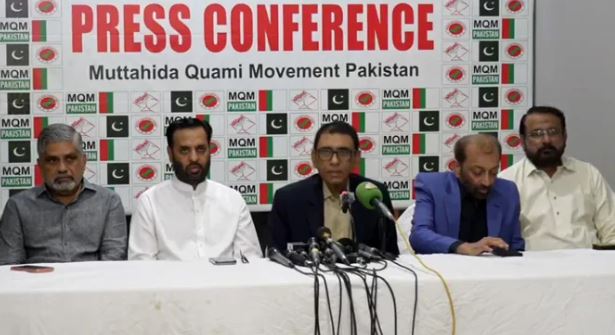
KARACHI, AUG 16: Muttahida Qaumi Movement-Pakistan (MQM-P) Chairman Khalid Maqbool Siddiqui on Sunday called for a national dialogue on the creation of new provinces, saying Pakistan’s existing administrative structure no longer corresponds to the country’s demographic realities and governance requirements.
The call comes amid a renewed debate on administrative reforms after Interior Minister Mohsin Naqvi proposed last month the creation of new administrative units, arguing that Pakistan’s “collapsed” governance structure requires restructuring to meet growing administrative challenges.
Siddiqui, addressing a press conference alongside senior MQM-P leaders Dr Farooq Sattar and Mustafa Kamal in Karachi, urged political parties to rise above partisan differences and build a consensus on administrative reforms.
He argued that the issue should be addressed through an inclusive national discussion rather than political confrontation.
He said support for the proposal was growing across the political spectrum, adding that MQM-P was prepared to engage with all stakeholders to develop a framework for the establishment of new provinces where they were needed.
Siddiqui maintained that Pakistan’s provinces were originally formed on linguistic considerations and had since evolved into large administrative units.
Despite substantial population growth over the decades, he said, successive governments had created numerous districts while avoiding a broader debate on provincial reorganisation.
“The effects of not creating new provinces should also be discussed,” he said, arguing that administrative boundaries should reflect population size and governance needs.
He added that Sindh was among the regions where the demand for additional administrative units was most pronounced.
The MQM-P chairman rejected the notion that advocating new provinces was controversial, noting that the Constitution itself contains provisions relating to the creation of provinces. “If it is considered an act of disloyalty, then why does the Constitution provide for it?” he asked.
Referring to the 18th Constitutional Amendment, Siddiqui said his party supported the reforms to ensure that the benefits of democracy reached all parts of the country.
He argued, however, that the objectives of decentralisation could not be fully realised without strengthening administrative structures at the provincial level.
He said MQM-P had already introduced a constitutional bill on the issue, which remains before a parliamentary standing committee, and recalled that the party had previously sought judicial intervention when progress stalled.
Siddiqui said MQM-P would continue supporting calls for new provinces from different parts of the country and remained open to dialogue with all political parties.
He also indicated that the party could again approach the Supreme Court if constitutional and legal obligations regarding the matter remained unfulfilled.
Kamal said that the creation of additional administrative units was not aimed against any ethnic group, including Sindhis, but was intended to improve governance and public representation.
He said a more decentralised administrative structure would give citizens greater influence over local governance and strengthen accountability.
Addressing the presser, Sattar said the establishment of additional administrative units has become essential for the country’s stability and cohesion.
He was of the view that bringing governance closer to citizens would improve public participation, enhance service delivery and ensure that local leadership emerged from the areas it represented.
Mixed reaction
The proposal has, however, elicited mixed reactions across the political spectrum. The Pakistan Peoples Party (PPP), which governs Sindh and is a key coalition partner of the ruling Pakistan Muslim League-Nawaz (PML-N), has firmly opposed the creation of new provinces.
Senior government figures, including Defence Minister Khawaja Asif and Prime Minister’s Adviser on Political Affairs Rana Sanaullah, have also refrained from endorsing the idea.
As the debate gathered momentum, Naqvi moved to clarify his earlier remarks, rejecting suggestions that he had criticised the government. He said he was part of the administration and would not issue a “charge sheet” against his own government.
Speaking to Geo News, the interior minister had said the current system would continue and complete its constitutional term, stressing that his comments about a “collapsed” governance structure referred to the gradual erosion of administrative and institutional capacity over the past eight decades rather than the performance of the present government.
A day ago, Sanaullah said that the government had not formulated any plan regarding the creation of new provinces.
Speaking on Geo News programme Naya Pakistan, he noted that various proposals were being floated publicly, with some advocating 12 provinces, others 20, and some even more.
He said MQM-P leader and Federal Minister Kamal’s proposal was primarily focused on Karachi, adding that the PML-N’s top leadership had not discussed the issue in recent days.
He also questioned the level of public support for the proposal, arguing that there was no widespread demand for new provinces across the country. Apart from calls for a Hazara province, he said, there was little evidence of a broader grassroots movement in favour of provincial reorganisation.
The proposal has, however, found support in some political quarters. Istehkam-e-Pakistan Party (IPP) President Abdul Aleem Khan backed the creation of new provinces, describing it as a national issue that should not be sacrificed for political expediency.
He also voiced support for the establishment of South Punjab and Bahawalpur provinces, saying demands for additional administrative units were emerging from different parts of the country.
Major opposition party Pakistan Tehreek-e-Insaf (PTI) Chairman Barrister Gohar Ali Khan also endorsed the idea, saying the country required additional administrative units.
He stressed, however, that any move to create new provinces should be based on broad political consensus and carried out through the constitutional process, including approval by the requisite two-thirds majority in the relevant assemblies.