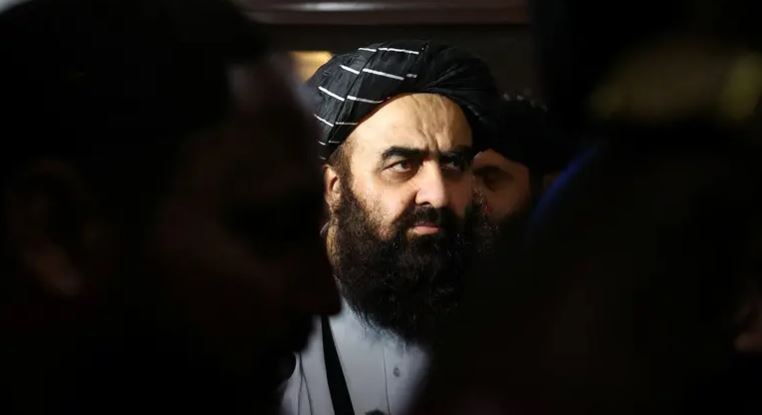
KABUL, AUG 31: Taliban Foreign Minister Amir Khan Muttaqi has invited American companies to invest in Afghanistan’s mining, infrastructure and agricultural sectors, the Financial Times reported on Monday.
During an interview with the publication, Muttaqi reportedly proposed that US-Afghan relations “should not be assessed through the lens of the past 20 years of war, but rather on the basis of future co-operation”, saying that Afghanistan would “absolutely” welcome US investment.
A Pentagon valuation of US Geological Survey (USGS) data in 2009 estimated at least $1trillion of untapped mineral resources in Afghanistan.
Since returning to power in 2021 the Taliban have concluded more than $7 billion of mining deals, much of which coming from companies connected to China, Iran and other countries willing to engage with their government.
Afghanistan contains copper, iron ore, lithium, rare earth elements, cobalt, chromite, gold, niobium, and gemstones. Lithium, copper, cobalt and rare earth elements are on the US 2025 Critical Minerals List, tied to electric vehicle batteries, defense tech and reducing dependence on China.
Some analysts and researchers are critical of these deals arguing that the Taliban is monetizing these minerals badly, on terms that outsource the important parts of the value chain, particularly refining, which is where the real profit margins and the power to control supply, pricing and market access sit.
Investors like China argue however that the US withdrawal created a vacuum they can fill with capital, infrastructure, and expertise Afghanistan lacks, without sociopolitical conditionalities Western engagement would attach.
The five-year anniversary of the Taliban’s return to power and the collapse of the US-backed government was celebrated in the streets of Kabul this month. While the country has been safer since the end of the occupation it remains one of the poorest nations on earth, a third of the population faces acute hunger, and women’s rights have been heavily restricted.
UN experts warned this month that “there should be no moves to normalize the Taliban de facto authorities, including by accepting diplomats or holding meetings in capitals, without demonstrated, measurable progress against human rights benchmarks, particularly for women and girls.”
Despite this, over the past year countries including China, India, Iran, Qatar and several Central Asian states have moved, in varying degrees, toward normalizing relations with the Taliban. Russia, which recognized the Taliban government last year, signed a military co-operation agreement in May. The EU also hosted Taliban officials in Brussels earlier this year to discuss possible migrant returns.
Thus far, the US has not made any moves toward a closer relationship to the Taliban.
Nonetheless, Muttaqi told the Financial Times that he encouraged the White House to reopen the US embassy which was abandoned in 2021, saying the Taliban had “ensured its security… rebuilt the road and planted new trees,” adding, “The area now looks very vibrant and attractive.”