

By Fawad Hassan
Every year, 8 September Navy Day offers Pakistan an opportunity not merely to revisit an important chapter of its military history, but to reflect on the evolution of a naval force whose responsibilities have expanded dramatically over the decades. From the audacity of Operation Dwarka in 1965 to today’s technologically advanced surface, subsurface, aviation and maritime-security capabilities, Pakistan Navy’s journey is one of adaptation, professionalism and an enduring commitment to safeguarding the country’s maritime interests.
The origins of Navy Day are inseparable from the night of 7–8 September 1965, when a Pakistan Navy task group approached the Indian coast and carried out Operation Dwarka. Conducted by a relatively young and numerically smaller navy, the operation demonstrated initiative, surprise, coordinated planning and the ability to carry naval power close to an adversary’s coastline. Dwarka’s enduring significance lies not merely in the action itself, but in the principle it represented: at sea, professional competence, preparedness and intelligent employment of available strength can compensate for numerical disparity.
That spirit would again be demonstrated during the 1971 war. PNS/M Hangor’s successful attack on INS Khukri became a landmark in submarine warfare the first sinking of a warship by a submarine since the Second World War. The episode remains central to Pakistan Navy’s submarine tradition and its emphasis on exploiting the inherent advantages of the undersea domain.
Pakistan’s maritime challenges today are vastly different from those of 1965. The country’s economic lifelines run through the Arabian Sea, making the protection of ports, shipping routes, energy flows and sea lines of communication an essential component of national security.
Consequently, Pakistan Navy has evolved beyond a force designed primarily for conventional fleet engagements. Its contemporary responsibilities encompass maritime deterrence, protection of sea lines of communication, maritime-domain awareness, counter-piracy, counterterrorism, coastal security, humanitarian assistance and disaster relief, alongside its core war-fighting mission.
Pakistan Navy has also developed a significant role in maritime diplomacy. The multinational AMAN exercises, professional exchanges and cooperation with regional and extra-regional navies have provided avenues for interoperability and dialogue in an increasingly contested Indian Ocean.
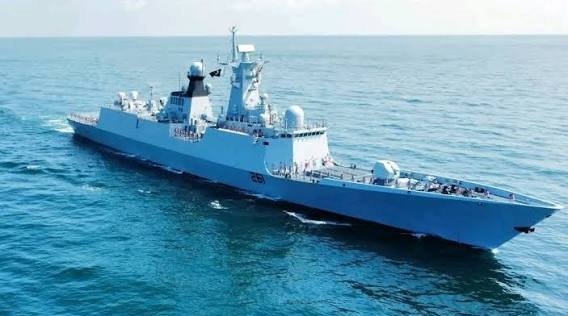
Perhaps the clearest evidence of the Navy’s transformation is the modernization of its fleet. The induction of Type 054A/P frigates, Babur-class MILGEM corvettes and Yarmook-class offshore patrol vessels has introduced modern sensors, weapons and multipurpose capabilities. PNS Babur and PNS Hunain entered service in 2024, while PNS Khaibar, the second Babur-class corvette, was inducted in April 2026.
The transformation below the surface is equally consequential. In April 2026, Pakistan commissioned the first of its new Hangor-class submarines, PNS/M Hangor. The eight-submarine programme is particularly significant because four boats are to be constructed at Karachi Shipyard under a transfer-of-technology arrangement, strengthening both underwater capability and domestic shipbuilding expertise.
This localization is strategically important. A future-ready navy cannot remain indefinitely dependent upon importing complete platforms. The construction of MILGEM ships at Karachi Shipyard and plans for the Jinnah-class frigate, envisaged as Pakistan’s first indigenously designed and built frigate-sized warship, point toward a gradual transition from acquisition to indigenous design, construction and technological ownership.
Similarly, Pakistan Navy of tomorrow will operate sophisticated ships and submarines unimaginable to those who sailed toward Dwarka six decades ago. But technology alone cannot create maritime power. It must be matched by trained sailors, capable commanders, resilient institutions and the ability to anticipate rather than merely react to change. Navy Day should therefore be both a remembrance and a commitment a remembrance of those who established Pakistan’s naval traditions, and a commitment to build a force capable of meeting the challenges of an increasingly complex Indian Ocean.
From Dwarka to Hangor, from conventional platforms to networked warfare, and from foreign acquisition toward indigenous capability, Pakistan Navy’s evolution reflects a broader strategic imperative: to remain credible today while preparing for the battlespace of tomorrow. The platforms will change and technologies will evolve, but the mission remains constant to guard Pakistan’s maritime frontiers, secure its economic lifelines and remain ready whenever the nation calls.
As Pakistan commemorates Navy Day, the most meaningful tribute to that generation is not simply to remember what happened at Dwarka. It is to preserve the qualities that made decisive action possible: professional excellence, vigilance, courage and readiness. The sea rarely announces the challenges it will bring. A navy’s task is to be ready when they arrive