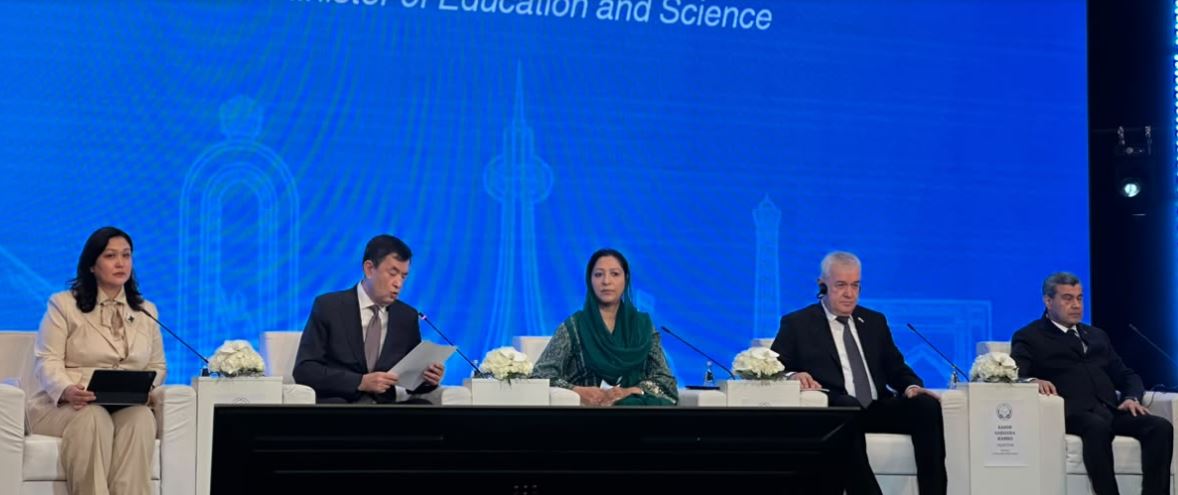
ISLAMABAD, Oct 28 (DNA): Minister of State for Federal Education and Professional Training Wajiha Qamar on Tuesday reaffirmed Pakistan’s commitment to strengthening educational and scientific cooperation with Uzbekistan and Central Asian states for regional integration and sustainable development.
Addressing the opening ceremony of the International Education Forum 2026 in Tashkent, themed “Developing a Common Educational Space in Central Asia and International Cooperation,” the Minister of State called for transforming historic regional ties into meaningful academic partnerships that create opportunities for future generations.
She said Pakistan and Uzbekistan enjoy deep-rooted relations founded on centuries of shared history, faith, culture and intellectual traditions, adding that the historic centres of learning in Samarkand, Bukhara and Tashkent symbolize the region’s remarkable contribution to global knowledge and civilization.
“Our ancestors connected our civilizations through knowledge. It is now our responsibility to connect future generations through opportunity,” she remarked.
The Minister of State appreciated Uzbek President Shavkat Mirziyoyev’s vision for advancing education, science and innovation, and expressed gratitude to the Government of Uzbekistan for bringing together international leaders, academicians and policymakers to promote educational cooperation.
Highlighting Pakistan’s national priorities, Wajiha Qamar said that under the leadership of Prime Minister Muhammad Shehbaz Sharif, the government was pursuing comprehensive initiatives to strengthen education, develop human capital and equip young people with skills required in the modern global economy.
She said the Prime Minister’s Education Emergency reflected Pakistan’s determination to bring out-of-school children into classrooms, improve learning outcomes and expand access to quality education, particularly for girls and underserved communities.
“Education is not merely a social priority; it is a strategic investment in prosperity, resilience and sustainable development,” she emphasized.
The Minister of State noted that artificial intelligence, digital transformation and scientific advancements were rapidly reshaping the global education landscape, making international academic collaboration more important than ever.
She said Pakistan was strengthening research and international partnerships through the Higher Education Commission (HEC), while the National Vocational and Technical Training Commission (NAVTTC) was working to equip young people with market-relevant technical and vocational skills.
Calling for a new era of educational cooperation between Pakistan and Uzbekistan, Wajiha Qamar proposed expanding student and faculty exchanges, developing joint degree programmes, facilitating mutual recognition of academic qualifications and promoting collaborative research initiatives.
She identified artificial intelligence, engineering, medicine, agriculture, mining, renewable energy and language education as promising areas for enhanced bilateral cooperation.
Referring to academic engagement involving Pakistan’s National University of Sciences and Technology (NUST) and Uzbekistan’s University of Geological Sciences, she said institutional partnerships could serve as important building blocks for deeper scientific and educational collaboration.
The Minister of State outlined three priorities for strengthening regional educational cooperation: greater academic mobility for students and researchers, stronger university-industry linkages to promote innovation, and inclusive educational opportunities for women and underserved communities.
She stressed that educational partnerships should move beyond formal agreements and translate into tangible benefits for students, researchers and societies.
“The measure of our success will not be the number of agreements signed, but the lives transformed through their implementation,” she said.
Wajiha Qamar further emphasized that Pakistan viewed educational cooperation with Central Asia as an important avenue for strengthening regional connectivity, advancing scientific research and promoting shared economic prosperity.
She reaffirmed Pakistan’s readiness to work closely with Uzbekistan, other Central Asian nations, Türkiye and international partners to build a more connected, inclusive and innovation-driven educational future.
Concluding her address, the Minister of State expressed confidence that the forum would pave the way for lasting institutional partnerships and renewed academic engagement across the region.
She reiterated that Pakistan remained committed to deepening its brotherly relations with Uzbekistan through sustained cooperation in education, science, research and cultural exchange.
Professor Dr. Zia Ul Haq, Executive Director of the Higher Education Commission of Pakistan, accompanied the Minister of State at the forum.