
Naufil Shahrukh
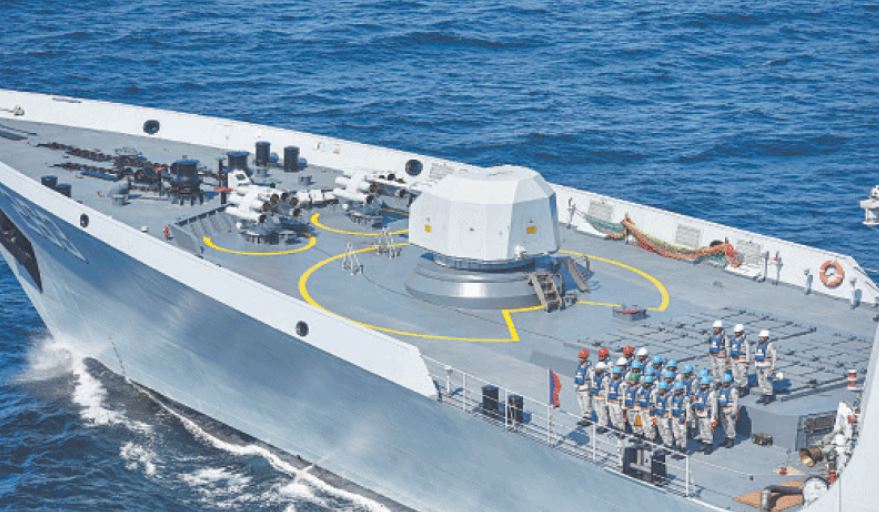
In the restless waters of the Arabian Sea, where the pulse of global trade beats hardest, the Pakistan Navy has for nearly two decades hosted a gathering that few outside maritime circles fully appreciate. The AMAN exercises, meaning “peace” in Urdu and carried under the simple banner “Together for Peace,” began in 2007 as a modest multinational effort. What started with twenty-eight countries has grown into one of the region’s most consistent platforms for naval cooperation. The ninth edition in February 2025 drew participation from more than sixty nations. The tenth, scheduled for early 2027, will mark two full decades of this work.
That timing matters more than ever. The Strait of Hormuz, the narrow passage through which roughly a fifth of the world’s oil and liquefied natural gas normally flows, has become a theatre of sustained friction. Iranian responses to American and Israeli military actions have produced mine threats, claims of tanker fires, renewed assertions of control over shipping lanes, and reciprocal strikes. Commercial traffic has thinned. Insurance costs have risen. Navies that once treated the Gulf approaches as routine now treat them as contested. In such an atmosphere the value of habits of cooperation, built patiently over years rather than invented in a crisis, becomes clear.
AMAN was never designed as a wartime alliance or a counter-coalition. Its purpose has always been more practical and more modest: to bring ships, aircraft, special operations teams, and observers from different political systems into the same professional space. Harbour-phase seminars, cultural exchanges, and sports competitions sit alongside sea-phase drills in anti-piracy, counter-terrorism, search and rescue, and live-fire coordination. The point is interoperability and mutual familiarity. When navies have already practised operating together, the friction of an emergency is lower and the risk of miscalculation is reduced.
Pakistan’s geography makes this role natural. The country’s coastline sits astride the approaches to the Gulf and the western reaches of the Indian Ocean. Nearly all of Pakistan’s trade by volume and the entirety of its energy imports move by sea. Maritime security is not an abstract strategic interest; it is an economic necessity. By hosting AMAN, the Pakistan Navy has turned that geography into a diplomatic asset. Nations that rarely share a table elsewhere find themselves planning serials, exchanging signals, and conducting formation steaming under a Pakistani flag. China, the United States, Iran, Saudi Arabia, Japan, Türkiye, and a range of African and Southeast Asian partners have all appeared at different editions. The exercise does not erase rivalries, but it creates repeated, structured contact that softens the edges of those rivalries.
The current Hormuz crisis illustrates why such contact is worth preserving. When one side closes or threatens a choke point and another answers with blockades or kinetic strikes, the space for calm communication shrinks. Commercial shipping becomes collateral. Coastal states that depend on energy flows or transit fees feel the secondary effects. In that environment a navy that has already practised joint boarding operations, shared common operating pictures, and established working relationships with counterparts from multiple capitals is better placed to contribute to de-escalation or, at minimum, to protect its own sea lines of communication. AMAN builds exactly those relationships in peacetime so they exist when they are most needed.
Critics sometimes dismiss multinational exercises as expensive pageantry. The record of AMAN suggests otherwise. Participation has expanded steadily even through periods of regional tension. The addition of the AMAN Dialogue in recent editions has widened the conversation beyond operational tactics to include broader questions of maritime governance, blue-economy development, and the management of non-traditional threats such as illegal fishing, narcotics trafficking, and environmental degradation. These are the everyday problems that persist long after headline confrontations fade. A platform that addresses both the high-end and the low-end of the maritime spectrum retains relevance across political cycles.
There is also a quieter form of soft power at work. For a country frequently portrayed through the narrow lens of land-centric security challenges, AMAN presents a different image: a professional navy capable of organising complex multinational activity, a host that can accommodate diverse guests without demanding ideological alignment, and a regional actor that prefers cooperative security to exclusive blocs. In an Indian Ocean already crowded with competing visions of order, that posture has value.
Looking ahead to the twentieth anniversary edition, the strategic environment will almost certainly remain unsettled. The Hormuz corridor will continue to test the resilience of energy markets and the discipline of naval forces. Rivalries among major powers will not disappear. What can be shaped is the density of practical cooperation available when friction rises. AMAN does not solve the underlying political disputes that produce blockades and retaliatory strikes. It does, however, keep open channels of professional communication and shared operational language among the very forces that would otherwise meet only in moments of crisis.
Pakistan’s investment in this platform has been steady rather than spectacular. That steadiness is its strength. In a region where trust is scarce and miscalculation is costly, the patient accumulation of joint experience is not a luxury. It is a form of insurance. The AMAN exercises remind us that peace at sea is not merely the absence of war; it is the presence of working relationships that make war less likely and crisis management more possible. In the shadow of Hormuz, that reminder is timely.