
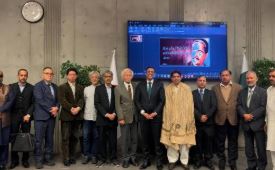
TOKYO, Nov 9 (DNA):An academic session exploring various aspects of the life, thought and philosophy of Allama Muhammad Iqbal, as well as his message for humanity, brought together distinguished scholars, researchers and literary figures from Pakistan and Japan, who shared their perspectives on his intellectual legacy.
The session featured discussions on Iqbal’s concept of humanity, the material and spiritual dimensions of the universe, human values, history and civilisation, and the contemporary relevance of his thought in the context of modern technology, said a news release.
The speakers presented their views on a range of subjects. Professor Kataoka Hiroji (Tamgha-e-Imtiaz) highlighted the humanistic dimensions of Allama Iqbal’s concept of humanity and his philosophy of humanism. Professor Zia ul Hassan (Osaka University) discussed the relationship between Iqbal’s thought and the material world. Professor Amir Khan (Tokyo University of Foreign Studies) explored the concept of spirituality in Iqbal’s poetry and philosophy. Professor Soyamane (Osaka University) spoke about the historical evolution of the Urdu language in Punjab, highlighting Iqbal’s intellectual and literary background. Dr. Taqi Abedi (Canada) emphasised the significance of human values and moral principles in Iqbal’s poetry. Professor Abdul Rauf (Director, Iqbal Academy) discussed the importance of Iqbal’s life, thought and intellectual legacy in connection with the 150th anniversary of his birth. Ambassador of Pakistan to Japan, H.E. Abdul Hameed, shared his views on the relationship between Iqbal’s thought and Artificial Intelligence (AI), highlighting the contemporary relevance of Iqbal’s philosophy in the modern age. Kenta Imagawa spoke on the intellectual perspectives of Iqbal in comparison with those of the German philosopher Friedrich Nietzsche. Professor Mamiya Kensaku (Tokyo University of Foreign Studies) shed light on various aspects of Iqbal’s scholarly and intellectual personality. Professor Khalid Sangrani shared his views on various dimensions of Iqbal’s poetry.
During the session, it was highlighted that Iqbal’s message continues to inspire reflection across diverse academic and cultural traditions. His poetry and philosophy encourage individuals to pursue self-awareness, knowledge and action, moral excellence, and the constructive use of their abilities. Participants also emphasised the importance of further research on Iqbal’s thought and strengthening academic and literary exchanges between Pakistan and Japan.
On the occasion, the Ambassador of Pakistan appreciated the participation of Japanese and Pakistani scholars and their diverse perspectives on Allama Iqbal’s thought. He observed that examining Iqbal’s philosophy in connection with contemporary themes such as humanity, spirituality, history, human values and Artificial Intelligence demonstrated that his intellectual legacy continues to provide guidance and inspiration for new discussions and research.
The academic session also carries special significance in the context of the 75th anniversary of the establishment of diplomatic relations between Pakistan and Japan, which will be commemorated in 2027. Such initiatives contribute to further strengthening academic, literary and cultural ties between the two countries.