Ansar Mahmood Bhatti
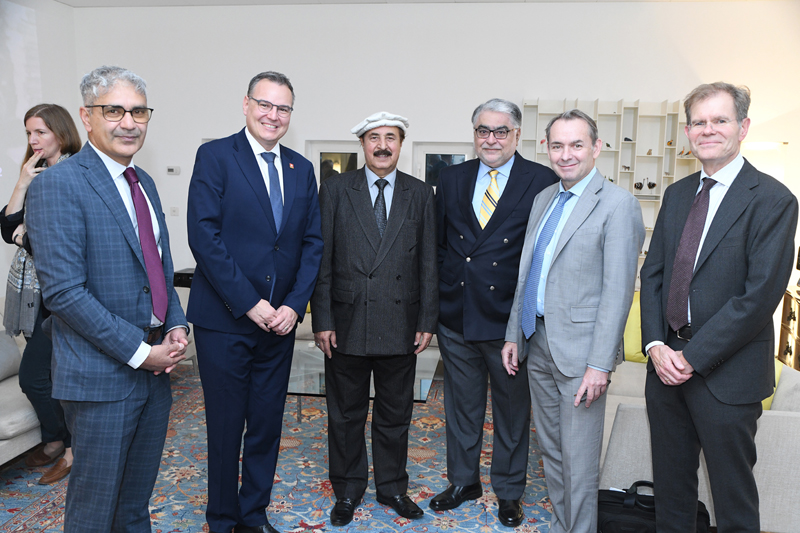
ISLAMABAD: Marking Francophonie Summit 2026, the Embassies of Switzerland and France and the High Commission of Canada in Pakistan jointly hosted a livestream and discussion on the Arctic research expedition CASCADES, highlighting the connections between glacier research in Greenland and the Hindu Kush-Karakoram-Himalaya (HKH) region.
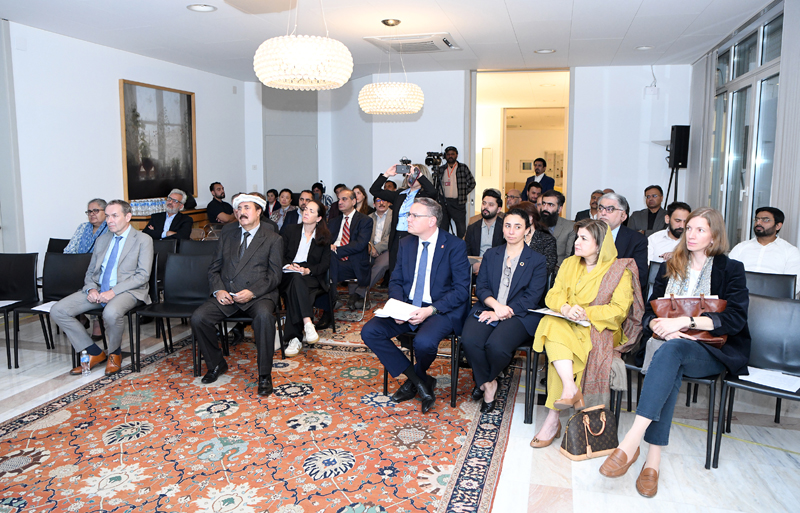
The event took place at the Swiss Residence in Islamabad and brought together diplomats, scientists, policymakers, and researchers to explore how climate change is reshaping ice-dependent ecosystems and communities across the globe.
Dr. Mohammad Sharif, Member of the Gilgit-Baltistan Assembly and Parliamentary Secretary for Health and Population Welfare, represented the Chief Minister of Gilgit-Baltistan, Amjad Hussain Azar.
The evening opened with remarks from Stéphane Rey, Ambassador of Switzerland; Jean-Noël Poirier, Ambassador of France; and Tarik Ali Khan, High Commissioner of Canada.
Speaking on the importance of Arctic research for countries beyond the polar region, Ambassador Jean-Noël Poirier drew on his experience in Greenland and underlined the visible effects of climate change already impacting local communities. He noted that changing ocean temperatures are affecting fish stocks, whale migration patterns, and shrimp populations, while increased glacier melt is creating new navigation challenges due to drifting icebergs. “The information we get from Greenland is very important for all countries to know what to expect from climate change in the future,” he said.
High Commissioner Tarik Ali Khan emphasized the importance of international scientific cooperation and the relevance of Arctic research to Pakistan’s mountain regions. He noted that the Arctic is warming nearly four times faster than the global average and stressed that climate change poses both environmental and security challenges. “What we learn at one end of the world’s cryosphere helps us understand the other,” he said, highlighting the parallels between glacier changes in Greenland and those affecting communities in the Karakoram, Hindu Kush, and Himalaya.
Stéphane Rey, Ambassador of Switzerland said “Melting ice in Greenland, the Alps, and the HKH region reflects a shared global challenge. As mountainous countries with retreating glaciers, Switzerland and Pakistan can learn from each other’s experiences.”
Jean-Éric Tremblay, Scientific Director of the Institut nordique du Québec and chief scientist for the expedition’s first leg, followed with a video message.
Guests then connected live with scientists aboard the Canadian research icebreaker CCGS Amundsen, including Dr. Bastien Rouault, CASCADES Coordinator at the Swiss Polar Institute; Dr. Sofia Müller of EPFL Valais; and Prof. Dany Dumont of Université du Québec à Rimouski, chief scientist for the second phase of the expedition.
Mr. Dinar Wali, geospatial computational researcher and founder of RegenX.eco, presented the links between polar and mountain ice research and explained how lessons from the Arctic can contribute to understanding glacier change in Pakistan.
The CASCADES Expedition is a collaborative 2026 Arctic research mission aboard the Canadian icebreaker CCGS Amundsen, studying how melting Greenland glaciers and sea-ice formation affect ocean ecosystems and the global climate.
The mission is jointly led by the Swiss Polar Institute (SPI), the Institut nordique du Québec (INQ), and the French Polar Institute (IPEV), in collaboration with Greenlandic institutions and Amundsen Science.
Alongside seven research projects covering five scientific clusters, the expedition’s outreach programme includes CLASSCADES, a series of free learning modules in French and German designed to help children aged 8-12 explore Arctic science, life aboard the CCGS Amundsen, and the importance of the Arctic for the future of the planet.