Opinion | By Farukh Shehzad
Walk into almost any home in Pakistan during exam season and you will feel it. The books are open. The tension is thick. A mother counts the days. A father counts the fees. And in the middle sits a child, memorizing page after page, hoping to remember it just long enough to write it on the paper.
I have watched this picture for more than 20 years. And I have come to a painful conclusion: many of our brightest students are not failing. They are slowly losing something that marks cannot measure. They are losing their confidence.
The Exam Factory: Memorize, Write, Forget
In too many classrooms, the child sits in a row. The teacher talks. The child copies from the board and memorizes pages for the exam. After the exam, most of it is forgotten.
Marks may go up. But the child does not grow into a clear thinker, a confident speaker, or a leader. Then, at twenty-two, that same bright young person sits in a job interview and freezes. Not because they lack intelligence, but because no one ever trained them for real life.
Let me be fair. Teachers are not the villains here. Many work hard in crowded rooms with very limited resources. The system rewards memory, so everyone follows it: schools, tuition centers, and parents.
[Add one verified statistic here, with a link to its source, for example from a recent education survey such as ASER Pakistan. Do not use any figure you cannot source.]
The Pressure Nobody Talks About
Then comes the pressure. Marks become a family matter. Relatives compare children over tea. Tuition fills the evenings. A low grade can feel like a shame on the whole household.
What does a child learn from this? That mistakes are dangerous. So they stop asking questions. They stop trying new things. They stop speaking up, because speaking up might be wrong.
But confidence is built exactly the other way. It grows when a child tries, fails, and tries again, and finds that the world does not end. Exam pressure teaches children to avoid risk. Real life rewards those who dare to take it.
Confidence Is Not a Gift. It Is a Skill.
Here is the good news. Confidence is not something a child is born with or without. It is a skill, and like swimming or cooking, it can be learned through practice.
For centuries, strong families and great schools trained the whole person: mind, character, body, and purpose. I call this elite education. It does not mean rich. It does not need expensive schools or foreign degrees. It means the best way of raising a capable human being, and parents can begin at home.
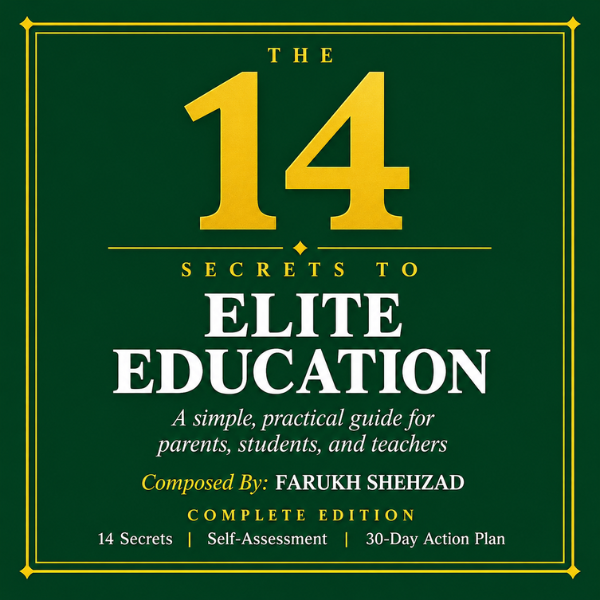
In my ebook, The 14 Secrets to Elite Education, I explain fourteen such ideas in simple English. Here are three of them that every worried parent can start using this week.
Secret 1: Let Your Child Do the Work (Independent Work)
In elite education, the student does 80 to 90 percent of the work and the decision-making. The teacher, or the parent, acts like a coach. Think of a cricket coach: he explains, shows, watches, and corrects, but he does not bat for you.
Many of our children depend on notes, guide books, and tuition for everything. So the moment there is no teacher to tell them what to do, they feel lost.
Here is a tiny change you can try tonight. When your child asks for help with homework, do not give the answer. Ask, “What have you tried so far?” Then let them think. You can also let your child plan one family outing, with the budget, the route, and the timings. Your only job is to ask questions.
History shows how powerful this can be. According to his own account, the great scholar Ibn Sina learned a great deal by himself, and he struggled for a long time with a difficult book until he found a small guide that made it clear. He did not wait to be spoon-fed. He searched for the tools himself.
Want the full guide? Get all 14 secrets, with easy steps for parents in every chapter. [E-BOOK LINK HERE: The 14 Secrets to Elite Education]
Secret 2: Teach Your Child to Speak and Write with Power (Active Literacies)
Reading is only half of literacy. The other half is writing clearly and speaking well. Yet in many schools, children read a lot, write very little except copied answers, and almost never speak in front of others.
There is a simple formula that works for almost any talk or letter. It is called Point, Reason, Example, Point. State your main idea in one sentence. Give your best reason. Add a short story or fact. Then repeat your main idea in fresh words.
Parents can practice this at home in three easy ways:
• At dinner, ask your child to describe their day in exactly three sentences: what happened, why it mattered, and what they learned.
• Hold a “Family Debate Night” on a fun topic, such as whether school should start later. Let your child argue each side for two minutes.
• Hold a “Family Speech Friday,” where everyone speaks for one minute on any topic.
One rule: never laugh at a mistake in a talk. One laugh can silence a child for a year.
The Farewell Sermon of the Prophet Muhammad (peace be upon him) is a model of clear speech. According to the narrations, he used short, clear sentences, took one subject at a time, repeated his key points, and at the end asked the crowd whether he had conveyed the message. Simple words, one idea at a time, repetition, and a check that the listeners understood.
Secret 3: Let Them Face Hard Things (Tough Challenges)
Strong people are made by difficulty. A child who never faces anything hard at ten may break at twenty-five. Over-protection, however loving, weakens a child.
The wise way is to build courage in small steps. For a shy child who fears speaking in front of the class, try a ladder: speak alone to a mirror, record your voice, speak to one trusted person, then to the family, then to a small group, and finally to the class. Celebrate each step.
A good challenge has four features: it is hard but possible, it is real, someone supportive is nearby, and the feedback is honest.
Think of squash legend Jahangir Khan. As a boy he was thin and sickly, and he had surgery for a hernia, so many doubted he could ever become an athlete. In 1979, his elder brother and coach died suddenly during a match in Australia. Jahangir went back to work even harder. That year, at fifteen, he became the youngest ever World Amateur champion, and from 1981 to 1986 he did not lose a single match: 555 wins in a row.
Two small habits help at home. Do not call your child “shy.” Say, “You are learning to speak.” And do not give trophies just for showing up. Give honest praise for real effort and real progress.
A Five-Minute Start for Tonight
You do not need a degree, extra money, or a special teacher. Tonight at dinner, ask your child: “Did anyone do something today that surprised you? Why do you think they did it?” Listen to the full answer. Do not correct or lecture. Ask it again tomorrow.
This tiny habit begins to build a child who understands people, and that is the foundation of confidence and leadership.
Learn All 14 Secrets
These three are only a taste. The 14 Secrets to Elite Education is a 53-page guide in simple English for parents, students, and teachers. Every chapter gives you the secret in plain words, a true story from history or literature, five action steps, a special “For Parents” section with steps for tonight, this week, and this month, and a Quick Summary. At the end, you get a 14-question self-assessment and a 30-day action plan with a daily tracker.
Results come from small steps repeated over time, not from a magic fix. But the first step takes only five minutes.
To learn all 14 secrets, buy now and download the E-book, link is below.
Get your copy of The 14 Secrets to Elite Education. Instant PDF download. [CLICK HERE]
Our children do not need to be rich to grow into confident, capable adults. They need the right method, and parents who are willing to begin. Start tonight.
Quick Answers for Worried Parents
Why do Pakistani students lose confidence? Often because of rote learning, heavy exam pressure, and constant comparison. Children learn to avoid mistakes instead of learning from them.
How can parents build confidence in children at home? Give them real responsibility, let them do their own thinking, practice speaking and writing together, and let them face small, safe challenges.
What is elite education? It is the best way of raising a capable human being by training the mind, character, body, and purpose. It does not require rich parents or expensive schools.

Disclosure: The writer of this article is also the composer of the ebook The 14 Secrets to Elite Education, which is mentioned above.