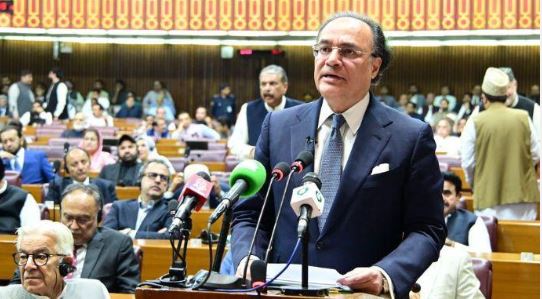
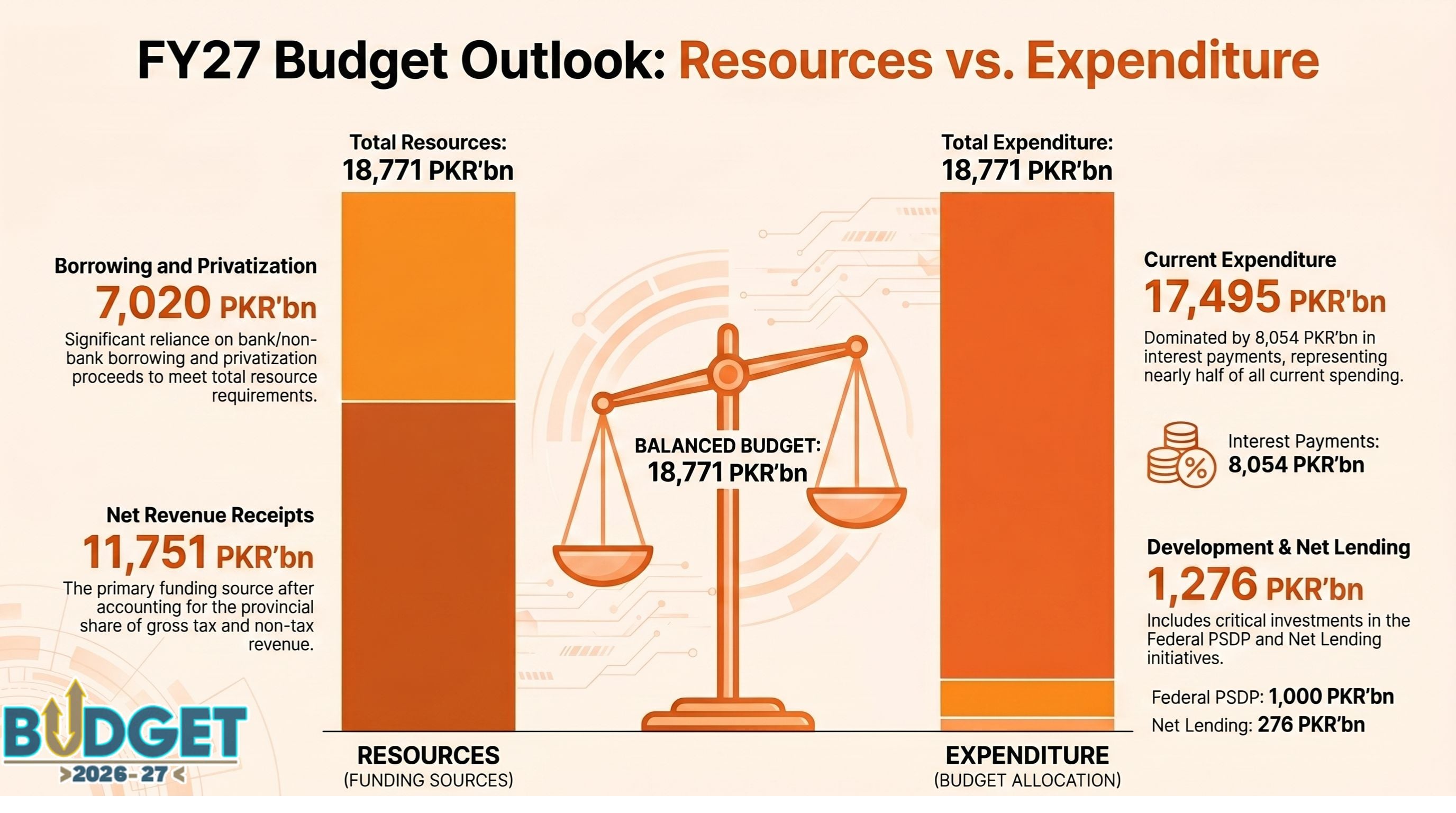
ISLAMABAD, JUN 12: Finance Minister Muhammad Aurangzeb on Friday presented a budget with a total outlay of Rs18,771 billion as the federal government tries to balance a fragile economic situation due to an energy crisis amid the Middle East tensions.
Presenting his term’s third budget in the National Assembly, the finance minister noted: “This budget is being presented at a time when Pakistan has achieved the status in the eyes of its people and the world as a country whose voice is listened to, and whose friendship is desired.”
FinMin Aurangzeb said that this did not “happen by chance” and explained that after Pakistan handed a humiliating defeat to India during last year’s war, the entire world was “compelled to take notice”.
“Today, the world acknowledges Pakistan’s defensive strength,” he said, noting that the nation has also had the honour of brokering a ceasefire between Iran and the United States, putting the South Asian country in a strong position.
The session witnessed noisy scenes, with opposition members raising slogans while treasury lawmakers welcomed PM Shehbaz by thumping desks in the lower house.
During the proceedings, PTI lawmakers also brought placards and posters into the NA. At one point, members of the treasury and opposition benches also became involved in a scuffle.
Giving a breakdown of the envisaged Rs18,771 billion budget, the finance minister said that the largest share — Rs8.054 trillion — has been earmarked for mark-up payments, followed by Rs3 trillion for defence and Rs1 trillion for the federal development programme.
The Federal Board of Revenue’s (FBR) tax-to-GDP ratio rose from 8.5% to 10.3% over the past three years, an increase of nearly two percentage points, he said.
In the financial year 2026-27, the economic growth rate is expected to remain at 4% while the average inflation rate is likely to be 8.2% during the next fiscal year, he added.
“The results of these measures are also visible in our fiscal stability. Our fiscal deficit in June 2023 was 7.8% of GDP, which by the end of the current financial year will come down to 4%,” he said.
Pakistan was facing a primary deficit equal to 0.7% of GDP two years ago, he said, adding that the government has brought the primary balance to a surplus of 1.6%.
According to the finance czar, an improvement of 2.3% has come in the primary balance relative to GDP.
During the current year, the average rate of inflation is expected to remain at approximately 7%, which is less than the current financial year’s estimate of 7.5% despite the US-Iran war, he said.
“In recent months, inflation has increased primarily due to the tension in the Middle East. God willing, when the war clouds clear, the rate of inflation will reduce further,” he added.
The finance minister maintained that the trust of global development and financial institutions in the country’s economy has increased due to the government’s policies.
Aurangzeb said that Pakistan, for the first time after 2022, returned to the international bond market and, for the first time in four years, Pakistan successfully issued a $750 Euro Bond.
PSDP
The finance minister then noted that the Public Sector Development Programme (PSDP) is the very instrument of government investment through which “we harness domestic and foreign resources for social and economic development”.
In the meeting of the National Economic Council held on June 10, he said, the national development programme for the financial year 2026-27 was approved, the total volume of which is Rs3,675 billion rupees.
This includes Rs1,000 billion for the Federal Development Programme, Rs2,224 billion for all provincial development programmes, and Rs451 billion for investment by State-Owned Enterprises (SOEs).
“This allocation reflects the new distribution of responsibilities following the 18th Constitutional Amendment, under which the responsibility for the social sector has largely shifted to the provinces, whilst the Federation focuses particularly on projects of national and strategic importance.”
He added that more than 60% of the Federal Development Programme is focused on key sectors including transport and communication, water resources, and energy; whilst the remaining portion has been allocated to other important sectors, including IT, science and technology, agriculture, health, and education.
“All these projects are aligned with the ‘Udaan Pakistan’ initiative and the National Economic Transformation Plan based on the 5Es.
In the Federal Development Budget 2026-27, Rs54.6 billion has been allocated for the sustainable urban development and housing sector.
Through this allocated amount, 150,000 affordable and climate-resistant residential units will be constructed at the federal and provincial levels, digital master plans will be prepared for 10 major cities, and significant improvements will be brought to the provision of urban water supply and sanitation.
Income tax
The FinMin added that Prime Minister Shehbaz Sharif’s government “is fully aware of the difficulties faced by the public and private sector salaried class”.
He said that in light of these difficulties, the government has decided to “provide relief to salaried individuals across four income slabs”.
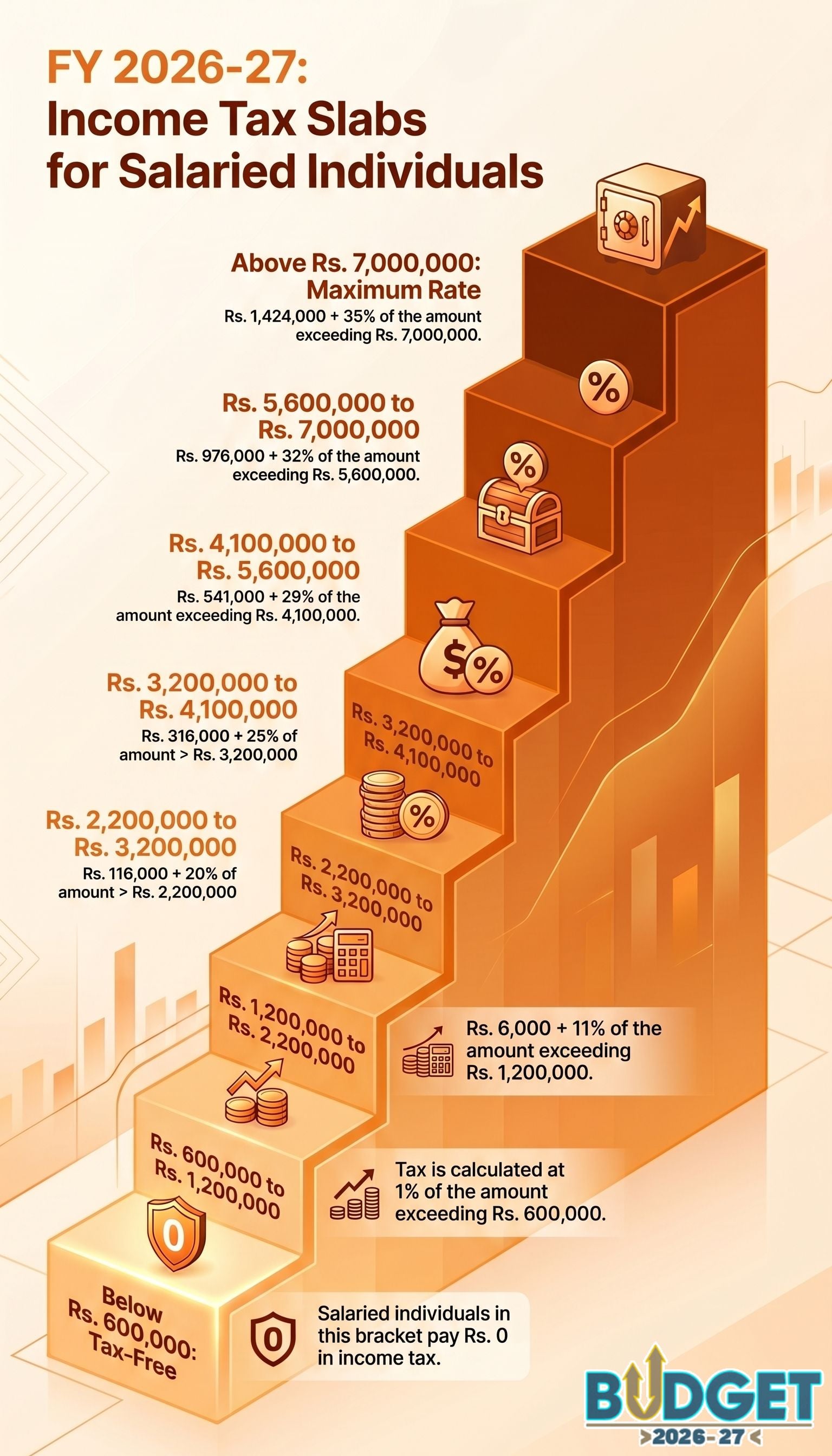
In this regard, for salaried individuals earning between Rs2.2 million-Rs3.2 million, it is proposed to reduce their tax rate from 23% to 20%. For salaried individuals earning between Rs3.2 million-Rs4.1 million, it is proposed to reduce the tax rate from 30% to 25%.
For those with an income between Rs4.1 million-Rs5.6 million, it is proposed to reduce the income tax rate from 35% to 29%. Similarly, for salaried individuals earning between Rs5.6 million-Rs7 million, it is proposed to reduce the tax rate from 35% to 32%.
He added that the government has decided to completely abolish the super tax, which ranged from 1%-7.5%, across six slabs of business income between Rs150 million to Rs500 million. Similarly, for income exceeding Rs500 million, it is proposed to reduce the super tax rate from 10% to 8%.
The purpose of this measure is to promote small businesses and industries, as well as to create ease of doing business. However, the existing surcharge on banks, oil and gas exploration companies, and fertiliser companies will remain intact.
Health and education
Moving forward, he said that public healthcare was the government’s key national priority. In the Federal Development Programme 2026-27, Rs25.1 billion have been allocated for health projects, he noted.

“These include the expansion of tertiary healthcare facilities, the strengthening of emergency and critical care, the scaling up of cancer treatment facilities, an integrated disease surveillance and diagnostic system, and the modernisation of the regulatory infrastructure,” he said.
FinMin Aurangzeb further said that higher education and research serve as the backbone of “our economic and social growth”.
He added that Rs46 billion have been allocated for the higher education sector, which represents a “remarkable increase” compared to the Rs34.9 billion allocated last year.
The finance minister said that this includes provisions for scholarships for deserving students, enhancing the research capacity of universities, upgrading the Pakistan Education and Research Network, and promoting digital learning as well as an AI-based education system.

“Separately, Rs3.6 billion have been allocated for science and technology, which will help promote technology transfer, SMEs, renewable energy, electronics, and technology in agriculture and health, among other areas,” he added.
Energy reforms
The finance minister said that Pakistan has achieved major successes on many fronts of the energy sector despite the ongoing crisis in the Middle East.
Over the past two years, the government has implemented structural reforms in the energy sector that will not only address the current crisis but also prepare Pakistan for potential future crises, he added.
“The electricity sector is passing through the deepest reformative phase of its history,” he said, adding that the government achieved savings of over Rs143 billion compared with the allocated subsidy for power consumers during the fiscal year 2025-26.
As part of the reforms, the government will identify, register, and verify all subsidised consumers for the launch of the Direct Subsidy Mechanism from January next year.
According to the finance minister, the government achieved net-zero accumulation of circular debt in the electricity sector this year, meaning no additional burden was added.
The government has renegotiated with Qatar and Italy on its long-term Sale and Purchase Agreements and agreed on a reduction of 35 LNG cargoes for the year 2026, he said, adding that the move will save approximately $1.2 billion in foreign exchange.
“Keeping in view the US-Iran war, we also focused attention on increasing local gas production,” he said, adding that the country’s oil exploration companies added approximately 100mmcfd additional gas into the national system.
Corporate sector and privatisation
In his speech, the finance minister said that the “economic improvement” has also had a positive impact on the Pakistan Stock Exchange. He added that the improvement enhanced performance of Pakistan’s corporate sector.
“In January–March 2026, the corporate sector earned 22% higher profits compared to the same period last year, while during the first nine (9) months of the current financial year, this profit growth stands at 9%,” he said.
He also noted that this year, 11 IPOs have been launched so far, which is the highest number in a single year across the last two decades. Similarly, 39,000 new companies have been registered with the SECP.
Major global companies such as Google are investing in Pakistan and more than 250 new companies have started their businesses in the Technology Zones established by the government, providing employment to over 25,000 tech professionals.
Moving forward, he said that he feels immense pleasure in informing this House that the government’s promise — made during the last budget — was no longer just a promise, but has instead become a reality.
“We commenced with the privatisation of First Women Bank and then, on 23rd December 2025, the entire nation witnessed in Islamabad, through a transparent and live-televised auction, the handover of Pakistan International Airlines (PIA) to the private sector for a total sum of Rs185 billion.
Following the successful privatisation of PIA, the government is implementing a five-year plan under which several government institutions will be handed over to the private sector, including DISCOs, GENCOs, banks, insurance companies, and airports.
Debt management
During his speech, the finance minister noted a reduction of 68.5% in national debt this year, saying the progress was the result of the implementation of a well-regulated medium-term ddbt management strategy.
Over the past two years, the government has reduced its debt burden by Rs4.9 trillion through the early repayment of loans and the replacement of expensive debt with lower-cost borrowing, he added.
According to the finance minister, the average maturity of domestic debt has increased from 2.8 years in 2024 to 3.8 years in May 2026, significantly reducing refinancing risk.
The government is also offering direct investment opportunities in government bonds through digital wallets operated by telecom companies, he said.
The aim of these measures is to ensure that national debt in the coming years is not only reduced, but also more diversified, cheaper, and built on stronger, more stable foundations, according to the finance czar.