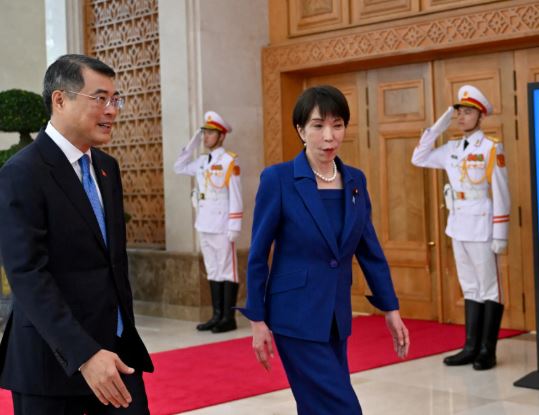
TOKYO, Nov 10: Japan and Vietnam will accelerate public-private cooperation on critical minerals, Prime Minister Sanae Takaichi said Monday after talks with Vietnamese President To Lam, describing economic security cooperation as a top priority in their bilateral relationship.
The meeting in Tokyo came as Japan seeks closer ties with Vietnam amid political and economic pressure from China, including restrictions on rare earth exports, while also aiming to help the fast-growing Southeast Asian country strengthen its energy supply network.
The two countries issued a joint statement citing an increasingly complex geopolitical environment and pledging deeper cooperation on defense, economic security and investment.
Takaichi said the visit will allow the two countries to “make great strides forward under our Comprehensive Strategic Partnership for peace and prosperity in Asia and the world,” while Lam described it as “substantive and extremely fruitful.”
In their joint statement, the two countries affirmed the importance of initiatives to facilitate the early implementation of liquefied natural gas and gas-fired power projects backed by Japanese investment and agreed to advance cooperation on introducing nuclear power to Vietnam.
On critical minerals, which Vietnam is believed to have in abundance, the two countries agreed to consider concrete cooperation projects to strengthen their supply chains.
Takaichi last visited Vietnam about six months ago, when she met Lam, who also heads the country’s ruling Communist Party, for the first time.
In May, the countries agreed to make Vietnam’s Nghi Son Refinery and Petrochemical Complex the first project under a Tokyo-led financing framework aimed at ensuring stable energy supplies for Asian nations with limited strategic oil reserves.
On security, Japan and Vietnam agreed to consider swiftly providing Vietnam with equipment for United Nations peacekeeping operations under Japan’s Official Security Assistance program, a defense equipment support framework for like-minded countries.
Japan values Vietnam’s support for its diplomatic vision of a “free and open Indo-Pacific,” seen as a counter to China’s growing assertiveness in the region. Takaichi unveiled an updated version of the concept during her visit to Vietnam.
The leaders shared concerns over developments in the South China Sea and underscored the importance of freedom of navigation, in an apparent reference to China, according to their joint statement.
Both countries have faced territorial claims by Beijing in the East China Sea and South China Sea, respectively.
Despite the territorial disputes, Vietnam takes a multidirectional approach to foreign policy, seeking to maintain a balance in relations, including with China.
Ahead of the leaders’ meeting in the State Guest House in Tokyo, Lam addressed the House of Representatives and said Vietnam “highly appreciates” that Takaichi unveiled the evolved free and open Indo-Pacific concept in Hanoi.
Lam said Vietnam supports the concept as one that “contributes to maintaining regional peace, as well as promoting cooperation and development in the Indo-Pacific in accordance with international law.”
Lam and his wife, Ngo Phuong Ly, are on a four-day visit to Japan through Wednesday, when they will meet and have lunch with Emperor Naruhito and Empress Masako at the Imperial Palace before returning to Vietnam.