By: Farukh Shehzad
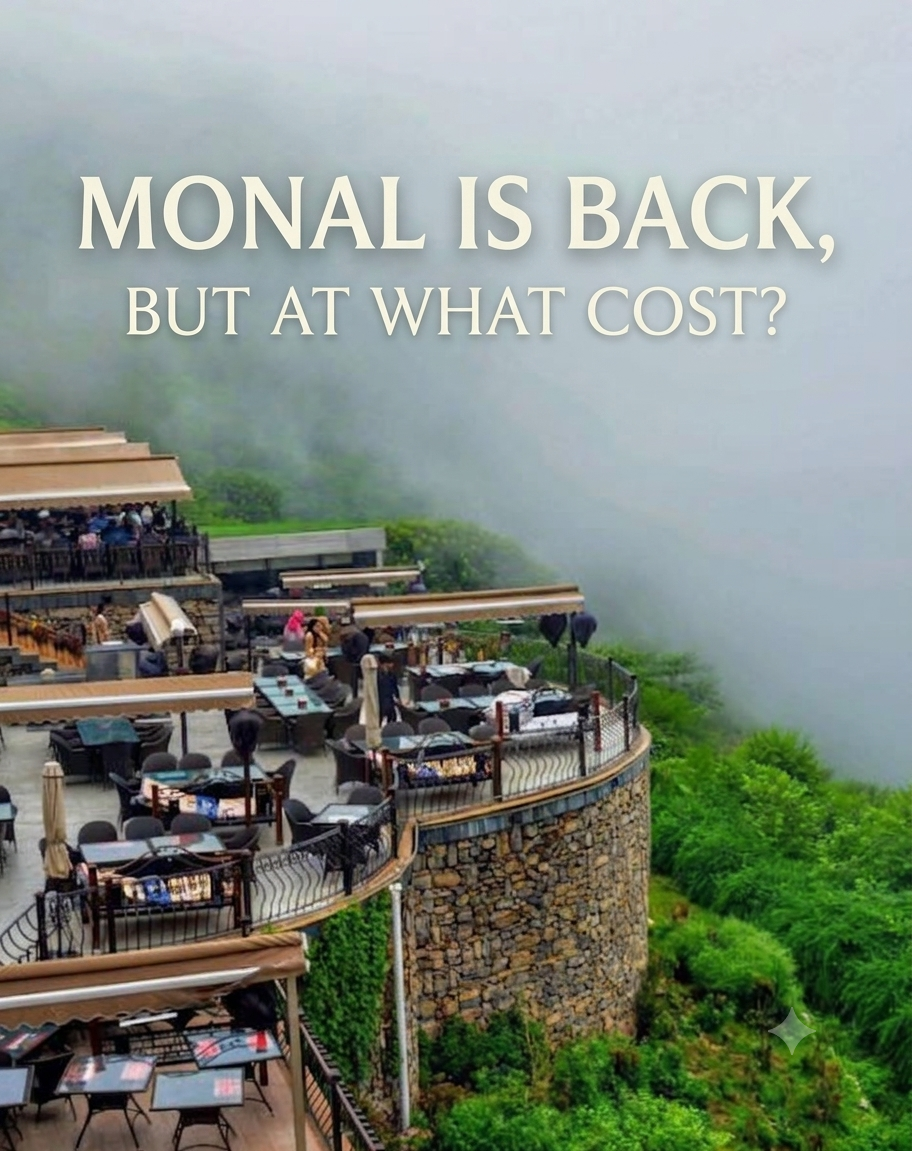
In a dramatic turn of events that has captured the nation’s attention, the newly formed Constitutional Court of Pakistan has overturned a preceding Supreme Court verdict that had ordered the immediate demolition of the iconic Monal Restaurant. For the millions who have cherished the panoramic views of Islamabad from this hilltop eatery, the decision feels like a breath of fresh air. The Court has ruled that the original order was “wrong,” effectively saving the structure and allowing it to reopen its doors to the public.
On the surface, this is a victory for the restaurant’s loyal patrons and its staff, who faced an uncertain future. However, beneath the veneer of celebration lies a labyrinth of legal ambiguity and political volatility. The question that lingers is not whether the food is good or the view is spectacular, but rather: Is reopening Monal Restaurant a 100% correct decision?
In the current climate of Pakistan, the answer to that million-dollar question is a resounding “no,” and proceeding without addressing this uncertainty is a perilous gamble—particularly for the owner.
The Curse of Judicial Reversals
The legal saga of Monal Restaurant is a textbook example of what happens when judicial finality becomes an oxymoron. The Supreme Court of Pakistan, the apex court of the land, had previously examined the case and concluded that the restaurant was built on an illegal site, mandating its demolition. That order carried the full weight of the state’s highest judicial authority.
Yet, in a move that has shocked legal experts and laymen alike, the newly instituted Constitutional Court has swept that decision aside, declaring it null and void. While this may seem like a classic check-and-balance mechanism, it exposes a troubling trend: the fragility of judicial decisions in Pakistan.
If the Supreme Court’s verdict can be overturned so swiftly by a new constitutional body, what guarantees exist that today’s reprieve will not be reversed tomorrow? In Pakistan’s legal ecosystem, where new benches, review petitions, and even newly formed courts can alter precedents overnight, the owner of Monal is standing on shifting sands.
The Weight of Pakistan’s Foolish Politics
Unfortunately, the legal confusion does not exist in a vacuum; it is heavily intertwined with the country’s turbulent political landscape. In recent years, Pakistan’s politics have been characterized by intense rhetoric, polarization, and a frequent disregard for institutional continuity. Courts are frequently caught in the crossfire of political conflicts, where rulings are sometimes viewed not as impartial legal judgments, but as strategic maneuvers in a broader political contest.
Given this environment, the “victory” for Monal may be short-lived. As we have seen time and again, a decision celebrated today can become a weaponized tool tomorrow. Should political winds shift, or should a new judicial body with a different ideological leaning emerge, there is a very high probability that the demolition orders will resurface. The cycle is predictable: a new court is formed, the previous decision is declared void, and the wrecking balls are summoned once more.
For the owner, reopening the restaurant in the face of such volatility is an immense financial risk. The costs associated with running a high-end establishment are enormous. Rehiring staff, restocking inventory, and marketing a grand reopening require substantial capital investment. However, if history is any indicator, all this investment could be rendered useless within months—or even weeks—if another judicial ruling swings the pendulum back toward demolition.
The psychological and financial toll of repeated closures and demolitions would be devastating. The owner is not just fighting a legal battle; they are fighting a system where the rules of the game change with every new constitutional tweak. In a stable democracy, a court decision provides finality. In Pakistan, it provides a temporary reprieve.
Conclusion
While the public rejoices at the reopening of Monal Restaurant, the celebration is premature. Until Pakistan’s political class and judiciary can agree on a framework of consistency and respect for precedent, any decision rendered by any court is merely a placeholder.
Reopening Monal without securing a legislative or constitutional guarantee against future reversals is not just a business decision; it is a leap of faith into a system that has proven time and again that it lacks the stability to protect its own judgments. For the owner, the wisest course of action might not be a grand reopening, but rather a cautious observation of how this new Constitutional Court interacts with the Supreme Court in the coming months.
In Pakistan’s current state of judicial whiplash, what is saved today can be shattered tomorrow. And that is a risk too heavy for any business to bear.