By Iftikhar Ali
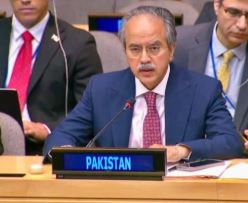
UNITED NATIONS, Apr 21 (APP):Pakistan has reaffirmed its support to the African demand for enhanced representation of the world's second largest continent within the UN Security Council as part of the reform process to make the 15-member body more representative and effective to combat the growing challenges. “Rectifying the injustice suffered by Africa is not a matter of concession but of principle,” Ambassador Asim Iftikhar Ahmad, permanent representative of Pakistan to the UN, said in the ongoing Intergovernmental Negotiations (IGN) at its session devoted to discussing the “African Model” for restructuring the 15-member Council.
The African Model for the Council reform is a unified proposal endorsed by all 55 African Union (AU) member states. It demands two permanent seats (with equal rights/veto power) and five non-permanent seats for Africa to correct historical injustices.
The Security Council is currently composed of five permanent members — Britain, China, France, Russia and the United States — and 10 non-permanent members elected to serve for two years.
Full-scale negotiations to reform the Security Council began in the General Assembly in February 2009 on five key areas — the categories of membership, the question of veto, regional representation, size of an enlarged Security Council, and working methods of the council and its relationship with the General Assembly.
While there is broad agreement among member states that the Security Council requires expansion to improve representation and legitimacy, especially for the Global South, sharp differences remain on the size, composition, and powers of an expanded Council.
In his remarks, Ambassador Asim Ahmad said Pakistan stands ready to work with Africa and all partners for a just, democratic, and representative Council truly reflective of the UN Charter’s promise and responsive to the current realities.
Pakistan, he said, agrees that Africa’s demand, set out in the “Ezulwini Consensus” and Sirte Declaration for equitable representation of the region of Africa, stressing that it is entirely different from the demand of four States — India, Brazil, Germany and Japan — who are seeking permanent membership of the Security Council for individual States.
The African call is “not a pursuit of privilege but a desire for justice and equity,” the Pakistani envoy added.
At the same time, Ambassador Asim Ahmad reminded the delegates that Pakistan, which along with Italy leads the Uniting for Consensus (UfC) group, opposes the creation of new permanent seats, as Islamabad seek to democratize the Council through reform that promotes the aspirations of all member states. “We believe that additional elected members will enhance regional representation and ownership, thereby, imparting more legitimacy to the Council.”
The UfC and African positions, he said, are compatible in many ways, most notably on regional representation, rotation and consensus.
“UfC proposal has the flexibility to respond to the African desire for stronger and continuing representation on the Council based on regional consensus,” Ambassador Asim Ahmad said, adding it could also ensure representation of all the African sub-regions.
Similarly, he added, Africa’s demand for veto is for and on behalf of the entire African region, not for one or two states. While Pakistan stand for for the abolition or severe restriction of the veto power, mechanisms could be developed to provide Africa with the collective ability to protect its interests and positions as a region, even where there would be no extension of veto in a reformed Council.
Another commonality between the position of UfC and the African Union is their shared desire to achieve a result based on the “broadest possible agreement” that has gained understanding and support from the rest of the membership, he pointed out. “This support cannot be compared with aspirants of individual permanent seats whose unilateral claims have led to serious divisions in their respective regions and the wider membership,” he said in an obvious reference to the Group of Four countries, ho are campaigning for permanent seats on the Council.
At the outset, Sierra Leone’s Permanent Representative to the UN, Michael Imran Kanu, outlined the “African Model” for the Security Council reform, with a call for supporting it and thereby addressing the historical injustice suffered by Africa.